
Table of Contents
Overview
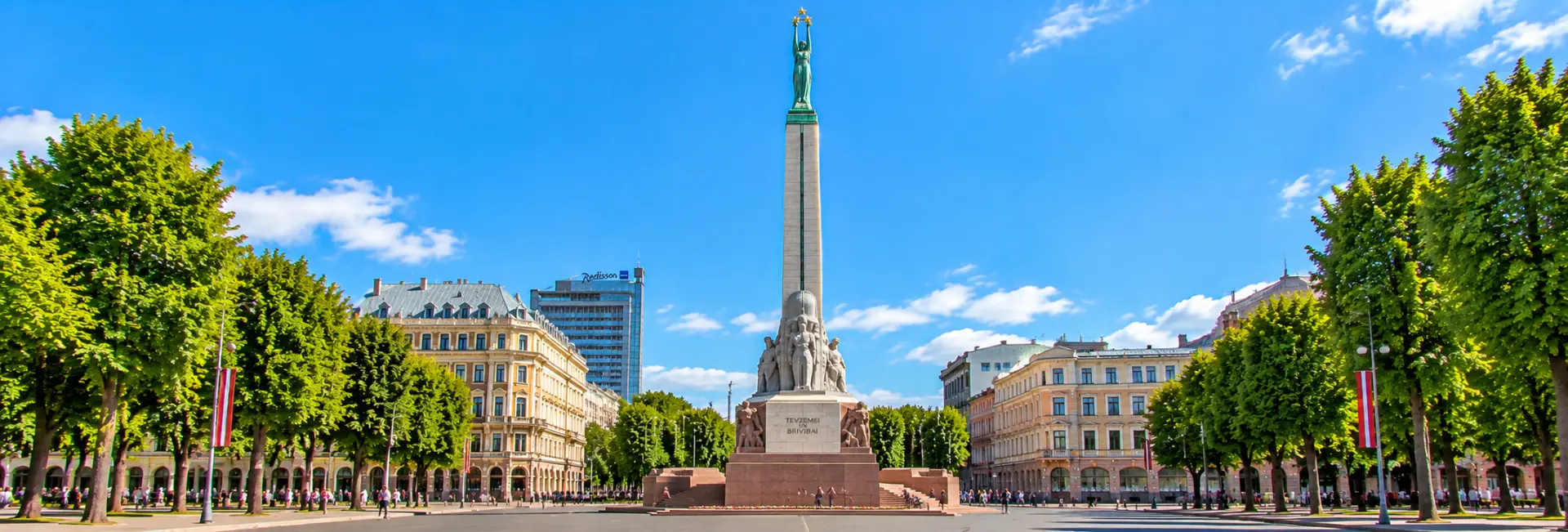
The Freedom Monument, known in Latvian as Brīvības piemineklis, is the best-loved symbol of Latvian independence and one of the first places many visitors head for in Riga. Rising about 42 metres at the edge of the Old Town, it honours the soldiers who died in the Latvian War of Independence between 1918 and 1920. Its dedication, Tēvzemei un Brīvībai, means "For Fatherland and Freedom."
The monument is built from granite, travertine and copper, and its form is easy to read from a distance. Heavy stone blocks rise in tapering stages to a slender column, and at the very top a copper woman nicknamed Milda lifts three gilded stars above her head. Around the base, dozens of sculptures tell stories of Latvian work, folklore, culture and struggle.
This is more than a photo stop. The monument is where crowds gather for official ceremonies, where flowers are laid on national occasions and where an honour guard stands watch in the daytime. A visit takes little time, yet it gives a clear sense of how Latvia sees its own story.
History
A Long Road to a Design
The idea of a memorial to the fallen of the War of Independence emerged in the early 1920s. In 1922 the prime minister, Zigfrīds Anna Meierovics, ordered rules to be drawn up for a design contest for a memorial column. The winning proposal was later rejected after protests from artists, and further contests ended without a clear result. A final contest in 1929 was won by the sculptor Kārlis Zāle with a design titled "Mirdzi kā zvaigzne," or "Shine like a star."
Construction and Unveiling
With the architect Ernests Štālbergs overseeing the work, construction began on 18 November 1931. The site was at the entrance to the Old Town, where a bronze equestrian statue of Peter the Great had stood from 1910 until the First World War. Private donations paid for the whole project.
The scale of the effort was huge. Working the stone alone took about 308,000 man-hours, and roughly 2,500 tonnes of material went into the monument. It was unveiled on 18 November 1935, the anniversary of the proclamation of the Latvian republic.
Survival Under Soviet Rule
After Latvia was annexed by the Soviet Union, the monument was considered for demolition more than once. It survived, in part because destroying a structure built from public donations risked stirring deep resentment. Soviet authorities tried instead to reinterpret its meaning, but for many Latvians it quietly remained a symbol of independence.
On 14 June 1987, about 5,000 people gathered there to lay flowers in memory of the victims of Soviet deportations. That gathering helped to revive the independence movement, which led three years later to the re-establishment of Latvian sovereignty.
Restoration and Care
Weather, traffic fumes and the porous nature of the travertine have all taken a toll on the stone. The monument was restored in 1962 and again in 1980-1981, and a major renovation between 1998 and 2001 cleaned the statue and regilded its stars before a reopening in July 2001. Maintenance continues today, financed partly by donations, in keeping with the way the monument was originally built.
Architecture and Design
Kārlis Zāle designed the monument as an upward journey. Massive blocks of red granite anchor the base, and lighter, narrower forms rise above them until the structure ends in a single slim column. The overall effect is restrained and monumental, with clean lines and very little ornament apart from the sculpture itself.
Materials and Structure
A wide red granite staircase of ten steps winds around the foot of the monument, and a round platform about 28 metres across carries the whole structure. Above it, two stacked rectangular blocks of red granite, partly faced with travertine, form the base. A taller block supports a monolithic travertine column about 19 metres high. Inside, the monument is built around a reinforced concrete frame, and a small interior room used for utilities is not open to the public.
The Figure of Liberty
The copper figure at the top, known as Liberty or Milda, is about 9 metres tall. She holds three gilded stars above her head, and the gilding has been renewed during several restorations.
Sculptures and Symbolism
The monument carries 56 sculptures arranged in 13 groups across four levels. Together they present a portrait of Latvia that covers daily labour, family life, learning, myth and conflict.
The Three Stars and Milda
The three gilded stars represent the historic regions of Vidzeme, Latgale and Kurzeme, joined in one country. The nickname Milda is affectionately used by locals, and its origin is debated, with no firm historical record behind the popular stories about the model for the statue.
The Main Sculpture Groups
- Latvian Riflemen and Latvian People: the Singers: two large travertine reliefs that flank the staircase at the front.
- Work: a fisherman, a craftsman and a farmer holding a scythe decorated with oak leaves.
- Guards of the Fatherland: an ancient Latvian warrior standing between two kneeling modern soldiers.
- Family and Scholars: groups on the rear of the monument showing a mother with her children and a mix of old and new thinkers.
- 1905 and the Battle on the Iron Bridge: side reliefs recalling the 1905 revolution and a key fight in Riga during the War of Independence.
- Four granite figures at the upper level: Latvia, Lāčplēsis (the Bear-Slayer of Latvian legend), Vaidelotis (an ancient Baltic priest) and the Chain Breakers.
Cultural and National Significance
For Latvians, the Freedom Monument is both a memorial and a meeting point. It stands for the sacrifice of those who fought for independence and for the idea that a small nation can choose its own path. The fact that ordinary people paid for it through donations is part of why it carries such emotional weight.
Its role grew even larger in the late 20th century. During the Soviet era, the monument became a quiet focus of national memory, and the flower-laying of 1987 was an early public step toward the independence movement. After independence was restored, it again became a focal point for official ceremonies and public gatherings, and the honour guard that had stood there from 1935 to 1940 was renewed on 11 November 1992.
Today the guard is made up of soldiers from the National Armed Forces. Their quiet, precise changing of the watch gives the plaza a ceremonial feel, and it reminds visitors that this is a living national monument and not only a tourist attraction.
What to See There
The monument is surrounded by a small pedestrian plaza, and a few details around it are worth a look.
- The honour guard: soldiers stand at the base in the daytime, and a changing of the guard takes place at regular intervals.
- The ten-step staircase and the front reliefs: stand close to the base to see the carving of the riflemen and the singers.
- The Laima Clock: a popular meeting spot on the Old Town side of the plaza, set up in 1924 and decorated with the Laima confectionery name in 1936.
- The pedestrian plaza: a stretch of road of about 200 metres was closed to traffic in 1990, creating a relaxed space for walking and pausing.
- The city canal and parkland: part of the old fortification system, now a green belt around the Old Town, with a hill and cascading waterfalls just to the north of the monument.
Ways to Experience It
Make It a Short Stop
Many visitors spend 20 to 40 minutes here, long enough to walk around the base, read the reliefs and take photos from the steps. It fits easily between the Old Town and the nearby parks.
Time Your Visit for the Guard
If you want a little ceremony, plan your arrival around a changing of the guard. The soldiers march in with formal precision, and onlookers usually fall into a respectful hush.
Join a Walking Tour
Guided walking tours of Riga often include the monument, with guides explaining the symbolism of the sculptures and the political history behind them. This is a good option if you want context for the Soviet-era story.
Walk the Canal Loop
The monument sits beside the city canal and its parks, so a leisurely stroll around the green belt makes a pleasant addition to the visit.
Best Time to Visit
Because the monument is an open-air site, the best time depends on the weather and on how much ceremony you want to see.
By Season
Late spring, summer and early autumn bring long daylight and comfortable walking weather, which makes it easy to linger on the plaza and walk the nearby parks. Winter is colder and the honour guard may not stand watch in extreme heat or cold, but the quieter atmosphere has its own appeal.
By Time of Day
Early morning, before the guard is posted, is the calmest time for photographs and quiet reflection. For the ceremony, visit during the daytime hours, and arrive a few minutes before the changing of the guard to find a good position. National days and other commemorations draw crowds and flowers, which can make for a memorable visit if you do not mind the busyness.
Visitor Tips
- The monument is an open-air site and there is no admission fee, so you can visit at any time of day.
- Check the current schedule for the honour guard before you plan around it. The guard is not always posted, for example during certain military exercises.
- Treat the monument as a memorial. Keep your distance from the guards, avoid disturbing ceremonies and do not climb on the structure.
- Be careful when crossing the roads around the plaza. Three streets still carry traffic past the monument.
- Allow 20 to 40 minutes for a relaxed visit, or a little longer if you want to see a changing of the guard.
- Public transport stops close by. Look for the stop called Brīvības piemineklis if you are arriving by tram or bus.
Nearby Attractions
The monument sits where the Old Town meets the boulevard ring, so a large number of sights are a short walk away.
- Riga Old Town: the medieval core of the city, with Town Hall Square, St. Peter's Church and Riga Cathedral all within walking distance.
- Latvian National Opera and Ballet: in the park just south of the monument, with a flower garden and fountain at the front.
- Riga City Canal and parks: a green ribbon that follows the line of the old city fortifications and is ideal for a gentle walk.
- Museum of the Occupation of Latvia: located on Town Hall Square and covering the country's history from 1940 to 1991.
- Boulevard district: a stretch of elegant boulevards lined with embassies, university buildings and historic architecture.
FAQs about visiting the Freedom Monument
What does the Freedom Monument commemorate? +
It honours the soldiers who died in the Latvian War of Independence from 1918 to 1920. It is also widely seen as a symbol of Latvia's freedom, independence and sovereignty.
Who is Milda? +
Milda is the affectionate nickname for the copper figure of Liberty at the top of the monument. The origin of the name is debated, and no firm historical record explains it.
What do the three gilded stars mean? +
The stars represent the historic regions of Vidzeme, Latgale and Kurzeme, united in a single country.
How tall is the monument? +
It stands about 42 metres high, with a travertine column of around 19 metres topped by a copper figure about 9 metres tall.
Is it free to visit? +
Yes. It is an open-air monument on a public plaza, and there is no admission fee.
When does the changing of the guard happen? +
A guard of honour stands at the base during the daytime and changes at regular intervals. Times and availability can vary, so check the current schedule on official Riga tourism sources before you go.
Can I go inside or climb the monument? +
No. The small interior room is used for utilities and is not open to the public, and the structure should not be climbed.
How long should I spend there? +
Plan on 20 to 40 minutes for the monument and plaza, and a little longer if you want to catch a changing of the guard.
How do I get to the Freedom Monument? +
It is a short walk from the Old Town, and several tram and bus lines run along the boulevard. The nearest stop is named Brīvības piemineklis.
