
Table of Contents
Overview
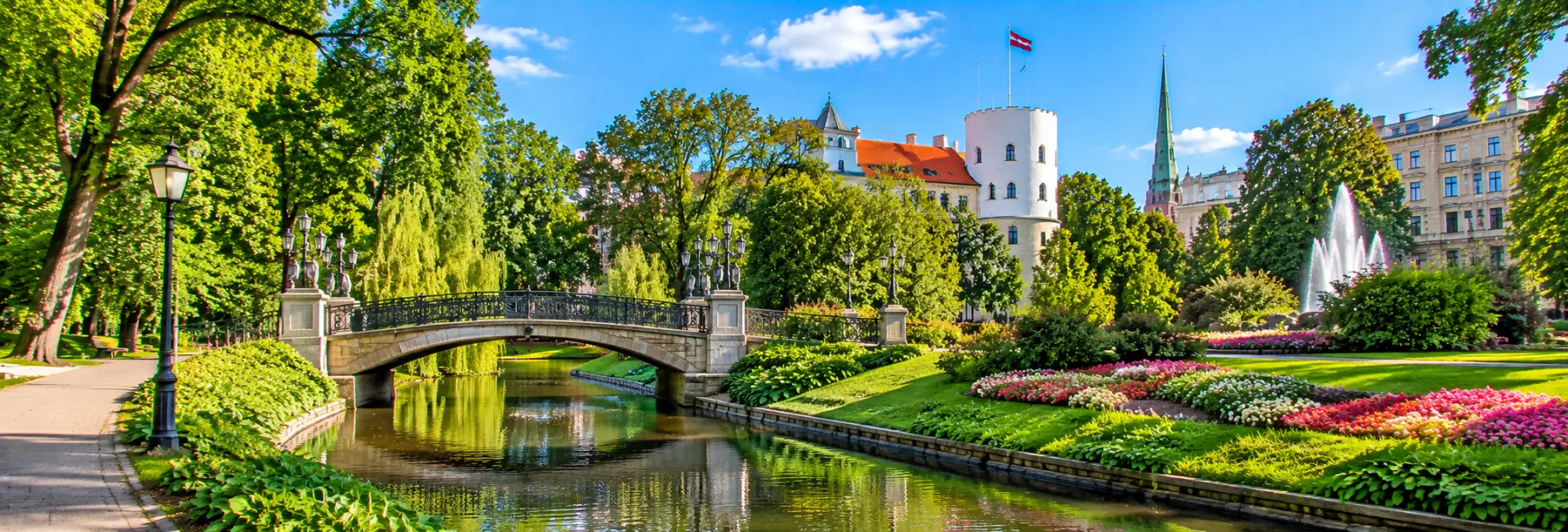
Bastejkalns Park, also called Bastion Hill Park, is a winding green belt on the northern edge of Old Riga. It follows the City Canal, the old moat of the medieval defences, and it centres on an artificial hill that is all that remains of the earthen fortifications that once ringed the city on this side.
The park is a place for gentle walking rather than ticking off sights. Paths run between flowerbeds and old trees, small bridges cross the canal, a stepped waterfall tumbles down the hillside, and swans, ducks and the occasional beaver share the water. It sits right beside the Freedom Monument and the Latvian National Opera, so most visitors pass through it without even planning to.
It also carries a more serious layer of meaning. At the foot of the hill, a set of memorial stones marks the spots where five people were killed on 20 January 1991, during the barricade days that defended Latvia's restored independence.
History
From Ramparts to Parkland
Until the middle of the nineteenth century, this ground belonged to Riga's eastern fortifications, a tangle of earthen ramparts, covered trenches, bastions and moats. The defences had lost their military purpose, and from 1856 the city began to pull them down. Earth from the ramparts was used to build up the banks of the old moat and to form a hill about fifteen metres high, which became known as Bastion Hill.
The Landscaping Years
Planners Johann Felsko and Otto Dietze proposed a ring of parks, gardens and wide boulevards in place of the walls, and the planting of Bastion Hill ran from 1859 to 1887. In 1879, the young Georg Kuphaldt became director of the Riga Gardens, and the greenery of Bastejkalns was his first big project. A wooden pavilion appeared in 1860 and was replaced by the first Bastion Hill café in 1887.
Bridges, Waterfall and Swans
A wooden footbridge over the canal was built in 1883, famously so steep that people slipped on it in winter, and a stone bridge took its place within about a decade. A cascade of dolomite from Saulkalne was added to the hillside in 1898, and around 1893 a decorative swan house designed by Heinrich Scheel was set on the water. The swans that lived there were gifts from a local bird-breeding society.
Twentieth-Century Changes
After the Second World War, new retaining walls were built in 1951 using fragments of bombed Riga buildings. The hill was replanted and decorated with sculptures in the late 1960s, and the sculpture Peace Dance was added in 1970. Later years saw new monuments join the park, including a memorial to Riga mayor George Armitstead in 2006.
Bastion Hill & Park Highlights
Bastion Hill
The hill is the park's anchor. A circling path leads up to the summit, where benches look out over the canal, the treetops and the roofs of the Old Town. It is a modest climb, and it makes a good place to watch the sun go down.
The Waterfall
The dolomite cascade on the hillside dates from 1898 and is still running. It once had underwater lighting, and today it remains one of the most charming nineteenth-century touches in the park.
The Bridges
Several small bridges cross the City Canal, and the best known is the footbridge near the Freedom Monument. Its railings are covered with padlocks, a wedding custom in which newlyweds attach a lock engraved with their names as a symbol of lasting love. Locals often call it the Bridge of Love.
The Swan House
A small pavilion on the water, with a slightly Chinese look to it, is the Swan House. It was built around 1893 and traditionally floats on pontoons in the warm months, then is pulled ashore for the winter.
Also Look For
- The Blaumanis monument, honouring one of Latvia's best-loved writers, completed in 1929 near the park.
- The Peace Dance sculpture, installed in 1970.
- The monument to George Armitstead, unveiled in 2006.
- Formal flowerbeds, gaslights and sculptures along the canal paths.
Trees, Gardens & Wildlife
A Collection of Trees
The park is not just lawns and paths. A survey from 1988 counted about 110 exotic trees and shrubs along with nearly twenty native species, so you can walk past maples, limes, chestnuts, hawthorns, walnuts and a ginkgo, among many others. Georg Kuphaldt, the landscape architect who shaped the planting, is known to have introduced North American species, and some of the park's exotic specimens date from his time.
Spring Colour
Spring is particularly attractive. Across the canal from the Opera, the University of Latvia's botanical garden is known for white magnolias, and flowering shrubs such as forsythia add bright yellow along the paths.
Wildlife on the Canal
Ducks and swans are regular residents of the canal, and beavers have made their home along its banks. They can be hard to spot, though a quiet walk early or late in the day gives the best chance.
Memorials & Monuments
The Barricades of January 1991
In January 1991, with Latvia moving to restore its independence, residents built barricades across Riga to protect key institutions. On the night of 20 January, Soviet special police forces attacked the nearby Interior Ministry building. Five people died in the fighting around Bastejkalns, among them police officers, cameramen and a schoolboy.
Memorial Stones
Small stones of a reddish-brown colour were placed at the foot of Bastion Hill, each at the spot where one of the victims fell. They are quiet and easy to miss, but they are among the most important places in the park, and flowers are left there every year, especially around the anniversary.
Other Reminders in the Area
The memory of the barricade period extends beyond the park. A plaza near the Powder Tower was named Barricade Square in 2016, and further plaques and stones in the surrounding streets mark other events from 1991. Visitors who want context can follow these markers on foot.
Respectful Visiting
Because the stones are an active place of remembrance, it is worth keeping voices down, avoiding sitting on them, and stepping carefully around any flowers.
Ways to Experience It
- Stroll the park: a loop along the canal and over the hill takes about 30 to 60 minutes at an easy pace.
- Climb Bastion Hill: use the circling path to the top for views and benches.
- Take a canal boat tour: boats run along the City Canal in warmer months, offering a different view of the park, the Opera and the edge of the Old Town.
- Visit the bridges: cross the Bridge of Love and look at the padlocks, or stand in the middle of a bridge for a photo of the canal.
- Walk the memorial route: pause at the stones at the foot of the hill, then continue to nearby sites connected to the barricades.
- Join a walking tour: many Old Riga routes start or finish near the park and the Freedom Monument.
- Bring children: there is a playground close by, and the paths and ducks keep younger visitors entertained.
Best Time to Visit
Season by Season
Spring brings magnolias and fresh planting, summer is the busiest season with canal boats running, and autumn paints the old trees in warm colours. In winter, the park is quieter and the structure of the hill and bridges is easier to see, though paths can be icy and boat tours stop.
Time of Day
Early morning is calm and ideal for photographs and for spotting wildlife. Late afternoon and sunset are popular for the view from the top of the hill, and the area stays lively into the evening, particularly in summer.
Remembrance Days
Around 20 January, the anniversary of the 1991 attack, people gather at the memorial stones to lay flowers. Visit then if you want to see how the place is remembered, but be mindful that it is an occasion for reflection.
Visitor Tips
- Entry is free and the park is open to the public all year round.
- Allow 30 to 60 minutes for a relaxed walk, or longer if you add a boat tour or a stop at the nearby sights.
- Wear comfortable shoes, as the hill paths slope and can be slippery when wet or icy.
- If you have limited mobility, the lower canal paths and bridges are easier than the hill.
- Do not climb on the memorial stones and avoid disturbing flowers left there.
- Do not feed or chase the wildlife, and keep dogs under control near the water.
- Check seasonal boat tour times locally, since they depend on weather and the time of year.
- Getting there: the park is a short walk from Old Riga and the Freedom Monument, and public transport stops nearby at Brīvības piemineklis and Raiņa bulvāris.
Nearby Attractions
- Freedom Monument: Latvia's national symbol of independence, standing right next to the park.
- Latvian National Opera and Ballet: a neoclassical opera house on the canal's opposite bank.
- Old Riga: the medieval centre, with cobbled lanes, the cathedral and Riga Castle, is a few minutes' walk away.
- Powder Tower: a surviving tower from the old city defences, close to Barricade Square.
- Latvian National Theatre: the building where Latvia proclaimed its independence on 18 November 1918, further along the canal.
- University of Latvia and its botanical garden: neighbouring grounds that add to the ceremonial feel of the area.
FAQs about visiting Bastejkalns Park
What is Bastejkalns Park? +
It is a historic park on the northern edge of Old Riga, built on the former city fortifications along the City Canal. Its name means Bastion Hill, after the artificial hill at its centre.
Is Bastejkalns Park free to enter? +
Yes. It is a public park and entry costs nothing. You can walk through it at any time of year.
How long should you spend at Bastejkalns Park? +
Plan 30 to 60 minutes for a relaxed walk around the paths, bridges and hill. Allow more time if you plan to take a canal boat tour or visit the nearby monuments.
What is the Bridge of Love? +
It is a small footbridge over the City Canal near the Freedom Monument, covered with padlocks left by newlyweds as a symbol of lasting love. Many couples engrave their names on the locks.
What do the memorial stones at Bastion Hill commemorate? +
They mark where five people were killed on 20 January 1991, during Soviet special forces' attack on the nearby Interior Ministry, at the time of the barricades defending Latvia's independence.
Can you take a boat trip from the park? +
Canal boat tours operate along the City Canal during the warmer months, usually from departure points near the park. Check times locally, since they depend on the weather and season.
What is the best time to visit Bastejkalns Park? +
Spring is lovely for magnolias and flowering shrubs, and summer is the liveliest period. Early morning and sunset are the best times for quiet walks and views from the hill.
Is the park suitable for children and for people with limited mobility? +
Children usually enjoy the ducks, bridges and nearby playground. The lower canal paths are easier for people with limited mobility, while the hill involves a sloping path.
What is near Bastejkalns Park? +
The Freedom Monument, the Latvian National Opera and Ballet, Old Riga and the Powder Tower are all within a short walk.
