
Table of Contents
Overview
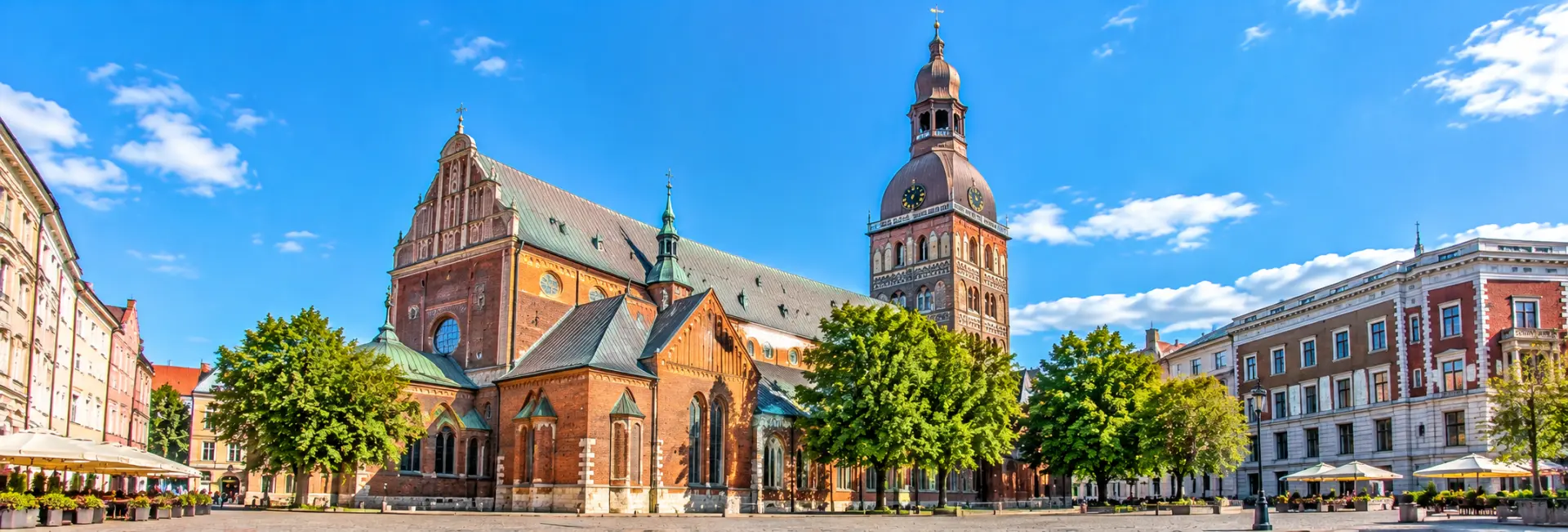
Riga Cathedral, known in Latvian as Rīgas Doms, is the largest medieval church in the Baltic states and one of the most recognisable landmarks in Latvia. Officially the Cathedral Church of Saint Mary, it stands on Dome Square in the heart of Riga's Old Town, a short stroll from the Daugava River.
The name puzzles many first-time visitors, because the building has no dome at all. "Dome" comes from the German word Dom, which simply means cathedral. What the church does have is a long brick body, a copper-clad Baroque tower topped with a weathercock, and a presence on the skyline that has shaped how Riga looks for more than eight centuries.
Today the cathedral is both a working house of worship and one of the busiest concert venues in the city. It is the seat of the Archbishop of the Evangelical Lutheran Church of Latvia, and its congregation still gathers here for regular services. Inside you will find a famous 19th-century organ, a quiet medieval cloister, richly carved furnishings and a blend of Romanesque, Gothic and Baroque architecture.
History
Foundation in 1211
Bishop Albert, the founder of Riga, laid the foundation stone of the cathedral on 25 July 1211. Very little is documented about the earliest building phase, but work is thought to have picked up speed around 1215, after the first cathedral church inside the city burned down. At about that time the builders switched from natural stone to brick, keeping stone blocks only for the outer corners of the walls.
By 1266 the choir and transept were finished enough for a church council to meet inside, with the unfinished western part walled off. The first phase of construction used simple Romanesque forms. The plan began as a basilica, changed to a hall church, and was reshaped yet again in later centuries.
Medieval Growth and the Reformation
Around the turn of the 15th century the cathedral was enlarged with a western transept and side chapels, and the walls of the central nave were raised so the church became a basilica once more. The tower was heightened and crowned with an octagonal pyramidal spire, which is believed to have been the tallest in the city.
The Reformation reached Riga in the 1520s. The cathedral's original decorations were lost, and in 1525 the city's Lutheran confession was formally guaranteed by Wolter von Plettenberg, the Teutonic Order's master in Livonia. The old Catholic archbishopric faded away as Livonia itself collapsed in the following decades.
Fire, War and the Baroque Tower
A great fire in 1547 destroyed the Gothic spire. A new tower with a pyramidal spire and two galleries was completed by 1595, and the weathercock from that period can still be seen in the cloister. The siege of Riga in 1710 damaged the roof, and the repairs gave the choir a Baroque roof and the central nave an eastern gable marked with the year 1727.
In 1772 burials inside churches were banned across the Russian Empire, and the cathedral floor was raised as graves moved outside the city. Three years later the city council ordered part of the old spire demolished, and the Baroque tower that defines today's skyline was in place by 1776.
Restoration and the Modern Era
A major restoration between 1881 and 1914 gave the cathedral and its cloister the look visitors see today. Under Soviet rule the building was converted into a concert hall in 1959-1962, with the altar removed and seating turned to face the organ. Worship returned in the early 1990s. More recent work includes new copper roofing over the nave in 2011 and the re-plating of the tower exterior in 2015.
Architecture and Design
Riga Cathedral is a building that grew over centuries, and its architecture reads like a timeline. The oldest parts show restrained Romanesque forms, the 13th-century cloister is Early Gothic, the roofs and tower are Baroque, and the 19th-century restoration added touches of Art Nouveau. Few churches in the region show so many periods in a single complex.
The Exterior
The walls are built of brick with stone reserved for the corners, giving the cathedral a solid, sober look. The long nave sits under a steep copper roof, while the choir carries its own Baroque roof. The tower is the visual centrepiece, with its gallery levels, copper sheathing and weathercock.
On the façade, a statue of Bishop Albert looks out over the square. It is a copy of an original by the sculptor Karl Hans Bernewitz. The main doors face Herder Square, which is named after the philosopher Johann Gottfried Herder.
The Interior
Inside, tall vaults rise over a wide nave. The atmosphere is relatively restrained, partly a legacy of the Reformation, which swept away much of the medieval decoration. Attention is drawn instead to the carved wooden pulpit, the stained glass and the monumental organ. The raising of the floor in the 18th century and the Soviet-era conversion into a concert hall both left their mark, though the space is once again arranged for worship.
Cultural and Religious Significance
Riga Cathedral is the seat of the Archbishop of the Evangelical Lutheran Church of Latvia and the main venue for ecumenical services in the country. Regular worship takes place in Latvian, so the building remains part of everyday spiritual life and not just a monument to the past.
Historically it was the principal bishop's church of Livonia until that territory collapsed in 1561, and its story closely mirrors the story of Riga: Catholic bishops, Hanseatic merchants, Reformation-era reformers, Swedish and Russian rulers, and the upheavals of the 20th century. Scenes from that past, including the 1525 edict of religious freedom and the city's greeting of the Swedish king Gustavus Adolphus in 1621, are depicted inside the cathedral.
Music is the other pillar of its identity. The cathedral has been a leading concert venue for centuries, and its boys' choir has performed and recorded internationally. Organ recitals, choral concerts and festival events fill the calendar throughout the year.
The cathedral also sits inside the Historic Centre of Riga, which was inscribed on the UNESCO World Heritage List in 1997. That listing recognises the medieval street pattern together with the city's outstanding Art Nouveau architecture and its 19th-century wooden buildings, and the cathedral's tower is one of the landmarks that anchors the Old Town view.
The Walcker Organ
For many visitors, the organ is the reason to come. It was built by E. F. Walcker and Company of Ludwigsburg, Germany, and first sounded in January 1884. At that time it was the largest and most technically advanced organ in the world, with 124 stops and innovations such as a Barker lever, a crescendo pedal and pre-set combinations. Franz Liszt wrote a piece dedicated to its inauguration.
Scale and Sound
The instrument is 25 metres high, 11 metres wide and 10 metres deep, with 6,718 pipes. About half are made of wood, including pine, maple, oak, pear and apple, while the rest are a lead and tin alloy. The longest pipes are more than 10 metres tall and the shortest measure just 13 millimetres. Stop names such as Vox humana, Vox celeste and Unda maris, meaning human voice, heavenly voice and waves of the sea, hint at the range of colour on offer.
The Case and Its Restoration
The ornate organ façade is older than the instrument behind it. Its design dates back to 1601, when the builder Jacob Raab completed a new organ after the 1547 fire, and it ranks among the oldest surviving organ façades in Europe. Rococo-style pedal pipes were added in the 1770s by Heinrich Andreas Contius, an organ builder Johann Sebastian Bach had once recommended. The Dutch firm Flentrop of Zaandam rebuilt and restored the whole instrument between 1981 and 1984, returning it to its original arrangement across two balconies with two consoles.
Notable Features
Beyond the main nave, a handful of features reward a slower look.
- The cloister: a cross-vaulted Early Gothic gallery from the 13th century, wrapped around a quiet courtyard. It once connected the cathedral to the monastery of the cathedral chapter, and today it displays historic objects and stone fragments, including the old weathercock from the 16th-century tower.
- The pulpit: an elaborately carved wooden pulpit from the 17th century, one of the most admired pieces of furniture in the church.
- The stained glass: tall windows, including late 19th-century examples, that bring colour into the stone interior and illustrate moments from the city's history.
- The Bishop Albert statue: placed on the façade facing the square, it marks the founder of both the city and the cathedral.
Ways to Experience It
Visit the Cathedral and Cloister
A standard visit covers the nave and the cloister, and most people spend between one and two hours exploring both. Take your time in the cloister, which is often calmer than the main church.
Attend a Concert
Short midday concerts are held daily and offer a taste of the Walcker organ's sound. Longer, full-length concerts take place regularly in the evenings, featuring organists, choirs and soloists. Check the official programme before you travel, as popular evenings can sell out.
Climb the Tower
Guided tower tours lead visitors up narrow spiral staircases, 217 steps in total, to the foot of the spire about 60 metres above the ground. A reasonable level of fitness is needed, and tour times and booking rules change with the season, so confirm the details with the cathedral first.
See the Organ Up Close
The cathedral also offers visits to the organ balcony, which must be booked in advance. It is a rare chance to see the console and the inner workings of this historic instrument.
Best Time to Visit
Riga Cathedral can be enjoyed in every season, and the best time depends on what you want from the visit.
By Season
Summer brings long daylight hours and a lively Old Town, along with the largest crowds. Spring and early autumn are usually more relaxed and pleasant for walking between sights. In winter the stone interior holds the cold, so a warm coat is wise, but the quieter atmosphere suits concerts and unhurried exploration.
By Day and Time
Weekday mornings are generally the calmest period for browsing the nave and cloister. If you want to hear the organ, plan around the midday concert. On Sundays the cathedral opens to sightseers only in the afternoon, because the morning is reserved for worship.
Visitor Tips
- Confirm opening hours before you go. Hours differ on Sundays and can change from week to week, and the official website publishes the current schedule.
- Admission to the cathedral also covers the cloister, while concerts, tower tours and organ balcony visits are arranged separately.
- Allow one to two hours for the nave and cloister, and extra time if you are adding a concert or tower tour.
- Dress respectfully and keep voices low, especially if a service or rehearsal is underway. This is an active church.
- Wear comfortable shoes. Dome Square is cobbled, and the tower climb involves many steps.
- Accessibility is possible for visitors with special needs who are accompanied by an assistant, although wheelchair users may need to wait a short while at the entrance. Contact the cathedral ahead of your visit if you need support.
Nearby Attractions
The cathedral sits in the middle of Old Town, so there is plenty to combine with your visit.
- Museum of the History of Riga and Navigation: part of the same cathedral complex and the oldest public museum in Latvia, covering more than 800 years of the city's story and the history of seafaring.
- Riga Castle: a few minutes' walk away, home to the Latvian National Museum of History.
- Art Museum Riga Bourse: a short walk from Dome Square, with international art collections in a grand historic building.
- St. Peter's Church: another of the Old Town's great churches, well known for its tower.
- The Daugava embankment: a pleasant promenade for a stroll before or after your visit.
FAQs about visiting Riga Cathedral
Why is it called the Dome Cathedral if it has no dome? +
The word "Dome" comes from the German Dom, which means cathedral. The name refers to the type of church, not to its shape, so there is no dome on the building.
How long should I spend at Riga Cathedral? +
Most visitors need between one and two hours to see the nave and the cloister at a relaxed pace. Add extra time if you plan to attend a concert or join a tower tour.
Is Riga Cathedral open on Sundays? +
Yes, but only in the afternoon, because the morning is reserved for worship. Opening hours can vary from week to week, so check the official website before you go.
Do I need to buy a ticket? +
There is an admission fee for sightseeing that includes the cloister. Concerts, tower tours and organ balcony visits are ticketed or booked separately, so check the official site for current prices and booking rules.
Can I climb the tower? +
Yes, through guided tours that climb 217 steps to the foot of the spire, about 60 metres above ground. Tour availability changes by season and booking may be required, so confirm with the cathedral in advance.
When can I hear the organ? +
Short midday concerts take place daily, and fuller concerts are held regularly in the evenings. The concert programme on the official website lists the current dates and programmes.
Is the cathedral accessible for visitors with mobility needs? +
The cathedral can welcome visitors with special needs who are accompanied by an assistant, though entering with a wheelchair may involve a short wait. The cobbled square and stone floors can also be challenging, so it is best to contact the cathedral before visiting.
How do I get to Riga Cathedral? +
It stands on Dome Square in the heart of Old Town, so the easiest way to arrive is on foot. From the main railway station it is roughly a 20 minute walk.
Can I visit during a service? +
Services are open to everyone, but sightseeing is usually paused during worship. If you attend, dress respectfully and keep noise to a minimum.
