
Table of Contents
Overview
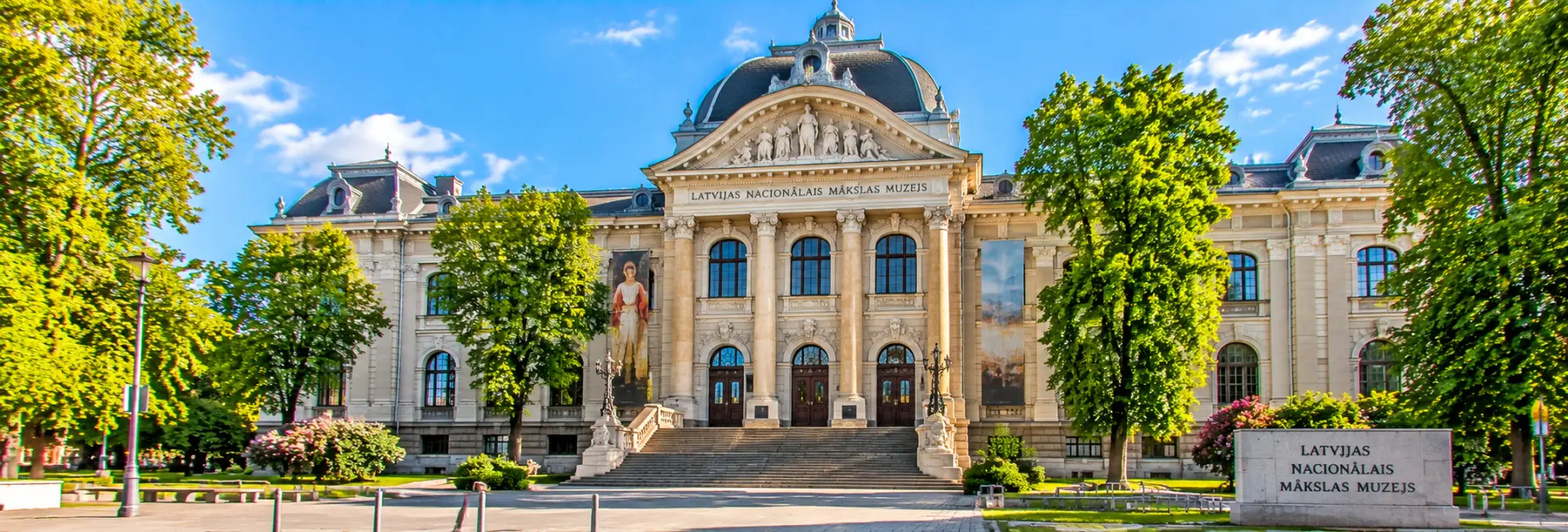
The Latvian National Museum of Art is the country's leading art museum and one of the most important cultural institutions in the Baltic region. Its main building, a grand historicist palace beside the Esplanade park on Riga's Boulevard Circle, was designed for exactly this purpose and was the first in the Baltics to be built as an art museum.
Inside, the permanent display follows two centuries of Latvian painting, graphic art and sculpture, from the era of Baltic German portraitists to the Soviet years. Alongside it, a large exhibition hall and upper-floor galleries host changing shows of Latvian and international art.
The museum belongs to a wider family of sites that also includes the Art Museum Riga Bourse, the Museum of Decorative Arts and Design, the Romans Suta and Aleksandra Beļcova Museum and the Arsenāls exhibition hall. Taken together, the collection runs to more than 52,000 works, but the main building is the natural starting point for anyone who wants to understand how Latvian art developed.
History of the Museum
Early Collections
The roots of the museum's collection stretch back to the Himsel Museum, founded in Riga in 1773, where an art cabinet was separated out in 1816. A city picture gallery followed in 1869, and the Riga Society for Art Promotion was established in 1870. From 1879 until 1905 the city gallery rented rooms in a private building on what is now Kalpaka bulvāris.
A Purpose-Built Home
The museum's own building was constructed between 1903 and 1905 for the Riga City Art Museum and the art society, and it opened on 14 September 1905. Its architect, Wilhelm Neumann, became the museum's first director and led it until early 1919, when painter Vilhelms Purvītis took over.
National Art Comes to the Fore
After Latvia became independent in 1918, the museum put growing emphasis on national art. From 1920 a state museum of art also occupied part of Riga Castle. Under Soviet rule, the collections were reorganised so that Latvian and Russian art and foreign art were separated into different institutions.
One Museum, a New Name
The two strands were brought together, and since September 2005 the museum has carried the name Latvian National Museum of Art. The Museum of Foreign Art, now the Art Museum Riga Bourse, and the Museum of Decorative Arts and Design became part of it from 2010.
Reconstruction and Reopening
An international architectural competition for the reconstruction and extension of the building was announced in 2010, and the major works took place from 2013 to 2016. The museum was officially reopened on 4 May 2016 with a new permanent display of Latvian art and a modern new block alongside the historic building.
Architecture & Building
A Historicist Landmark
The main building is an outstanding example of historicist architecture, with a formal facade whose rear looks over the Esplanade park. It is recognised as an architectural monument of national importance and is one of the standout buildings on the Boulevard Circle. Wilhelm Neumann (1849 to 1919), the Baltic German architect and art historian who designed it, planned the structure and the proportions of the galleries to meet the standards of art museums in turn-of-the-century Europe.
Painted Lunettes and Wall Landscapes
The upper-floor lobby is decorated with six semicircular paintings by Latvian painter Vilhelms Purvītis and Estonian artist Gerhard von Rosen. Purvītis also painted wall landscapes for the third-floor vestibule, including a view of the Koknese castle ruins from 1907. These works are part of the building itself and are among its most memorable details.
The New Block
The reconstruction preserved the historic building while adding a modern extension. A new stairwell in the central part of the building links the ground floor with the new block and the main hall on the first floor. Below ground, the Great Exhibition Hall offers a large, flexible space for major shows.
Rooftop and Glass
The museum has two roof terraces that visitors with a permanent exhibition or all-inclusive ticket can reach during opening hours. On the fourth floor, one exhibition hall has a section of glass flooring, a small modern surprise within the historic shell.
Collections & Exhibits
Latvian Art, 19th to 20th Century
The permanent exhibition, titled Latvian Art. 19th to 20th Century, occupies the second and third floors of the historic building and tells the story of two centuries of art in Latvia. Roughly 500 works from the collection are on show, giving a concentrated overview rather than an exhausting survey.
A Story in Chronological Order
The display begins with the Baltic German art scene of the nineteenth century. It then follows the rise of professional Latvian painters, many of whom trained at the St Petersburg Academy of Arts, and the formation of a national school around the turn of the twentieth century. The later galleries move through the shift to Socialist Realism after the war and continue into the second half of the twentieth century.
Beyond the Main Display
- Painting, graphic art and sculpture dating from the eighteenth century to the middle of the twentieth century.
- Memorial collections devoted to Jāzeps Grosvalds, Teodors Zaļkalns and Gustavs Šķilters.
- Russian art, which forms part of the wider collection, although what is on show varies.
- Temporary exhibitions in the Great Exhibition Hall and the fourth-floor galleries, which change regularly.
Current Programme
From 25 July to 1 November 2026, the museum is presenting a survey of Latvian drawing from the eighteenth century to today, shown alongside an international exhibition of contemporary drawings from a donation to the Centre Pompidou in Paris. Programmes like this change often, so check the museum's website for what is on during your visit.
Must-See Highlights
- The Purvītis and von Rosen lunettes in the upper lobby and the wall landscapes in the third-floor vestibule.
- Vilhelms Purvītis's atmospheric landscapes, which helped define Latvian painting and are particularly known for their winter light and snow.
- Paintings by Jānis Rozentāls, including The Princess and the Monkey.
- Works by Johans Valters, another key figure of the turn-of-the-century generation.
- Graphic works by Rihards Zariņš, the artist behind the designs for early Latvian banknotes.
- Avant-garde and Constructivist art linked to Gustavs Klucis, now renowned worldwide, though which works are on display can vary.
- Paintings from the later twentieth century by artists such as Džemma Skulme, Jānis Pauļuks and Boriss Bērziņš.
- The roof terraces and the glass floor, for views and a different perspective on the building.
Ways to Experience It
- See the permanent display: the best introduction to Latvian art and the main reason to visit.
- Explore the temporary exhibitions: the Great Exhibition Hall and upper galleries host a rotating programme that includes both Latvian artists and international guests.
- Join a guided tour: the museum offers tours of its exhibitions, as well as educational programmes for different ages.
- Use the digital guides: a mobile application and a visual guide on the museum's website explain the building and help you plan your route.
- Visit the roof terraces: accessible during opening hours with a permanent exhibition or all-inclusive ticket.
- Take a break at the cafe or restaurant: on-site refreshments and a museum shop make it easy to spend a longer visit here.
- Bring children: families can take part in art studio sessions and activities designed for younger visitors.
- Explore the collection online: the museum has put selected works and stories on its website and on Google Arts & Culture.
Best Time to Visit
Days and Hours
The museum has been listed as open from Tuesday to Sunday and closed on Mondays. Listed hours are 10:00 to 18:00 from Tuesday to Thursday, 10:00 to 20:00 on Friday, and 10:00 to 17:00 on weekends. Friday's later closing makes it a good evening option, but always confirm current hours with the museum before you go.
Season
Because it is an indoor attraction, the museum works in any weather, which makes it ideal for a rainy or cold day. In summer, the roof terraces and the Esplanade park outside add a reason to linger.
Free Days
The museum has offered free entry to the permanent display on the last Sunday of each month. Check whether this is still the case when you plan your visit, as it is also likely to be a busier day.
Visitor Tips
- Allow around two hours to see the permanent display and one or two temporary exhibitions without rushing.
- Use the main entrance from Krišjāņa Valdemāra iela and buy your ticket at the ticket office. Guards may ask to see tickets during your visit, so keep yours with you.
- Check the schedule before you come, because some halls may be closed while exhibitions are being changed.
- Look for the lift and the museum's wifi network if you need them, and note that benches are provided in the exhibition halls and vestibules.
- Confirm ticket prices, opening hours and any free admission days on the museum's official website, as these details change.
- If you want the roof terraces, buy a ticket that includes the permanent exhibition or the all-inclusive option.
- Combine the visit with a walk in the Esplanade park, which borders the rear of the building and Jaņa Rozentāla laukums on the park side.
Nearby Attractions
- Esplanade Park: the green space beside the museum, a pleasant place to rest after the galleries.
- Latvian Academy of Art: the art school next door, which makes the neighbourhood a natural hub for art.
- Nativity of Christ Cathedral: a landmark Orthodox cathedral that stands on the other side of the Esplanade.
- Latvian National Opera and Ballet: a short walk away along the Boulevard Circle, and pairs well with the park.
- Freedom Monument and Bastejkalns Park: the national symbol of independence and the canal-side park beside it.
- Art Museum Riga Bourse: a sister museum on Doma laukums in Old Riga, with a different, more international focus.
FAQs about visiting the Latvian National Museum of Art
Where is the Latvian National Museum of Art? +
The main building is at Jaņa Rozentāla laukums 1, on Krišjāņa Valdemāra iela, beside the Esplanade park in central Riga.
What can you see at the museum? +
The permanent exhibition, Latvian Art. 19th to 20th Century, presents about two centuries of Latvian painting, graphic art and sculpture. The museum also hosts temporary exhibitions in the Great Exhibition Hall and upper galleries.
When was the museum building constructed? +
It was built between 1903 and 1905, to a design by architect Wilhelm Neumann, and opened on 14 September 1905. It was the first building in the Baltics created specifically as an art museum.
When was the museum renovated? +
A major reconstruction and extension took place between 2013 and 2016, and the museum was officially reopened on 4 May 2016.
What are the opening hours? +
Listed hours are Tuesday to Thursday 10:00 to 18:00, Friday 10:00 to 20:00 and weekends 10:00 to 17:00, with the museum closed on Mondays. Check the museum's website for the current schedule.
Is there a free day at the museum? +
The museum has offered free entry to its permanent display on the last Sunday of each month. Confirm this before your visit.
How long does a visit take? +
Plan around two hours for the permanent display plus a temporary show, and longer if you want to visit the roof terraces, the cafe or a guided tour.
Does the museum have a cafe and a shop? +
Yes, the museum has a cafe and a museum shop, along with a restaurant listed on its website.
Is the museum suitable for children? +
Yes. The museum runs educational programmes and art studio activities for families, and its visual guide and exhibitions can be enjoyed by visitors of different ages.
