
Table of Contents
Overview
The Three Brothers (Trīs brāļi) are a row of three narrow, tightly packed houses on Mazā Pils iela in the heart of Old Riga. Together they form the oldest surviving group of residential buildings in the city, and each one preserves a different moment in how Riga's townspeople built and lived, from the late Middle Ages to the Baroque era.
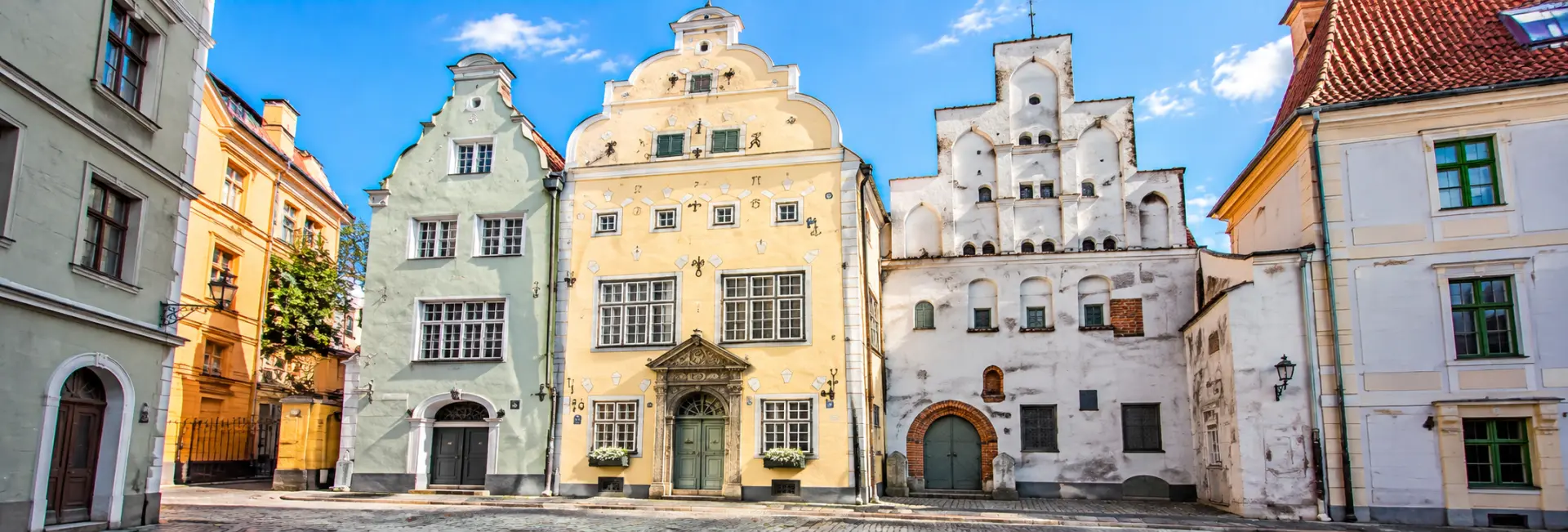
The ensemble is small, but it packs a lot into a short stretch of cobbled street. Stepped gables, a pointed medieval doorway, a Dutch-influenced facade and a curving Baroque roofline sit side by side, so a single glance along the terrace works like a compact lesson in architectural history.
The houses are also very much in use today. They hold the offices of Latvia's national heritage protection authority and the Latvian Museum of Architecture, and in 2020 they received the European Heritage Label, a rare honour for a Latvian site.
History
A Craftsmen's Street on the Edge of Town
In the medieval period, Mazā Pils iela, whose name means Small Castle Street, lay near the outskirts of Riga. Craftsmen and their families lived and worked here, and the oldest of the houses was a place where production, trade and household life all shared a single large room. Space was limited, which explains the narrow plots and tall, slim frontages.
Why They Are Called the Brothers
The name is generally thought to have come from a similar row of buildings in Tallinn known as the Three Sisters. A more romantic local tale says that the houses were built by three men of the same family, though it remains a story rather than a documented fact. Whatever the truth, the label stuck, and it suits buildings that are so clearly related yet so different in character.
Changes Through the Centuries
Number 17 was altered in 1697, when a bakery was installed in it. The extension reached into the courtyard and later out toward the street, swallowing a small open space that had originally sat in front of the building. The other two houses took their present form in the seventeenth century, each reflecting the taste and wealth of its time.
War Damage and Rebuilding
Like many parts of Old Riga, the ensemble suffered damage during the Second World War. A major restoration followed in the 1950s, which gave the houses much of the appearance visitors see now. That project is one of the reasons the complex is regarded as an important chapter in the story of heritage protection in Latvia, and not only as a collection of old houses.
The Three Houses
Number 17: The Oldest Brother
Number 17 dates from the end of the fifteenth century or the start of the sixteenth, and it is recognised as the oldest surviving masonry dwelling in Riga. Its crow-stepped gable and pointed-arch doorway show Gothic roots, with some Renaissance touches added later. The house is set back slightly from its neighbours, a clue to how the street originally looked.
Inside, the plan was simple. A single main room contained a hearth with a chimney-kitchen, while the attic worked as a storage space for goods. It is a vivid example of how a medieval household used every square metre.
Number 19: The Showpiece
Number 19 took on its present appearance in 1646. Its facade shows the influence of Dutch Mannerism, a style that reached Riga through the trade links of the Hanseatic world. The elegant stone portal was added in 1746, bringing a touch of Classical refinement to the front. This is also the house that holds the Latvian Museum of Architecture.
Number 21: The Baroque Brother
Number 21 received its look toward the end of the seventeenth century. Its sinuous, curved gable marks it out as Baroque, and its narrow frontage hides a building that stretches back into the courtyard.
What to Look For
- The contrast in gable shapes, from stepped to Mannerist to curved.
- The change in the floor plan and window arrangement from house to house.
- The different colours of the facades, which help the three buildings stand apart.
- The historic stone portals and old versions of the city coat of arms set into the courtyard walls.
Restoration & Heritage Recognition
The 1950s Restoration
The restoration carried out between about 1953 and 1957 was led by architect Pēteris Saulītis. His team gave the houses their current look and brought in architectural details rescued from other buildings in the old town that had been destroyed in the war. The courtyards behind the three houses were also joined into one shared space, and stone portals and coat-of-arms fragments were set into the walls.
The extension that had been added to number 17 in the seventeenth century was removed as part of this work, restoring the house closer to its earlier form.
Status and Awards
The ensemble is protected as a national architectural monument and lies within Old Riga, the historic centre listed by UNESCO. On 30 March 2020, the European Commission also awarded it the European Heritage Label. The label recognises sites for their symbolic value in European history, and the Three Brothers were put forward partly for their role in protecting cultural heritage in Latvia, especially in difficult periods.
Latvia has only two sites with this label, the other being the historic centre of Turaida, which makes the Three Brothers a notable stop for anyone interested in how Europe remembers its past.
Inside the Complex
The Latvian Museum of Architecture
The museum was established in 1994 and officially opened in April 1995. It is the country's only museum that follows the work of professional architects connected to Latvia, and its collection holds around 15,000 items, including drawings, sketches, blueprints, watercolours and models.
It does not run a permanent display. Instead, its exhibition hall hosts changing shows on architectural history and on current developments in the field, so what you see depends on when you visit. The collection itself has been digitised and made publicly available online.
The Shared Courtyard
Visitors can also enter the united courtyard, where historic construction details from lost Riga buildings are displayed. It is a quiet counterpoint to the busy street, and a good place to see how the three houses connect behind their separate facades.
The Heritage Authority
Part of the complex is occupied by the National Cultural Heritage Board, the body responsible for protecting Latvia's historic monuments. Those offices are working spaces rather than visitor attractions, though the arrangement is a fitting one for buildings that have themselves been so carefully preserved.
Ways to Experience It
- Stroll the street: the facades can be viewed from the pavement at any hour at no cost, and many people simply walk past as part of an Old Town loop.
- Step back for the full view: the lane is narrow, so crossing to the opposite wall helps you fit all three houses into one frame.
- Visit the museum: a short stop inside number 19 lets you see the current exhibition and the courtyard.
- Join a walking tour: walking tours of Old Riga often pass along Mazā Pils iela, so the Three Brothers fit naturally into a route with the castle and the cathedral.
- Photograph the details: stepped gables, portals, window frames and rooflines all reward a closer look.
- Explore the museum online: the collection's digital catalogue offers a preview if you cannot visit in person.
Best Time to Visit
Time of Year
The exterior is open to view all year, so the ensemble works in any season. Spring through early autumn brings the best conditions for walking the Old Town, while winter gives the facades a quieter, more atmospheric look, though cobbles can be slick when wet or icy.
Time of Day
Mazā Pils iela is a popular route, so early morning is the best time for unobstructed photographs and a calmer atmosphere. Soft low sun brings out the colours and the texture of the plasterwork.
For the Museum
The museum keeps standard daytime hours that have generally been listed as weekday opening, with some days extending into the evening. Always check its current schedule before planning a visit, because exhibitions and opening times can change.
Visitor Tips
- Allow 15 to 30 minutes for the exterior and courtyard, or up to an hour and a half if you want to explore the museum in depth.
- Confirm opening hours and any admission details with the Latvian Museum of Architecture before you go, as they can change.
- Wear comfortable shoes. The street is cobbled and uneven, and can be slippery in wet weather.
- If step-free access matters to you, contact the museum in advance, since detailed accessibility information is not widely published.
- Remember that parts of the complex are government offices, so respect any signs that mark areas as closed to visitors.
- Combine the visit with nearby sights, as the Three Brothers are only a few minutes' walk from several of Old Riga's best-known landmarks.
Nearby Attractions
The Three Brothers sit on a lane that links Dome Square with Castle Square, so there is plenty to pair with a visit.
- Riga Cathedral: one of the largest medieval churches in the Baltics, just around the corner.
- Riga Castle: a fortress dating from the fourteenth century, now the president's residence and a museum.
- Latvian War Museum and the Powder Tower: housed in a surviving tower of the old city defences.
- House of the Blackheads: an ornate guild building on Town Hall Square.
- Swedish Gate: a rare remnant of the old city walls on nearby Torņa iela.
FAQs about visiting the Three Brothers
What are the Three Brothers in Riga? +
They are three adjoining houses at Mazā Pils iela 17, 19 and 21 in Old Riga. Together they make up the oldest surviving ensemble of residential buildings in the city.
Why are they called the Three Brothers? +
The name is believed to echo a similar group of buildings in Tallinn called the Three Sisters. Local legend adds that three brothers from one family built them, but this is a story rather than a documented fact.
How old are the Three Brothers? +
Number 17 dates from the end of the fifteenth or the early sixteenth century, number 19 took its present form in 1646, and number 21 reached its current look at the end of the seventeenth century.
Can you go inside the Three Brothers? +
Part of the ensemble is open to visitors through the Latvian Museum of Architecture in number 19, where you can see changing exhibitions and the shared courtyard. Other parts are government offices and are not open to the public, so check the museum's current hours before you go.
Is it free to see the Three Brothers? +
Yes, viewing the facades from the street costs nothing and is possible at any time. Museum admission has been listed as free, but confirm current details with the museum.
How long do you need at the Three Brothers? +
A quick look at the exterior takes about 15 to 30 minutes. If you plan to visit the museum and courtyard, allow up to an hour and a half.
What is the European Heritage Label? +
It is an EU designation for sites with a strong symbolic role in European history. The Three Brothers were awarded the label on 30 March 2020, and they are one of only two Latvian sites to hold it.
Where are the Three Brothers and how do you get there? +
They are on Mazā Pils iela in the centre of Old Riga, between Dome Square and Castle Square. Most visitors arrive on foot, and the Old Town is compact and walkable.
Which of the three houses is the oldest? +
Number 17, the one set slightly back from the others, is the oldest and is recognised as Riga's earliest surviving masonry dwelling.
