
Table of Contents
Overview
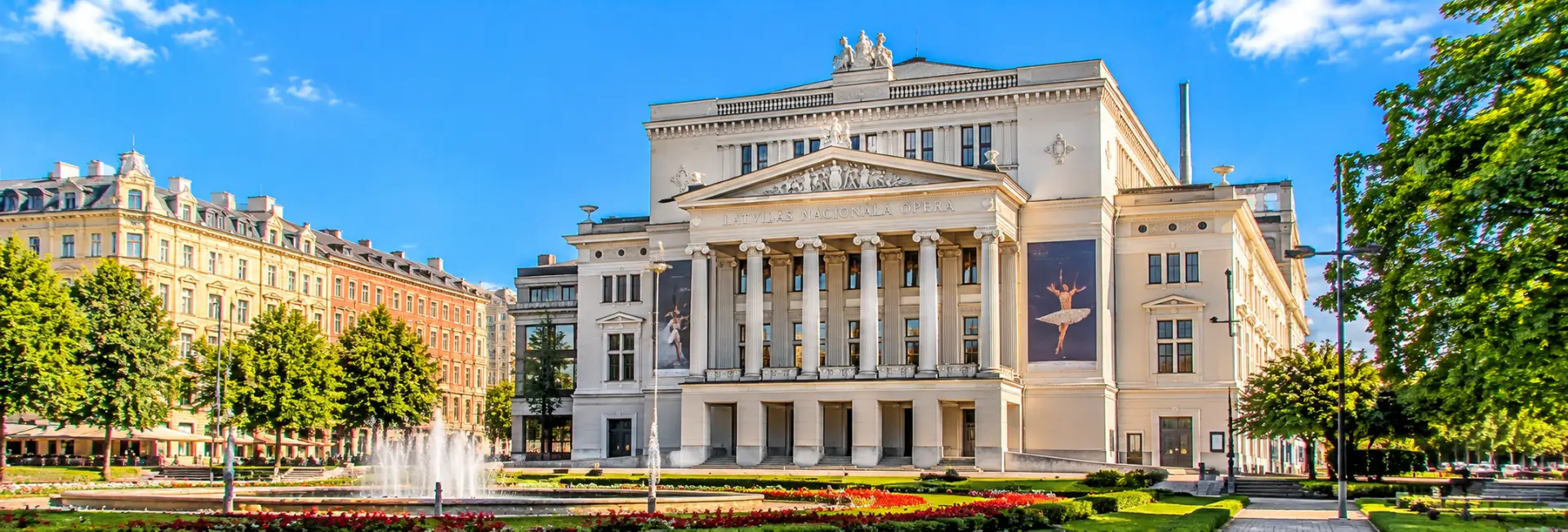
The Latvian National Opera and Ballet is Riga's principal home for opera and ballet, set in a pale neoclassical building at Aspazijas bulvāris 3, between the edge of Old Riga and the city canal. The theatre was completed in 1863 as the Riga City Theatre, and its columned front has been one of the best-known facades in the centre of the capital ever since.
Today the building houses the national opera company, the national ballet, a chorus and an orchestra. A normal season runs from mid-September to the end of May, with close to 200 performances and several new productions each year, and it ends with the Riga Opera Festival in June.
It is as much a historic monument as a working theatre. The opera house is protected as a national architectural monument, and it carries stories of fire, electrification, independence and wartime change inside walls that still host performances most evenings of the season.
History
From City Theatre to National Stage
Opera and ballet were part of Riga's cultural life long before the present building existed. A German-language city theatre opened in 1782, and the composer Richard Wagner worked in Riga as music director between 1837 and 1839. When the city centre was redesigned in the 1850s, planners chose the former bastion site beside the canal for a new theatre, and Ludwig Bohnstedt's design, drawn up by a St Petersburg architect, won the commission in 1860.
The 1882 Fire and Rebuilding
On 14 June 1882 the theatre burned down, leaving little more than its outer walls. The city's chief architect, Reinhold Schmaeling, led the reconstruction, which kept to Bohnstedt's original design and was completed in 1887. The rebuilt theatre was modern for its day, and it came with the city's first electric power station. The tall smokestack of that plant is still visible near the building.
A Latvian Opera in the Building
The Latvian National Opera was founded in 1918, and in 1919 the government formally gave it the status of national opera along with a home and state funding. The building passed into its hands, and in 1922 the first professional ballet ensemble in Latvia joined the opera troupe. Between the wars, the company played a central role in Riga's musical life.
Soviet Years and Restoration
After the Soviet occupation in 1940, the theatre was renamed the Opera and Ballet Theatre of the Latvian SSR, and the building was refurbished in 1957 and 1958. In 1990 the company took back its national name, and the house closed for a complete restoration that lasted until 1995. Its first performance on reopening was a Latvian opera, Jānis Mediņš's Fire and Night. A new annex followed in 2001.
Renovation in 2025 and 2026
The most recent chapter is a large energy-efficiency overhaul of the historic wing, funded largely by the European Union's recovery programme and estimated at around 12 million euros. It covers heating, ventilation, electrical systems, water supply and roof insulation, and it is described as the biggest investment in the building since the 1990s. The main stage reopened to audiences on 4 June 2026 with the Riga Opera Festival.
Architecture & Design
A Greek Classical Front
The building is designed in a Greek classical manner, and its most recognisable feature is the Ionic portico on the street facade. A group of allegorical figures decorates the front, and the white-toned stonework helps the house stand out against the greenery of the nearby park. Locals sometimes refer to it affectionately as Riga's white house.
Interiors and Stagecraft
The original interiors were fitted out by the firm of August Volz. Inside, the Great Hall is crowned by a large chandelier, part of the ornate setting people expect from a nineteenth-century opera house. Behind the scenes, a heavy concrete fire curtain and the stage machinery are among the details that tour guides like to point out.
Wagner Above the Stage
A bas-relief of Richard Wagner is set above the stage, a nod to his time in Riga. It is lit up during performances of his operas, which makes it a small but memorable detail for anyone who spots it.
A Building With Layers
The house has been remodelled several times, in the 1880s, the 1950s and the 1990s. The latest work includes restoring the historic tiled floor of the foyer, and the surrounding gardens, with a fountain and bronze statue, soften the setting in warmer months.
The Halls Inside
- The Great Hall: the historic main auditorium, designed by Ludwig Bohnstedt and built in 1863. It seats about 950 people and is the setting for the major opera and ballet productions.
- The New Hall: a smaller space completed in 2001 to a design by architect Juris Gertmanis, seating around 240. It is used for more intimate productions and concerts.
- The Dress Circle Hall and the Red Hall: smaller rooms, seating roughly 170 and 100 people at most, whose availability can vary during building work.
- The foyers and gardens: public areas where audiences gather before the performance and during intervals.
Seating figures differ slightly between sources, and some areas have been affected by renovation work, so check the theatre's seating plan when you book.
The Company & Its Stage
Opera and Ballet Under One Roof
The institution combines the Latvian National Opera and the Latvian National Ballet, together with its own chorus and orchestra. The repertoire is rooted in classical and romantic works, but contemporary opera and dance have become a regular part of the programme alongside children's productions and new Latvian works.
Stars Who Started Here
Many internationally known musicians began their careers on this stage, including conductor Andris Nelsons and singers Kristīne Opolais, Elīna Garanča, Marina Rebeka and Aleksandrs Antonenko. That pedigree is one reason an evening here carries real weight, even for visitors who do not know the repertoire well.
The Riga Opera Festival
Every June the season ends with the Riga Opera Festival, which brings together new productions, popular revivals and guest soloists. The 2026 edition ran from 4 to 20 June and included La bohème, Carmen, Aida and a series of ballets, closing with a gala concert.
Ways to Experience It
- See a performance: an opera or ballet evening in the Great Hall is the best way to experience both the building and the company.
- Take a backstage tour: the opera has offered guided tours of about an hour that cover the historic and newer parts of the building, the stage and its machinery, and the theatre's daily work. Tours have been available in Latvian, English and German, but they were paused during building work, so check the website for the current schedule.
- Attend the Riga Opera Festival: a concentrated run of performances at the end of the season, ideal for a short stay.
- Look at the exterior: the portico and gardens can be admired at any time and are a fine photo stop.
- Combine it with a walk: the opera sits beside a park and the canal, so it fits easily into a stroll between Old Riga and the Freedom Monument.
Best Time to Visit
Season
The main season runs from mid-September to the end of May, with the festival in June. Performances are scarce in high summer, so check the calendar if you are visiting in July or August and plan your trip around the dates you want.
Time of Day
Most performances take place in the early evening, so the building is at its liveliest then. For photographing the facade without crowds, a morning visit gives clean light and a quiet boulevard.
Weekdays and Weekends
Weekend performances and popular titles tend to sell fastest, so book ahead if you have a particular production in mind.
Visitor Tips
- Buy tickets from the official website or the box office, and check the repertoire before fixing your travel dates.
- Book early for festival evenings and well-known productions, which can sell out.
- Arrive with time to spare so you can find your seat, visit the cloakroom and see the foyers.
- Check whether your production has surtitles or an English summary, particularly for operas sung in other languages.
- Ask about accessibility before you book, as access to some areas can change during renovation work.
- If you plan to join a guided tour, buy a ticket in advance and arrive early, because late entry is not allowed on tours.
- Expect some restrictions inside the building while the renovation programme finishes, such as closed rooms or limited facilities.
- Refreshments have been served at café spaces on the basement level, entered from the foyer, and in the Red Hall, which is handy for intervals and for a coffee before a show.
Nearby Attractions
The opera stands on the boundary between the medieval centre and the nineteenth-century boulevards, so a performance slots neatly into a wider evening or day of sightseeing. Most of the places below are reachable on foot in a few minutes, which makes it easy to combine dinner, a walk and a show without needing transport.
- Freedom Monument: Latvia's national symbol of independence, only a short walk away.
- Bastejkalns and the City Canal: a green park and waterway directly beside the opera, good for a walk before or after a show.
- Old Riga: the medieval centre, with the cathedral, castle and cobbled lanes, begins just a few minutes away on foot.
- Boulevard Circle: the ring of parks and avenues that follows the line of the old city fortifications, where Aspazijas bulvāris is located.
FAQs about visiting the Latvian National Opera and Ballet
Where is the Latvian National Opera and Ballet? +
It is at Aspazijas bulvāris 3 in central Riga, beside the city canal and a short walk from both Old Riga and the Freedom Monument.
How old is the opera house? +
The building was completed in 1863 as the Riga City Theatre. It was gutted by a fire in 1882 and rebuilt to the original design, reopening in 1887.
What is performed at the Latvian National Opera and Ballet? +
The programme combines classical and romantic opera and ballet with contemporary works, children's productions and original Latvian pieces. The company stages around 200 performances each season.
When is the opera season? +
It runs from mid-September to the end of May and is followed by the Riga Opera Festival in June. Check the website calendar for exact dates, since summer performances are limited.
Can you tour the building without seeing a performance? +
The opera has run guided backstage tours of around an hour, but they were suspended during renovation work and were due to resume from September 2026. Confirm the current schedule and languages on the theatre's website before planning around one.
How do you buy tickets? +
Tickets are sold at the opera's box office and through its official website. Book early for festival evenings and popular titles.
Did Richard Wagner work at the opera? +
Wagner was the music director of the Riga city theatre from 1837 to 1839, which was held in an earlier theatre building. A bas-relief of him above the stage of the current house commemorates the link.
Is the opera house accessible? +
Accessibility information is not consistent across sources, and parts of the building are affected by renovation work. Contact the theatre before booking if you need step-free access.
What is the Riga Opera Festival? +
It is the annual summer festival that ends the season, bringing together new productions, revivals and guest artists over about two weeks in June, and finishing with a gala concert.
