
Table of Contents
Overview
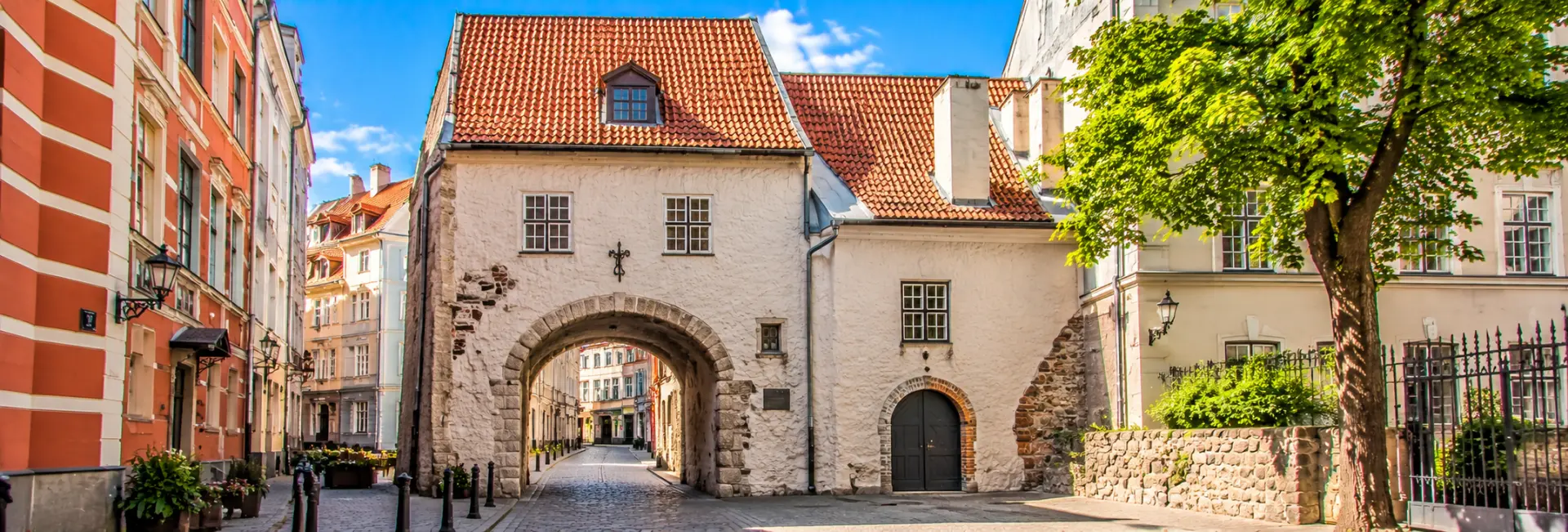
Tucked into the northern edge of Riga's Old Town, the Swedish Gate (Zviedru vārti) is a narrow stone archway that cuts through the line of the old city wall. It looks modest at first glance, yet it is the only one of Riga's eight historic city gates that still stands today.
The gate dates to 1698, when Riga was a prized possession of the Swedish Empire. It was built to give soldiers and residents a direct way through the wall to the barracks that stood just outside the city. Over three centuries later, people still walk through the same opening, now on their way to cafés, souvenir shops and Old Town sightseeing.
What makes the gate special is not its size but its survival. It is a rare physical reminder of how fortified Riga once worked, and it comes with a handful of colourful legends that guides love to share. Because it sits right beside other fragments of the defences, it is easy to turn a quick look into a rewarding stroll through the city's military past.
History
A City Behind Walls
Riga was founded in the early 13th century, and its first defensive perimeter went up remarkably fast, with the basic circuit of walls in place around 1234. Over the following centuries the fortifications were repaired, raised and rebuilt as weapons changed. Stone replaced earlier earth and timber defences, and gun platforms later appeared along the tops of the walls.
The wall was pierced by a number of gates, which controlled who could enter and leave and gave the city its sense of enclosure. Today only one of those eight openings remains in place, and it is not a medieval relic but a product of the Swedish period.
The Swedish Era and the Gate of 1698
In the 17th century Riga belonged to the Swedish crown and was one of the empire's most important Baltic cities. A Swedish garrison was stationed here, and its quarters lay on the far side of the wall. The city needed a convenient passage between the inner town and those military buildings, and the gate was completed in 1698 to provide it.
Its Swedish connection is baked into its identity. The name refers to the era of its construction, and the carved lions on its stonework echo a heraldic symbol associated with the kingdom, which is why it is sometimes called the Lion Gate.
Russian Rule and the Fall of the Walls
Swedish control of Riga ended in 1710, when forces of Peter the Great captured the city during the Great Northern War. The gate outlived the regime that built it, and the barracks beyond it were rebuilt in the 18th century under Russian rule.
As artillery made the old walls less useful, the defences were gradually dismantled, with demolition beginning in the 18th century and sweeping through the 19th. Most of the gates vanished along with the wall. The Swedish Gate endured, along with a few stretches of wall nearby, and was later restored in the 20th century so that visitors could still read the layout of the old fortifications.
Recognition / Status
The Swedish Gate stands within the historic centre of Riga, an area inscribed on the UNESCO World Heritage List in 1997. The listing celebrates the city's well-preserved medieval street plan and its remarkable collection of Art Nouveau and wooden architecture, and the gate is part of the fabric that gives the Old Town its character.
Within Latvia, the surviving fortification remains of Old Riga are protected as cultural heritage, and the gate is treated as an important monument of the city's defensive history. Its significance is less about artistic grandeur and more about rarity, since it is the last intact example of a city gate in the entire wall circuit.
- Only surviving city gate of the original eight
- Located inside the UNESCO-listed historic centre of Riga
- Protected as part of Riga's remaining fortification heritage
- One of the key stops on the Old Town's defensive-heritage trail
Architecture & Design
A Compact Stone Passage
The gate is a simple, practical structure: a narrow arched opening in a stone-built block of the wall, sized for people and carts rather than grand processions. Its width is well under four metres, which gives the passage an intimate, almost secretive feel compared with the broad avenues beyond.
Above the arch, the building continues upward as living or working space under a pitched tile roof. This was common in fortified towns, where gates were more than doorways and often doubled as functional buildings. The result is a gate that reads as part of the street rather than a standalone monument.
Lions and a Date in Stone
The most distinctive decoration is the stone carving on the keystones of the arch. Lions are depicted on both sides, and the year 1698 is marked in the stonework, fixing the gate firmly to its moment in history. Local accounts note that the two lion faces differ in expression, which has helped fuel the gate's folklore.
The cobbled surface running through the passage adds to the old-world atmosphere. Walking through, you step from the bustle of Torņa iela into a cooler, quieter, enclosed space and out again within seconds.
Legends & Local Stories
The Soldier and the Girl
The most famous tale explains the gate's reputation as a place of tragic romance. According to the story, local young women were forbidden from befriending the soldiers of the garrison, yet one girl fell in love with a Swedish soldier and they met at the gate. When he stopped appearing, the story goes, townspeople who knew about the forbidden relationship punished her cruelly by walling her into the structure.
No historical evidence supports the story, and it is best understood as folklore rather than fact. Still, it gives the passage a haunting reputation, and it is often told to visitors who pause beneath the arch.
The Executioner's Window
Another popular tale concerns the dwelling above the gate. Guides sometimes say it was once home to the city executioner, who would signal an upcoming execution by placing a red rose on the windowsill the morning before. It is a vivid image, and one more example of how the gate has collected stories over the centuries.
In Fiction
The gate has also made its way into popular culture. It appears in Henning Mankell's crime novel Dogs of Riga, in which Swedish detective Kurt Wallander visits the site, adding a literary footnote for fans of Scandinavian crime fiction.
What to See There
The Old City Wall Fragment
Right beside the gate you can see one of the longest surviving stretches of the old wall, running along Torņa iela. It has been restored over time, so it looks fresher than its age suggests, but it still helps you picture the barrier that once surrounded Riga. Step through the gate and look left to find Trokšņu iela, where the inner face of the wall can be seen from the old city side.
Jacob's Barracks
Directly opposite the gate are the long, yellow, orange-roofed buildings known as Jacob's Barracks. Built in the 18th century and used for military purposes for generations, they stretch for roughly 230 metres and now hold shops, bars and restaurants. They are a good illustration of what lay on the far side of the gate.
The Powder Tower
At the end of the wall stands the Powder Tower, the only remaining defensive tower of its kind in Old Riga. Its present form dates to 1650, after an earlier tower was destroyed during a 17th-century siege, and cannonballs are still embedded in its walls. Today it houses the Latvian War Museum, making it an easy add-on to a visit.
Other Nearby Stops
- St. James's Cathedral, close to the end of Jacob's Barracks
- Riga Cathedral, a short walk south
- The Three Brothers, a trio of historic houses that show how residents lived in earlier centuries
- Town Hall Square and the House of the Blackheads, a natural continuation of an Old Town walk
Ways to Experience It
Most visitors meet the Swedish Gate as part of a guided or self-guided walk around Old Riga. It is a quick stop, usually ten to twenty minutes on its own, but it works well as the anchor of a short fortifications route that links the gate, the wall, Jacob's Barracks and the Powder Tower.
Walking tours often include a stop here because guides can tell the legends on the spot. If you prefer to explore independently, an audio guide or a bit of reading beforehand will help, since there is little on-site information about the gate's story.
Photographers tend to love the arch for its framing of the cobbled street and the warm tones of the surrounding buildings. Standing back slightly on Torņa iela gives a good view of the whole gateway, while stepping inside the passage allows for closer shots of the stonework.
Best Time to Visit
Because the gate is an open-air site on a public street, you can see it at any hour and without paying. That freedom means the best time depends on the atmosphere you want.
Early morning is usually the calmest time, when the street is quiet and soft light picks out the texture of the stone. Evening can be equally atmospheric as the Old Town glows and cafés fill up. Midday tends to be busier, especially when walking tour groups pass through.
Seasonally, late spring through early autumn offers the most comfortable walking weather, while winter brings a quieter, moodier Old Town where the gate may feel especially timeless. Rain darkens the cobbles and stonework in a way some visitors find photogenic, though the uneven stones can be slippery.
Visitor Tips
The Swedish Gate is a short, easy stop, so planning around it rather than just for it will give you a better experience. Pairing it with the nearby wall, barracks and tower turns it into a satisfying micro-itinerary.
- Entry is free and there is no ticket or opening hours to worry about, since it is a street-level monument.
- Wear comfortable shoes with good grip, as the cobblestones are uneven and can be slick when wet.
- Allow about 10 to 20 minutes for the gate alone, and more if you add the Powder Tower or a walk along Jacob's Barracks.
- Note that the restaurant called Zviedru Vārti is on Torņa iela beside the gate, not inside the historic gate building itself.
- Read about the gate in advance or use an audio guide, because on-site signage is limited.
- The gate is a working street passage, so step aside when taking photos to let pedestrians through.
- If you want a quieter visit, go early in the morning or later in the evening.
FAQs about visiting the Swedish Gate
What is the Swedish Gate in Riga? +
The Swedish Gate (Zviedru vārti) is a stone archway built in 1698 through Riga's old city wall. It is the only surviving city gate of the original eight and now stands as one of the Old Town's best-known historic landmarks.
Why is it called the Swedish Gate? +
It was built when Riga was under Swedish rule and was meant to connect the city with the nearby garrison barracks. The name reflects that period, and it is sometimes also called the Lion Gate because of the carved lions on its stonework.
Where exactly is the Swedish Gate? +
It is at Torņa iela 11 on the northern edge of Riga's Old Town, close to the Powder Tower and Jacob's Barracks. It is easily reached on foot from the main Old Town squares.
Is it free to visit, and what are the opening hours? +
Yes, it is free. Because the gate is part of a public street, you can see it at any time of day or night.
How long should I spend at the Swedish Gate? +
Ten to twenty minutes is enough for the gate on its own. If you also want to walk along the wall, see Jacob's Barracks and visit the Powder Tower, plan for an hour or more.
What can I combine with a visit to the gate? +
The Powder Tower and Latvian War Museum, Jacob's Barracks, St. James's Cathedral, Riga Cathedral, the Three Brothers and Town Hall Square are all within a short walk, so the gate fits neatly into a wider Old Town route.
Is the story about the girl walled into the gate true? +
No evidence supports it, and it is generally treated as local folklore. It remains a popular legend that many guides tell to visitors.
