
Table of Contents
Overview
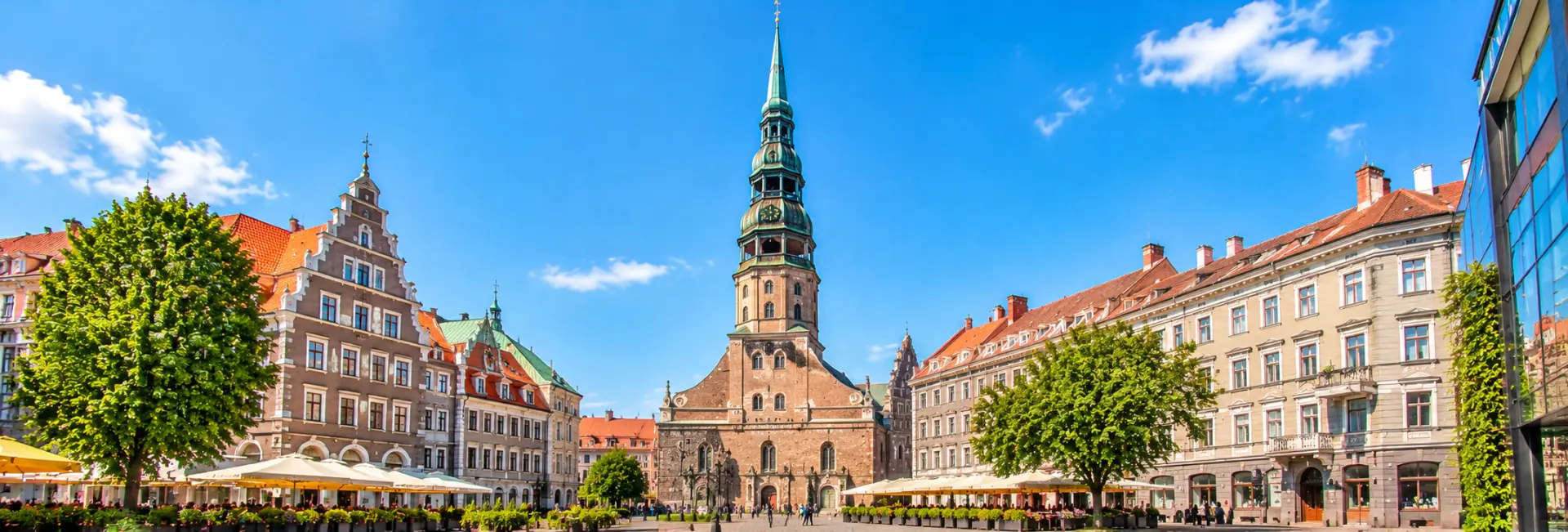
St. Peter's Church, known in Latvian as Svētā Pētera baznīca, is one of the oldest and most recognisable landmarks in Riga. It rises beside Town Hall Square in the heart of the Old Town, and its slender spire can be spotted from almost every corner of the historic centre. First mentioned in records from 1209, it is a Gothic basilica with a Baroque west front, dedicated to Saint Peter and today a parish church of the Evangelical Lutheran Church of Latvia.
The church is best known for its tower. A lift carries visitors up to a viewing platform 72 metres above the street, where a wide panorama takes in the red roofs of the Old Town, the Daugava River and, on a clear day, much more of the city. The building itself rewards a visit as well. Its tall, bright interior hosts art exhibitions and concerts, and its walls carry the marks of a long cycle of fires, lightning strikes and wartime destruction, each followed by determined rebuilding.
For many travellers, St. Peter's is the easiest place in Riga to grasp the layout and the story of the city in a single stop.
History
Medieval Origins
Records mention a church of St. Peter in Riga in 1209. It was built of masonry, which helped it survive a city fire that same year. Only fragments of that earliest church remain today, mostly in the outer walls of the nave and inside some of the pillars.
The church took its Gothic form in the 15th century. A new sanctuary was begun in 1408 under the master builder Johannes Rumeschottel of Rostock, who based the design on St. Mary's Church in his home city. War delayed its completion until 1419. The older nave was then rebuilt to match, and by the 1470s the two parts were joined into a three-aisled basilica with ornate vaulting.
A Tower That Kept Falling
The tower's story is dramatic. A tall octagonal steeple added in 1491 collapsed in March 1666, damaging a neighbouring building and killing eight people. Its replacement was finished in 1690 with a copper-roofed wooden steeple of roughly 148 metres, crowned with a sphere and a rooster, and said to be the tallest wooden structure in Europe at the time. Local legend claims the builders hurled a glass from the top to forecast how long it would last: the more pieces, the longer the life.
The prediction proved optimistic. Lightning struck in May 1721 and set the church and tower ablaze, leaving only the walls standing. After years of rebuilding, a new copper-clad steeple of about 120 metres was completed in 1746, and its rooster was gilded the following year.
Destruction and Rebirth in the 20th Century
Artillery fire destroyed the church on 29 June 1941. Research and planning began in the 1950s, and the main restoration ran from 1967 to 1983. The tower was rebuilt on a metal frame, with a lift added so its galleries could serve as viewing platforms. A faithful copy of the old rooster, the seventh in the tower's history, was raised in August 1970. The Latvian Lutheran congregation resumed services in 1991, and ownership returned to the Evangelical Lutheran Church of Latvia in 2006.
Architecture and Design
St. Peter's is a Gothic basilica with Baroque additions, a mix that reflects centuries of repair and rebuilding after each disaster.
The Gothic Interior
The sanctuary shows off the soaring lines and fine detailing typical of Gothic design, with an altar area made up of five chapels. The central part of the nave rises to about 30 metres, giving the hall a sense of height and light that surprises many first-time visitors. After the citywide fire of 1677, wooden vaults replaced the earlier masonry ceilings, and the church was refitted over the following years.
The Baroque West Front
The western façade dates from the later 17th century. Its brickwork was covered in reddish limestone from the Salaspils and Koknese areas and decorated with volutes, pilasters, cornices and vases carved from Gotland stone. In 1692 the city council approved a design for three matching portals, financed by the merchant Klaus Mistett and richly adorned with Baroque limestone sculpture. The façade and portals were restored again between 1987 and 1991.
The Tower and Viewing Platform
Going Up
The tower stands 123.25 metres tall, and visitors are taken to the second gallery at a height of 72 metres. A lift handles the vertical journey, so there is no long climb, although the route begins with some steps inside the church before you reach it. The ride itself takes about a minute.
The View
From the platform you can look down on the rooftops and spires of the Old Town, trace the outline of Town Hall Square, follow the Daugava River and see across to the Pārdaugava district on the opposite bank. In clear weather the view reaches as far as the Gulf of Riga. The platform is fairly narrow and can be windy, so hold on to hats and phones, and allow time to walk around all four sides.
Clock, Bells and Rooster
The tower clock was relaunched in July 1975 and, in keeping with old tradition, has only an hour hand. Since 1976 the chimes have played the Latvian folk song Rīga dimd five times a day, and the bells mark the top of each hour. High above it all, the gilded rooster is the latest in a long line of weathervanes, since earlier ones were bent by storms, blown down or lost when the tower collapsed.
Cultural and Religious Significance
St. Peter's began its life as a Catholic church and became Lutheran after the Reformation reached Riga in the 1520s. It has remained a place of Lutheran worship ever since, apart from the decades when war damage and Soviet-era use kept it from serving as a regular parish church. Today it is again a parish church of the Evangelical Lutheran Church of Latvia, while also functioning as a cultural venue.
The church is counted among the oldest historical monuments in the Baltic states, and it stands within the Historic Centre of Riga, which was inscribed on the UNESCO World Heritage List in 1997. For Riga's residents, its spire is a familiar symbol of the city and of its ability to rebuild after catastrophe.
That resilience is part of its meaning. The church has been burned, struck by lightning and shelled, yet each time the city has chosen to restore it. Even small objects tell the same story. A bronze candelabrum made in 1596 was removed from the church during the Second World War and ended up in Poland, and it returned to Riga in 2012 under an agreement on the return of cultural property.
Notable Features
Beyond the tower, a number of details are worth seeking out inside and around the church.
- The bronze candelabrum: a large seven-candle holder cast in 1596 by a Riga foundry, which returned to the church in 2012 after decades abroad.
- The statue of Roland: the original statue of the knight, a traditional symbol of the city's rights and justice, which previously stood on Town Hall Square and is now kept inside.
- Epitaphs and altar: restored stone and wooden epitaphs and a wooden altar that survive as part of the original interior fittings.
- The west portals: three Baroque entrances decorated with limestone sculpture, best appreciated from the square outside.
- The history displays: stands and screens that explain the church's repeated destruction and reconstruction.
Ways to Experience It
Ride the Lift to the Platform
The most popular way to visit is to combine the church interior with the lift ride to the viewing platform. It suits a short stop in the Old Town and gives a useful overview of the city before or after you explore its streets on foot.
Explore the Church Interior
Allow time to walk through the nave, read the history displays and look at the historic furnishings. The calm, high-ceilinged space makes a good break from the busy cobbled streets outside.
Catch an Exhibition or Concert
The church regularly hosts art exhibitions and concerts. Programmes change throughout the year, so check the official website for current events before your visit.
Listen for the Bells
If you are nearby on the hour, listen for the bells, and keep an ear out for the Rīga dimd melody played during the day.
Best Time to Visit
The best time for St. Peter's depends mostly on weather, since the view from the tower is the main attraction.
By Season
Clear days in late spring, summer and early autumn give the most rewarding views, and in summer the church tends to stay open later, which makes sunset visits possible. Winter brings crisp air and quieter streets but also colder, windier conditions at the top and shorter daylight hours.
By Day and Time
Arriving soon after opening usually means fewer people at the platform and a calmer walk through the nave. Late afternoon can also work well for warm light over the rooftops, but leave enough time before closing, because ticket sales stop earlier than the church itself. Check the weather before paying for the tower, as low cloud or mist can hide the best views.
Visitor Tips
- Check current opening hours and ticket prices on the official website. Both change with the season and with events.
- Expect a ticket to be required for the tower and exhibitions, and check what is included before you buy.
- Allow one to two hours if you want to explore both the interior and the platform.
- Bring a warm layer. The platform is open to the wind, even on mild days.
- Remember this is an active church. Keep voices low and dress respectfully, especially during services.
- Accessibility is limited because of steps inside the church before the lift, so contact the church ahead of time if you need step-free access.
- Look for the tower first on your walk through the Old Town. It is a handy landmark for finding your bearings.
Nearby Attractions
St. Peter's sits at the centre of the Old Town, so it is easy to pair with other sights on foot.
- Town Hall Square and the House of the Blackheads: right next to the church, a historic heart of the Old Town.
- Bremen Town Musicians statue: a small bronze group near the church, given to Riga by its sister city Bremen.
- Museum of the Occupation of Latvia: located on Town Hall Square, covering Latvia's history from 1940 to 1991.
- Riga Cathedral: another landmark of the Old Town, a short walk away on Dome Square, known for its famous organ and medieval cloister.
- The narrow lanes of the Old Town: a pleasant place to wander for cafes, shops and historic buildings after your visit.
FAQs about visiting St. Peter's Church
What is St. Peter's Church best known for? +
It is best known for its tall tower and the viewing platform 72 metres above the Old Town. The church is also one of the oldest historic monuments in the Baltic states and has been rebuilt several times after fires and war.
How tall is the tower and how high does the lift go? +
The tower is 123.25 metres tall. The lift takes visitors to the second gallery at a height of 72 metres.
Do I need to climb stairs to reach the viewing platform? +
There is a lift for the main ascent, but the route begins with some steps inside the church. Visitors who need fully step-free access should contact the church before visiting.
How long should I spend at St. Peter's Church? +
Plan on 45 minutes to two hours, depending on whether you want to see the church interior, any current exhibitions and the viewing platform. A quick visit focused on the tower can take about 30 minutes.
Is there an admission fee? +
A ticket is usually required for the tower and exhibitions, and prices vary by visitor type and season. Check the official website for current prices and for what each ticket includes.
When is the best time to go up the tower? +
Choose a clear day, ideally soon after opening or in the late afternoon for softer light. In summer the church tends to stay open later, so evening visits are sometimes possible.
Why does the clock have only one hand? +
The restored clock follows an old local tradition and shows only the hour. It was relaunched in July 1975.
Is St. Peter's Church still a place of worship? +
Yes. It is a parish church of the Evangelical Lutheran Church of Latvia as well as a venue for exhibitions and concerts, so access can be limited during services.
How do I get to St. Peter's Church? +
It stands beside Town Hall Square in the heart of the Old Town, so the easiest way to arrive is on foot. From other parts of the city, a tram, bus or trolleybus to the Grēcinieku iela stop leaves a short walk.
