
Table of Contents
Overview
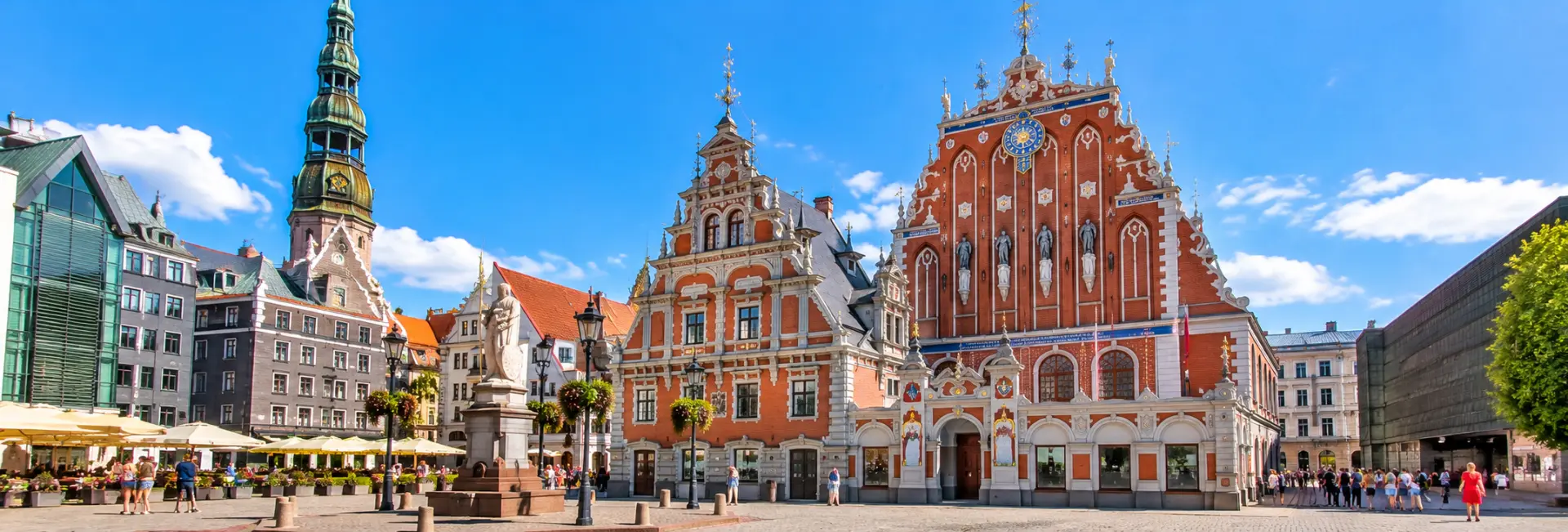
The House of the Blackheads, known in Latvian as Melngalvju nams, is one of the most striking buildings in Riga. It stands on Town Hall Square in the heart of the Old Town, where its ornate gabled facade, golden details and astronomical clock draw crowds from morning to evening. For many visitors it is the building that says "Riga" more clearly than any other.
The house began as a place for meetings and feasts in the 14th century and later became the home of the Brotherhood of Blackheads, a guild of unmarried merchants, shipowners and foreigners. Destroyed in the Second World War and rebuilt in the 1990s, it is today both a museum and a ceremonial venue for concerts, receptions and official events.
Step inside to see historic cabinets, richly decorated halls, medieval cellars and one of the biggest silver collections in the Baltic States. Even if you only have time to admire the facade, the building is a memorable stop on any walk through the city.
History
The New House of 1334
The building was first recorded in 1334 as the New House, part of the Town Hall Square ensemble. It was designed as a place where various organisations in Riga could hold meetings, banquets and celebrations. Over the following centuries the house was rebuilt and embellished many times, beginning in 1522 with carved stonework at the entrance and continuing to the late 19th century, when stone lions were placed above the entrance and a statue of St George appeared at the corner of an extension.
Around 1620 the house received the Dutch Renaissance appearance that still defines its character. In 1713 it became the exclusive property of the Brotherhood of Blackheads, and from then on it was known by their name.
Destruction
The house survived for centuries as a social and ceremonial centre, but in 1941 it was badly damaged during fighting in Riga. The building burned and was reduced to ruins, and the remains were later cleared away. For nearly half a century, Town Hall Square had a gap where one of its most beloved buildings had stood.
Rebuilding
After Latvia regained independence, the idea of restoring the House of the Blackheads took hold. Archaeological excavations began on the site in 1992, and in 1996 construction started on a new building based on the uncovered foundations and historical records. Many residents helped by donating funds toward the reconstruction. The rebuilt house was consecrated on 9 December 1999.
A saying once written on the building's gate was fulfilled by the project: if I should ever collapse, raise me up again.
The Brotherhood of Blackheads
The Brotherhood of Blackheads was an association of mostly German merchants, shipowners and foreigners, many of them unmarried, who lived and traded in Riga. They used part of the house for meetings from the 15th century and, in the 17th century, became its sole occupants. Their name and emblem come from their patron saint, St Maurice, a Roman commander who was martyred. The head of a Black Moor became their symbol and was included in their coat of arms.
The Blackheads were known for lively gatherings. Their festivals, banquets and balls made the house the social centre of the city for generations, and they used it to welcome distinguished guests and trade partners. They were also generous donors, and the wealthiest members gave silver goblets, candleholders and dinner sets to their house and churches.
The brotherhood itself faded away in the 20th century. Its name remains in the building, and the figure of the Black Moor is a common motif that you can spot in decoration and souvenirs around the house.
Architecture and Facade
The House of the Blackheads is a Gothic building with a highly decorative Dutch Renaissance facade. The front rises in steps and gables, with sculpted detail, gilded accents and a rhythm of windows that makes the narrow frontage feel theatrical. The overall effect is rich, ornamental and unmistakably tied to the wealth of a Hanseatic trading city.
What to Look For
- The astronomical clock - high on the facade, it shows not only the time but also the phases of the moon, the zodiac, the date and the month.
- Coats of arms - the arms of Riga appear alongside those of the Hanseatic cities Bremen, Lübeck and Hamburg, a reminder of Riga's trading connections.
- Allegorical figures - statues including Neptune, god of the seas, Mercury, god of merchants and travellers, and figures representing Concord and Peace express the values of a trading community.
- Lions and St George - 19th-century additions that give the corners and entrance extra character.
- The doorway - the entrance carries inscriptions and carved details that reward a closer look.
The building you see today is a reconstruction, built to match the form it had before the war. Its materials and craftsmanship are modern, but the design follows the historic building closely, and it takes a trained eye to notice that it is not centuries old.
Inside the House
The museum exhibition guides visitors through the history of the building, the brotherhood and the city. Rooms are furnished and decorated in the styles of different periods, so the visit feels like moving through time.
Historical Cabinets and the Salon
The historical cabinets are arranged in the style of a 19th-century interior. They are said to be where the brotherhood's council met, made key decisions and reviewed its accounts. The Salon, the smallest hall in the house, was restored in 2020 in a style typical of the late 19th and early 20th centuries.
The Blue Guard Hall
This hall recalls the Blue Guard, a cavalry company founded by merchant journeymen in 1720. Named for their light blue uniforms with silver trim, the guards mostly took part in processions that welcomed and escorted nobles, and they gained military importance again after Napoleon's invasion of Russia.
The Celebration Hall and Lübeck Hall
The luxurious Celebration Hall, with royal portraits in carved wooden frames, has hosted concerts by renowned musicians. The historic Lübeck hall and a gallery of composers are also open to visitors.
Medieval Cellars
The cellars were built with the main building in 1334 and are the only parts that survive in their original medieval form. Merchants once stored wine, grain, leather, flax, honey and wax here, and the brotherhood is said to have kept its wine reserves and treasures in the vaults.
The Silver Collection
One of the largest silver collections in the Baltic States is displayed in the historical cabinets. It includes gifted and purchased pieces and shows how wealthy Blackheads donated fine silver to their house.
Ways to Experience It
Self-Guided Visit
Most visitors explore the museum at their own pace. An audio guide is available in more than a dozen languages, including English, German, French, Finnish, Estonian and Latvian, and it adds context to each room. The number of devices is limited, so ask on arrival.
Guided Tours
Guided tours of about an hour can be arranged in advance, in Latvian or English and in other languages by request, and they are a good choice if you enjoy stories and legends. Tours outside regular opening hours are also possible by arrangement.
Refreshments and Special Occasions
A portable cafe called the Roll Bar serves hot drinks and snacks before, during or after a visit, and combined tickets with coffee or a glass of sparkling wine are sometimes offered. The house also hosts concerts, receptions, weddings and photo sessions, so you may find the Celebration Hall in use for a special event.
Admiring the Exterior
Many people never go inside and simply enjoy the facade from Town Hall Square. Spend a few minutes studying the clock, statues and coats of arms, then walk around the corners to see the side details.
Best Time to Visit
The House of the Blackheads is open year-round, and the experience changes with the seasons. Spring and early autumn offer pleasant weather, golden light on the facade and fewer crowds than midsummer.
Summer is the busiest time, when Town Hall Square fills with tourists and outdoor cafes. Visiting soon after opening gives you the best chance of enjoying the interior and taking photographs without crowds.
In winter, the square becomes especially atmospheric, with festive lights and decorations around the holiday season. The museum offers a warm break from the cold, though the days are short, so plan your visit for the daylight hours. Special events and private functions can affect the museum's schedule, so it is wise to check before you go.
Visitor Tips
- The museum has been open daily in recent seasons, but hours change on certain dates and during private events. Check the official website for current opening times and closures before you travel.
- Ticket types include adult, discounted, family, group and audio guide options, and some offers include a drink. Prices change, so confirm them on the official site.
- Allow between 45 and 90 minutes to see the interior and enjoy the exhibition at a comfortable pace.
- Guided tours need to be booked in advance, especially if you want a tour in English or outside regular hours.
- Accessibility arrangements and special entry conditions are published on the official site, and you can contact the venue in advance if you have mobility needs.
- Photography policies may vary by room, so look for signs and ask staff if you are unsure.
- Car parking is available on the embankment, about 300 metres away, but the Old Town is easiest to explore on foot.
Nearby Attractions
The House of the Blackheads sits at the centre of Riga's Old Town, so almost everything of interest is within an easy walk. Town Hall Square and the Riga Information Centre are right outside the door, and St Peter's Church, famous for its tower and city views, is about 150 metres away.
The River Daugava is 200 metres away, and Dome Square, with the cathedral at its heart, is 350 metres from the entrance. The Freedom Monument stands about 700 metres away, and both the international bus station and the railway station are within a 10 to 15 minute walk. Together they make the house an ideal starting point for exploring the historic centre.
FAQs about visiting the House of the Blackheads
What is the House of the Blackheads? +
It is a reconstructed medieval guild house on Town Hall Square in Riga's Old Town. It was built in the 14th century, became the home of the Brotherhood of Blackheads and now serves as a museum and event venue.
Why is it called the House of the Blackheads? +
The name comes from the Brotherhood of Blackheads, a guild of merchants, shipowners and foreigners whose emblem was the head of a Black Moor. Their patron saint was St Maurice.
Is the building original? +
No. The original was destroyed during the Second World War, and the present building was reconstructed in the 1990s and consecrated in December 1999. Only the medieval cellars survive in their original form.
How long does a visit take? +
Plan on 45 to 90 minutes to see the exhibition and halls. You can spend less time if you only want to admire the exterior.
What are the opening hours and ticket prices? +
The museum has generally been open daily, but hours vary on certain dates, and prices change. Check the official website for current times, tickets and offers.
Can I take a guided tour? +
Yes. Tours of about an hour can be reserved in advance, in Latvian, English and other languages on request. Audio guides are also available in many languages.
What is inside the House of the Blackheads? +
Visitors can see historical cabinets, the Salon, the Blue Guard Hall, the Celebration Hall, the Lübeck hall, medieval cellars and a large silver collection.
What can I see on the facade? +
Look for the astronomical clock, coats of arms of Riga and the Hanseatic cities Bremen, Lübeck and Hamburg, and statues including Neptune and Mercury.
Is the House of the Blackheads the same as the one in Tallinn? +
No. The Brotherhood of Blackheads had houses in more than one Baltic city, and the Riga and Tallinn buildings are separate sites with their own history.
What else is close by? +
Town Hall Square, St Peter's Church, Dome Square, the River Daugava and the Freedom Monument are all within a short walk.
