
Table of Contents
- Overview
- Roman Malaca and the Theatre’s Origins
- Rediscovery and the Modern Archaeological Site
- Seating, Orchestra and Stage: What to Look For
- Reuse, Materials and the Alcazaba Connection
- Interpretation and Ways to Experience the Site
- Timing, Admission and Respect for the Remains
- A Walk Through Málaga’s Historical Layers
Overview
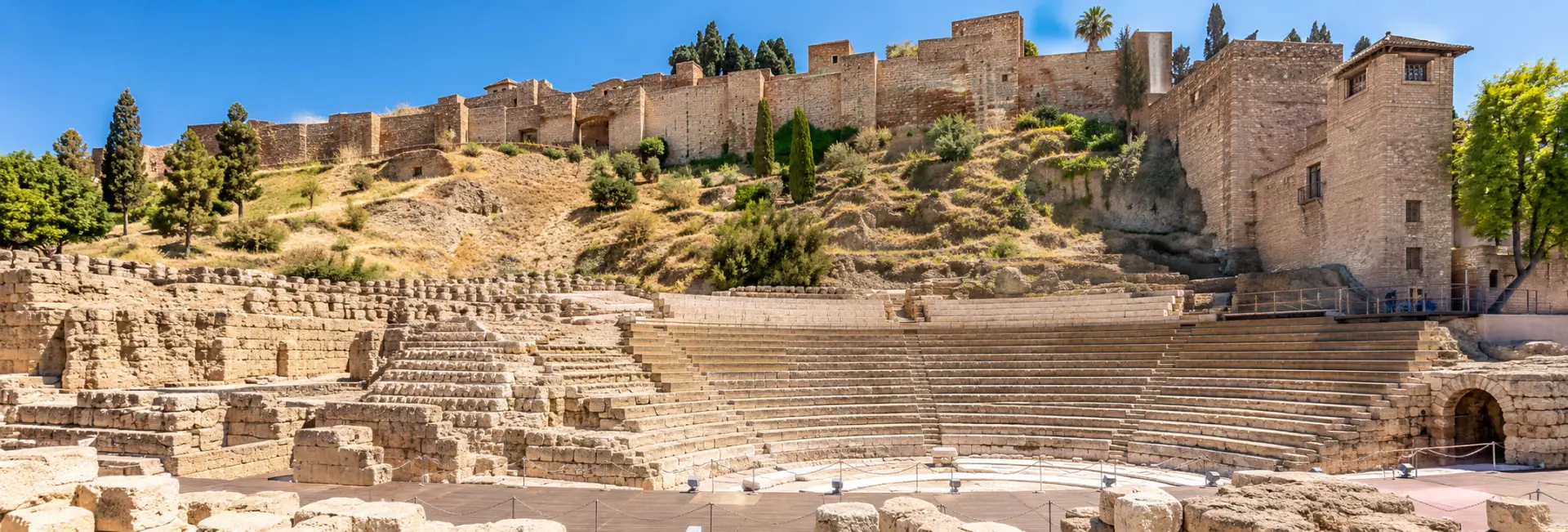
The Roman Theatre of Málaga occupies one of the city’s most revealing historic settings, directly beneath the Alcazaba on Calle Alcazabilla. Its surviving seating and performance areas make the Roman past visible within a busy modern street, with the later Islamic fortress rising behind.
That close relationship is the attraction’s defining feature. Visitors do not need to travel to an isolated archaeological park to encounter ancient Málaga; the remains form part of an everyday route through the centre. Even a short exterior look introduces the city’s layered history, while entering the site provides more context.
Allow approximately thirty to sixty minutes for a focused visit, depending on access, interpretation and your interest in archaeology. The theatre can fit easily into a wider walk, but it is worth pausing long enough to distinguish the principal parts of the building.
The aim is not to imagine that everything survives intact. The experience is about reading a partial structure and understanding how its remaining elements once worked together as a public performance space.
Roman Malaca and the Theatre’s Origins
The theatre was constructed in the early imperial period, during the age of Augustus. Its creation formed part of the public architecture through which Roman Malaca expressed civic identity. A theatre served entertainment, but also provided a setting where a community assembled and social distinctions were made visible.
Earlier baths occupied part of the area before the theatre was established. That sequence is a reminder that even the Roman site contained its own layers of redevelopment. The hillside was not simply an empty space waiting for a single monument.
The building remained in use into the Roman period before being abandoned by the third century. Later activities changed the site again, including uses connected with fish processing and, subsequently, burials. The history therefore continued after performances stopped.
Thinking in phases helps avoid a common misunderstanding of archaeological places. Ruins rarely represent one moment preserved without interruption. Here, the theatre is the most recognisable element within a longer history of construction, reuse and changing urban needs.
Rediscovery and the Modern Archaeological Site
The theatre’s modern rediscovery is associated with work in 1951 around the former Casa de la Cultura. Subsequent excavation and removal of later obstructions gradually revealed more of the ancient structure. The public view enjoyed today is the result of that recovery process.
This makes conservation part of the attraction’s story. Visitors see original remains alongside the effects of excavation, stabilisation and interpretation. The distinction does not diminish the site; it helps explain why some areas are legible while others require a plan or reconstruction drawing to understand.
Compare the surviving stonework with the explanatory material rather than assuming every visible surface belongs to the same period. An archaeological drawing may show a more complete arrangement, but it is a tool for understanding, not a claim that all those elements remain in place.
The urban setting also creates ongoing practical demands. Public access must coexist with protection of fragile remains and with the surrounding street. Temporary route changes or conservation restrictions should be seen as part of caring for an exposed site, rather than as an unexpected failure of the visit.
Seating, Orchestra and Stage: What to Look For
The curved seating area, or cavea, is the easiest part to recognise. Study how it rises with the slope and how its shape directs attention towards the performance zone. This immediately distinguishes the theatre from a random arrangement of stone terraces.
The orchestra lies between the seating and stage area. Its position helps explain how different parts of the audience and performance space related to one another. Use the visitor interpretation to identify the boundaries, especially where surviving surfaces do not form a complete outline.
The stage remains require more imagination because the full architectural backdrop no longer stands. Look for the footprint and surviving structural elements rather than expecting a complete façade. A plan can be especially helpful for connecting low remains with the larger building that once occupied the space.
- Identify the curved audience area first.
- Locate the space between the seating and stage.
- Compare surviving remains with the site plan.
- Notice how the hillside supports part of the structure.
- Distinguish ancient fabric from modern visitor infrastructure.
Once those relationships are clear, smaller details become easier to place. A few minutes of orientation can make the whole visit substantially more rewarding.
The audience arrangement also offers a way to think about Roman society. A theatre brought people together while assigning different positions within a carefully organised space. The surviving layout can therefore be read as an expression of social order as well as a solution to the practical problem of seeing a performance.
Try viewing the site from both a broad public vantage point and the permitted archaeological route. From outside, the curved form is easy to recognise; closer in, the relationship between levels and surfaces becomes more apparent. Neither perspective replaces the other. The first explains the monument’s place in the city, while the second helps turn its outline into a building designed for particular actions. Using both makes a short visit more informative without requiring a longer excursion.
Reuse, Materials and the Alcazaba Connection
The proximity of the Alcazaba encourages visitors to think about how later societies used earlier remains. Roman architectural materials were reused in subsequent construction, including elements incorporated into the fortress. This is an important connection between the two monuments, beyond their striking appearance in the same photograph.
Reuse should not be understood only as destruction. Across long urban histories, available materials were valuable resources, and buildings changed as political and practical needs changed. The theatre’s survival is consequently partial, while some of its former components entered another architectural life.
The broader site also preserves evidence of activities that followed the theatre’s abandonment. Fish-processing remains in the surrounding archaeological area point towards the economic life of ancient Málaga, complementing the civic story told by the performance building.
For visitors, the most useful question is how the same location could serve different purposes over time. Asking that question connects the theatre, later occupation and the fortress above into a coherent urban story. It is more revealing than treating each period as a completely separate chapter with no overlap.
Interpretation and Ways to Experience the Site
The interpretation centre provides an entry point into the archaeology and the history of Roman Málaga. Use it to establish what survives and where to look before entering the open remains. A small amount of explanation can prevent a short visit from becoming only a photograph of the seating.
There are two distinct experiences: viewing the theatre from the public street and following the authorised route inside. The exterior is convenient for orientation, while access to the archaeological enclosure depends on its own opening arrangements. Do not assume that visibility from outside means the site is always open.
A self-guided visit works well for travellers comfortable using a plan and concise interpretation. Guided options, when offered, can add detail about excavation and changing uses. Verify arrangements directly rather than assuming a tour is included with ordinary access.
With children, begin with the purpose of the building: where people sat, where they watched and how many directions an audience could look. The basic spatial question is often more accessible than a long explanation of Roman chronology or architectural terminology.
Timing, Admission and Respect for the Remains
The regional authority publishes the current visitor arrangements, including opening days, closure dates and booking guidance. The site is listed with free admission, but that should still be reconfirmed before publication or travel. Free access does not mean unrestricted hours or permission to enter every part of the ruins.
An earlier visit can be comfortable during hot periods because the archaeological area is outdoors. In cooler weather, allow for rain or wind and remember that exposed stone may require careful footing. Carrying water is sensible when combining the theatre with the uphill Alcazaba visit.
Keep to the designated walkways and do not climb on seating or masonry unless the authorised route explicitly allows it. Archaeological stonework is not ordinary street furniture. A photograph should never require touching fragile remains or crossing a barrier.
For access needs, ask the operator about the current visitor route, thresholds and viewing options. The street-level outlook may offer a useful alternative for some visitors, but it should not be presented as equivalent to full access. Confirm the experience that will actually be available to your group.
A Walk Through Málaga’s Historical Layers
The Alcazaba is the most natural next visit, because the theatre sits directly below its approach. Together they show a strong contrast between an open public performance space and a defended palace complex. Allow separate time and admission planning for the fortress.
The Picasso Museum offers another way to encounter ancient remains beneath a later building, as well as a major modern-art collection. Pairing it with the theatre can create a day organised around the layers of the city rather than a single historical period.
Málaga Cathedral is also within the central walking area and introduces the city’s later Christian monumental history. Choose a manageable combination rather than attempting every major interior in one sequence. Time spent walking between sites helps make their geographical relationship meaningful.
Calle Alcazabilla itself deserves a pause. Standing back to see the theatre with the Alcazaba above gives a concise visual introduction to Málaga’s past. After exploring the details, returning to that broad view is an effective way to bring the visit together.
FAQs about visiting the Roman Theatre of Málaga
Is the Roman Theatre free to visit? +
The regional authority lists free admission. Recheck current access conditions and opening days before travelling.
Can I see it from the street? +
Yes. Exterior views are possible from Calle Alcazabilla, while entry to the enclosure follows its own schedule.
How long should I allow? +
Around thirty to sixty minutes is a useful estimate for the interpretation and archaeological route.
Is it part of the Alcazaba ticket? +
Treat it as a separate attraction with separate access arrangements, even though it sits beside the fortress approach.
Is the theatre still complete? +
No. The surviving remains reveal the principal layout, while interpretation helps explain missing elements.
What is the best nearby pairing? +
The Alcazaba is the most immediate historical companion; the Picasso Museum and cathedral are also close.
