
Table of Contents
- Overview
- A Square with Several Historical Identities
- The Torrijos Monument and Civic Memory
- Picasso’s Birthplace and the Difference Between Museums
- Architecture, Perimeter Walks and Everyday Atmosphere
- Ways to Experience the Square
- Timing, Accessibility and Practical Tips
- Nearby Attractions and a Picasso-Themed Walk
Overview
Plaza de la Merced is one of Málaga’s best-known historic squares, combining a strong Picasso connection with a prominent civic monument and an active public setting. It works both as a destination and as a place to pause while moving between the northern old town and Calle Alcazabilla.
The square rewards a visit that looks beyond its cafés. The central obelisk, the surrounding façades and the Picasso-related sites give it several distinct layers of meaning. A short circuit is often enough to identify those layers, while a museum visit can turn the stop into a longer cultural outing.
There is no single compulsory route. You can begin with the central monument, walk around the perimeter and then decide whether to enter the Birthplace Museum. That flexibility makes the square useful for companions with different interests or energy levels.
Allow about twenty to forty minutes for the public space itself, with additional time for any indoor attraction or meal. These are planning estimates, not official visit durations.
A Square with Several Historical Identities
The square has carried different names and roles over time, including associations with market activity and with the liberal figure Rafael del Riego. Those changes reflect the way public spaces acquire political and social meanings rather than remaining fixed in one identity.
By the nineteenth century, it was an important urban setting, and the monument to General Torrijos gave its centre a powerful commemorative focus. The square also became closely associated with Picasso through his birthplace on its edge. These histories overlap without being the same story.
A useful way to understand the place is to separate its functions: space for trade and movement, a setting for civic memory, and a location within an artist’s biography. The present-day terraces and pedestrian activity add another layer rather than replacing the earlier ones.
Look at how the open centre and built perimeter work together. A square needs room for gathering, but it also depends on the buildings that define its edges. Walking around those edges can reveal more of its character than crossing diagonally and leaving immediately.
The Torrijos Monument and Civic Memory
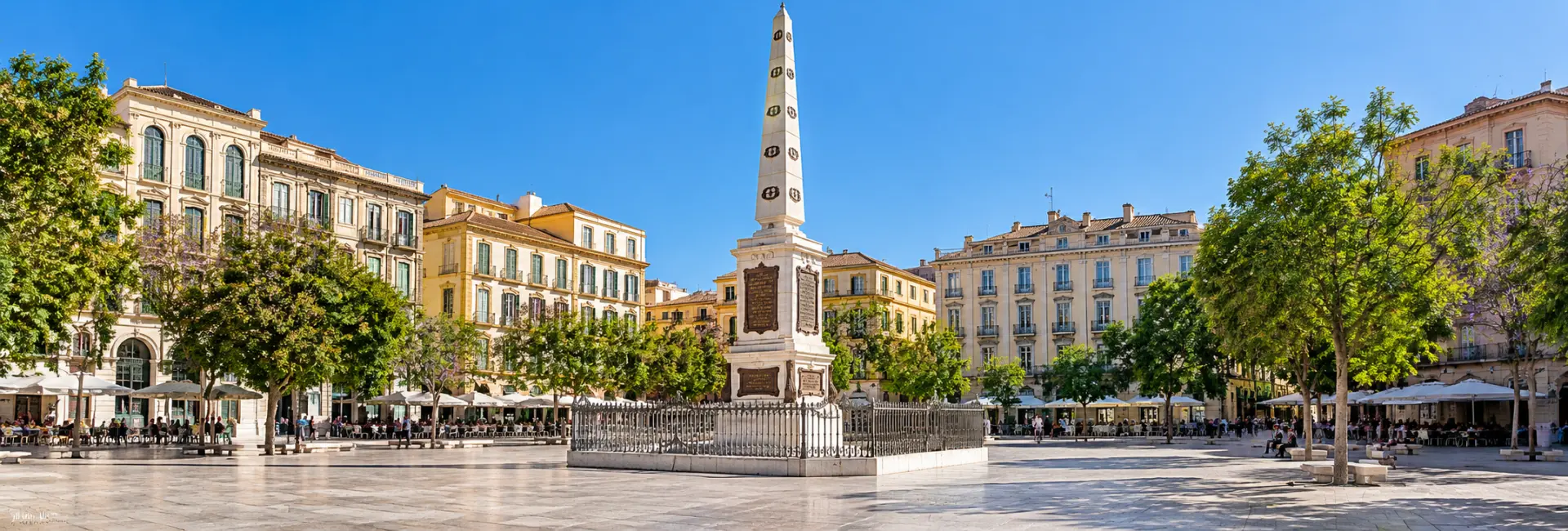
The obelisk commemorating General Torrijos has stood in the square since 1842. It is the principal visual anchor, giving the open space a clear centre and a historical subject distinct from Picasso. Visitors often notice it first without stopping to consider what it represents.
Read the inscriptions where accessible and consider the role of a public memorial. Such a monument does more than identify an individual; it establishes a place where a city expresses memory and values. That function helps explain why it occupies such a prominent position.
A respectful visit does not require specialist knowledge of nineteenth-century politics. Begin with the person named, the commemorative date and the way the monument directs attention upward. More detailed historical interpretation can then be added through reliable local material.
Avoid treating the structure merely as a convenient backdrop or climbing feature. Keep the base and surrounding circulation clear, and take photographs from a position that includes the relationship with the square. The setting is part of the monument’s meaning.
Picasso’s Birthplace and the Difference Between Museums
Picasso was born in Málaga, and the house associated with his birth stands on Plaza de la Merced. The Birthplace Museum provides the strongest reason for art-minded visitors to spend longer here, developing the connection between the artist and his family’s local setting.
This is not Museo Picasso Málaga in Buenavista Palace. The two institutions have different addresses and purposes, so check the name carefully when booking or following navigation. Visiting one does not automatically mean that you have visited the other.
The square also contains a seated bronze sculpture of Picasso, installed in 2008 and made by Francisco López Hernández. It offers an accessible point of contact with the artist’s public image, but should be understood as a later commemorative work rather than a historic object from his lifetime here.
Use the outdoor setting to establish context before entering a museum. The scale of the square, the relationship between home and public space, and the surrounding streets are things a gallery label cannot fully convey. At the same time, avoid assuming that every modern detail reproduces the square Picasso knew.
Architecture, Perimeter Walks and Everyday Atmosphere
A circuit around the square reveals how the façades establish a continuous public room. Look at the rhythm of balconies and windows, the corners where streets enter, and the way ground-floor businesses connect the buildings to present-day activity. These details are easy to overlook when attention stays on the centre.
The experience changes depending on where you stand. From the edge, the obelisk and open space form a broad view; from nearer the centre, the surrounding buildings become the main subject. Trying both positions gives a fuller understanding of the square’s proportions.
Cafés and terraces are part of the atmosphere, but they are not the whole attraction. You can enjoy the public space without making a purchase, or choose a table if you want time to observe it more slowly. Check the menu and seating conditions before settling down.
The square remains part of a residential and commercial neighbourhood. Keep that everyday use in mind, particularly when visiting in a group or later in the day. A place associated with a famous artist is still a shared local space.
Ways to Experience the Square
A short self-guided visit can follow three simple stops: the Torrijos monument, the Picasso sculpture and the exterior of the Birthplace Museum. This gives the square a clear narrative without requiring a long historical lecture. Add the museum if you want greater depth.
Photography works best when it records a relationship rather than an isolated object. Include the square around the obelisk or the surrounding setting around the Picasso sculpture, while avoiding intrusive images of people seated nearby. Wait for a suitable moment rather than asking ordinary users of the space to move.
For families, the square can provide a manageable break between indoor attractions. Use a short observation task, such as comparing the tall monument with the seated sculpture, to introduce the different ways a city remembers people. Keep children clear of busy crossing points and café service routes.
A guided old-town walk may also include the square, but confirm how much time is allocated and whether museum entry is part of the booking. Passing through the plaza is different from a visit focused on Picasso’s biography.
The two principal commemorative forms offer a particularly clear comparison. The Torrijos monument rises above the viewer and organises the square around a vertical marker; the seated Picasso sculpture brings a famous figure closer to the scale of an ordinary encounter. Their different effects can be appreciated without ranking one above the other.
Ask how your behaviour changes near each. One may encourage standing back to take in the whole structure, while the other invites a closer look at expression and pose. These are design choices that influence how public memory is experienced. Including both in the same short walk gives the plaza a richer identity than describing it only as a Picasso stop, while still recognising why the artist’s connection draws so many visitors to this particular place.
Timing, Accessibility and Practical Tips
Choose the time according to the experience you want. A quieter period may suit architecture and reading inscriptions, while a busier one reveals more of the square’s social life. Heat, shade and available seating can affect how long you want to stay.
The public square does not require an admission ticket, but the surrounding museums and venues have their own schedules. Check those first if an indoor visit is central to your plan. It is easy to arrive at a pleasant public space and discover that the specific institution you intended to see is closed.
For visitors with mobility needs, consider the approach streets and the entrance to any museum separately from the square itself. Contact the relevant venue about step-free entry, facilities and assistance rather than relying on the openness of the plaza as evidence of complete accessibility.
- Use a clear meeting point if companions separate.
- Keep bags attended at terraces and during photographs.
- Leave space around memorials and museum entrances.
- Confirm the correct Picasso museum before booking.
- Allow extra time when public events affect the square.
Nearby Attractions and a Picasso-Themed Walk
Calle Alcazabilla leads towards the Roman Theatre and Alcazaba, making those monuments natural companions to the square. The change from an open civic space to the archaeological setting is especially rewarding because the distance is modest but the historical atmosphere changes substantially.
The Church of Santiago and Museo Picasso Málaga can form part of a Picasso-related route through the centre. Such a walk works best when it distinguishes documented biographical places from later institutions created to study and celebrate the artist. Both are meaningful, but in different ways.
The Cervantes Theatre is another cultural landmark in the surrounding area. A performance requires separate planning, while an exterior look can fit into a casual neighbourhood walk. Check the actual programme rather than assuming that a show will be available at a convenient time.
For a balanced half-day, choose the Birthplace Museum or the larger Picasso Museum as the main indoor stop, then add the square and one historical attraction. This leaves enough time to enjoy the streets between them and avoids turning the Picasso connection into a rushed sequence of names.
FAQs about visiting Plaza de la Merced
Was Picasso born on Plaza de la Merced? +
His birthplace is associated with the house on the square that now forms part of the Birthplace Museum.
Is the Birthplace Museum the same as Museo Picasso Málaga? +
No. Museo Picasso Málaga is in Buenavista Palace on Calle San Agustín.
What is the central obelisk? +
It is the monument to General Torrijos, placed in the square in 1842.
Is the square free to visit? +
Yes. Indoor museums, food and other services have separate charges or conditions.
How long should I stay? +
Allow roughly twenty to forty minutes for the square, plus time for a museum or meal.
What is nearby? +
The Roman Theatre, Alcazaba, Church of Santiago and Cervantes Theatre can be included in a surrounding walk.
