
Table of Contents
- Overview
- From Nasrid Shipyard to Municipal Market
- The Gateway, Iron Hall and Architectural Contrast
- Exploring the Stalls and Seasonal Produce
- Eating at the Market and Making Good Choices
- Market Etiquette and Responsible Photography
- Timing, Accessibility and Practical Planning
- Nearby Streets and a Food-Focused City Walk
Overview
Atarazanas Market combines everyday food shopping with a striking historic building. It is a working municipal market, so its appeal comes from activity as much as architecture: produce is selected, fish is prepared and regular customers move through the aisles with a purpose.
The building brings together two very different periods. A surviving Nasrid gateway recalls the site’s medieval shipyard, while the market hall belongs to nineteenth-century urban development. That combination makes the visit worthwhile even for travellers who do not plan to buy a full basket of ingredients.
Approach it as a place of trade that welcomes interested visitors, rather than a food-themed museum. The best experience comes from looking carefully, allowing customers space and purchasing something if a stall interests you. A short, respectful visit can reveal more than a long stop that blocks the working aisles.
Allow about forty-five minutes to an hour for an initial look, with extra time if you intend to eat. Check the current trading schedule before arranging the rest of the day around it.
From Nasrid Shipyard to Municipal Market
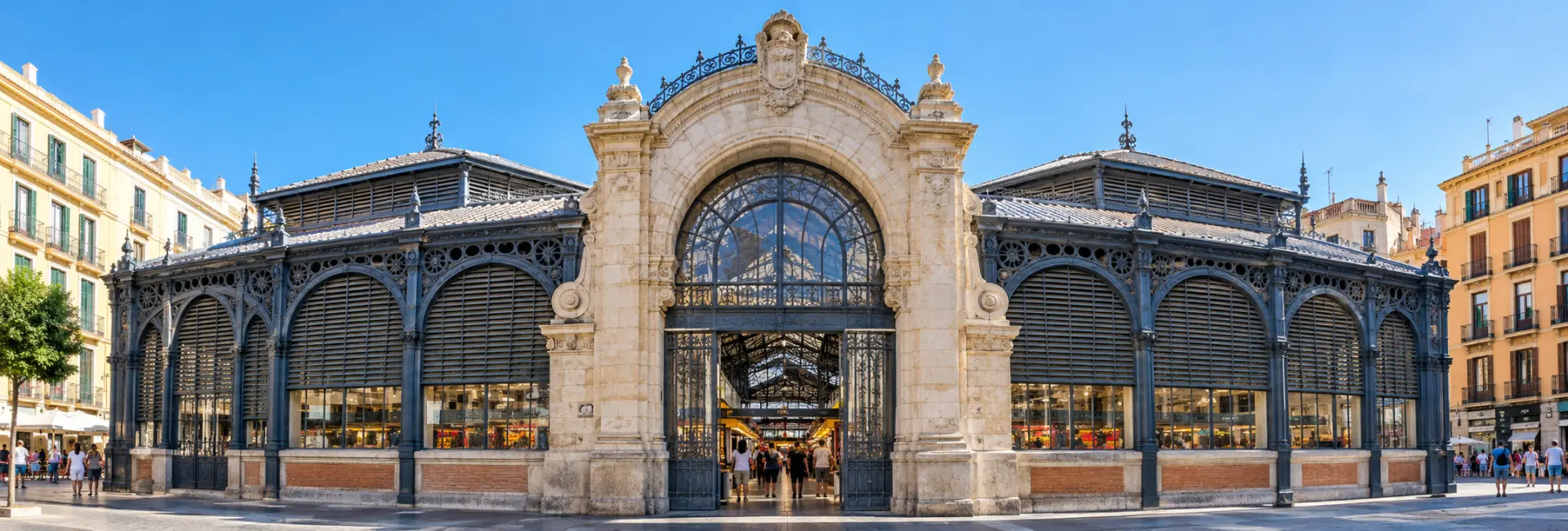
The name Atarazanas is connected with the site’s former shipbuilding role. In the fourteenth century, this was a Nasrid shipyard, and the monumental marble entrance is the most recognisable surviving element from that earlier use. The present inland setting can make that maritime history surprising.
The later market was designed by Joaquín de Rucoba and opened in 1879. Retaining the historic gateway connected the new public building with its predecessor, while the rest of the design answered a different purpose: providing a covered place for the city’s food trade.
This is a useful example of how Málaga’s urban landscape changed over time. The relationship between the city and water was reshaped, and a location associated with shipbuilding became part of the commercial centre. The building’s story therefore reaches beyond the objects sold inside it.
Rather than trying to imagine a complete medieval shipyard still present, focus on what genuinely survives. The gateway is a historic fragment incorporated into a later structure, and that act of preservation is central to the market’s identity.
The Gateway, Iron Hall and Architectural Contrast
Begin outside with the marble gateway before entering the market. Its form and material differ from the later hall, making the change in period visible without specialist knowledge. Give yourself enough distance to see how the entrance has been integrated into the larger façade.
Inside, the iron structure creates a different architectural language. The framework allows the hall to function as a covered commercial space, with an openness suited to movement and trading. Look upwards briefly to understand the structure, then return your attention to the people moving around you.
The large glazed feature at the opposite end adds colour and a visual focus to the interior. Its effect changes with light, but a photograph should be taken from a position that does not interrupt queues or stall access. The market’s architecture is best enjoyed without forgetting its daily function.
Compare the two types of craftsmanship: carved historic stone at the entrance and the repeated structural elements of the later hall. This contrast gives the building a distinctive character and helps explain why it is more than a convenient place to buy groceries.
The market is organised into three principal halls within a slightly trapezoidal plan. That arrangement is useful to notice when orienting yourself: a broad first circuit makes it easier to return to a stall without repeatedly crossing through the same busy point. Look at the structural divisions above as well as the products below.
A restoration carried out between 2008 and 2010 sought to recover the building’s original design. This later work is part of why the architecture can be appreciated so clearly alongside active trading. It also illustrates the challenge of conserving a building that must continue to function every day. The market cannot be treated only as a fragile historic shell, nor can its history be ignored in favour of convenience; the visit reveals that balance in a very direct way.
Exploring the Stalls and Seasonal Produce
A market visit becomes more interesting when you look for differences rather than expecting a fixed list of foods. The available produce depends on season, supply and individual traders. Notice what appears in abundance, how it is displayed and which stalls are busiest with local customers.
Fish, fruit, vegetables and other food products provide an introduction to the city’s everyday eating habits. The most useful questions are practical: what is in season, how is it prepared and what quantity is appropriate? If a trader has time, a simple polite question can add more value than photographing every display.
Avoid assuming that all food sold in the market is locally caught or grown. Origin labels and direct questions are more reliable than the setting alone. A historic market can sell goods from many places, just as it can serve both residents and visitors.
If buying ingredients, consider how they will be stored and used. Perishable purchases are best made with a clear plan rather than carried through a long afternoon of sightseeing. A smaller purchase that suits your accommodation is usually more practical than buying solely for the photograph.
Eating at the Market and Making Good Choices
Food and drink stops can be part of an Atarazanas visit, but they should not replace a look at the trading hall. Start by walking through the market, then decide whether you want a snack or a more substantial meal. This makes the visit feel connected to the place rather than only to a table.
Read menus and prices before ordering, especially for items whose cost may depend on weight, portion or preparation. Ask for clarification if something is unclear. Busy service is easier for everyone when expectations about quantity and cost are settled early.
For visitors with dietary restrictions, discuss ingredients directly with the vendor. A visual inspection is not enough to establish what is in a prepared dish or whether shared preparation surfaces are relevant. Do not rely on a general description of local cuisine for an individual food decision.
Allow space for people collecting orders and paying. A popular counter may have limited room, and lingering after finishing can obstruct the next customer. If you want a long, quiet meal, assess whether the particular venue and time of day suit that expectation.
Market Etiquette and Responsible Photography
Atarazanas works best for visitors when ordinary shopping can continue around them. Move to one side before checking a map or discussing what to buy, and avoid forming a group across an aisle. The space belongs to the market’s customers and traders as well as to sightseeing visitors.
Ask before taking close photographs of a trader or their work. A broad architectural image and a close image of someone’s face are different situations. If permission is declined or the stall is busy, move on without pressing the request.
- Join the apparent queue and watch how service is organised.
- Do not handle produce unless invited to do so.
- Keep bags from knocking displays or other customers.
- Ask prices and quantities before committing to a purchase.
- Step aside to eat where stopping is permitted.
A respectful approach often produces a more memorable visit because it allows genuine interaction. The objective is not to obtain an image of local life while interrupting it, but to understand something of how the market functions.
Timing, Accessibility and Practical Planning
Plan around the current market trading hours rather than the opening pattern of nearby restaurants. A morning visit is generally the most useful approach for seeing the food trade, but check the official municipal information for the exact day and schedule. Individual traders may finish at different times.
Arrive with a flexible shopping budget and a payment alternative. Do not assume that every stall accepts the same cards or that all purchases can be handled in the same way. Small transactions are easier when you are prepared for the trader’s preferred arrangement.
Visitors with mobility or sensory needs should consider crowding as well as the building entrance. A route that is manageable when quiet may be more difficult when queues narrow the aisles. Contact the market or municipal service for specific access information if required.
Navigate to the market building on Calle Atarazanas and identify the main entrance before following the flow into the hall. If meeting companions, agree whether the meeting point is outside the historic gateway or inside; a busy food market is easier to enjoy when nobody is trying to locate the rest of the group among the stalls.
Nearby Streets and a Food-Focused City Walk
The market fits naturally into a walk through the western side of the historic centre. From here, Calle Marqués de Larios and Plaza de la Constitución offer a contrasting commercial streetscape, while smaller surrounding lanes provide a more intimate view of central Málaga.
If the market is your main food stop, keep later meal plans flexible. A tasting or snack may be enough, or it may lead naturally into lunch. Avoid booking a large meal immediately afterwards simply because the market appeared to be only a short sightseeing stop.
For a cultural continuation, the Carmen Thyssen Museum is a useful pairing. Its focus on Spanish painting provides a different perspective on everyday scenes and regional imagery, without requiring a long journey across the city. Check museum admission separately.
A pleasant sequence is to visit the market while trade is active, walk through the centre and choose one museum or monument afterwards. This keeps the day varied and gives the market an appropriate place in the itinerary: an active part of the city rather than a decorative pause between larger attractions.
FAQs about visiting Atarazanas Market
Is Atarazanas a working food market? +
Yes. Respect shoppers, traders and queues while exploring the building.
What is the medieval part of the building? +
The monumental marble gateway survives from the Nasrid shipyard that previously occupied the site.
When should I visit? +
Plan for a trading morning and verify the official schedule for your chosen day.
Can I eat at the market? +
Food stops are available, but check the venue, menu, price and service arrangements before ordering.
Do I need to buy something? +
There is no need to make a purchase simply to appreciate the building, but avoid obstructing trading activity.
Should I bring a payment alternative? +
Yes. Check the stall’s payment options rather than assuming every trader accepts the same cards.
