
Table of Contents
- Overview
- A Nineteenth-Century Change to the City
- Reading the Architecture Above the Shops
- Plaza de la Constitución and the Street’s Two Ends
- Shopping, Browsing and Everyday Public Life
- Celebrations and the Changing Street Scene
- Walking Comfort, Access and Visitor Tips
- Nearby Attractions and a Short Old-Town Circuit
Overview
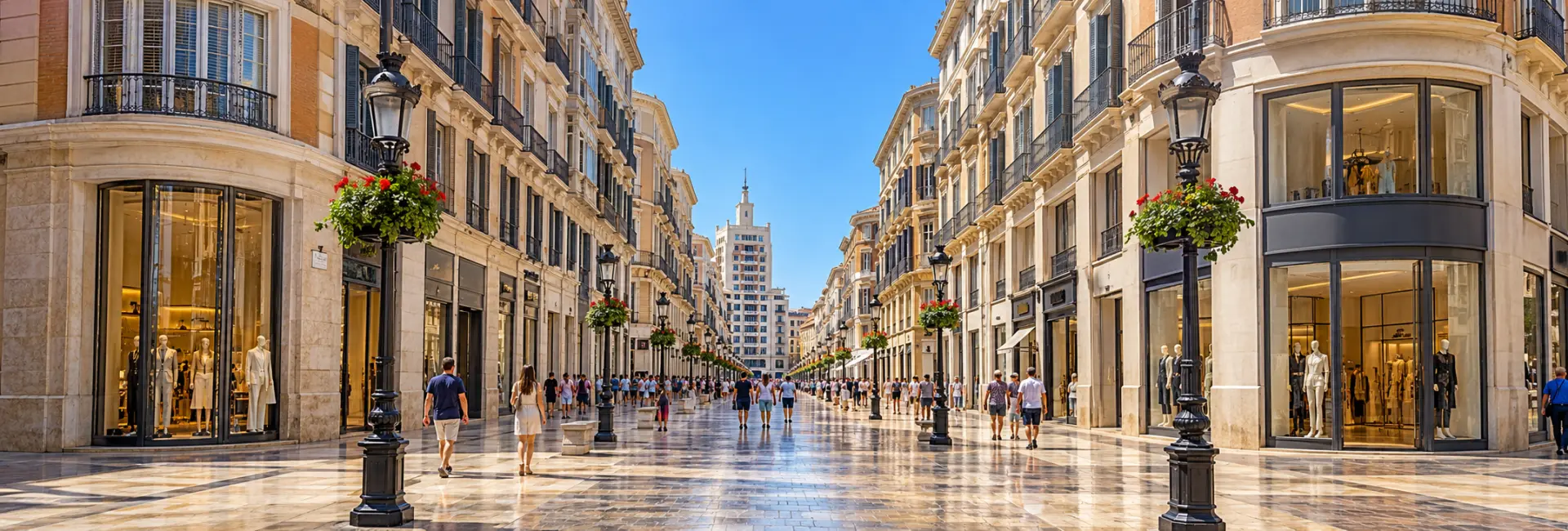
Calle Marqués de Larios is one of Málaga’s most recognisable public spaces. Usually shortened to Calle Larios, it forms a clear pedestrian route into the historic centre, with a consistent architectural character that distinguishes it from the smaller lanes nearby.
Shopping is an important part of its present-day role, but the street is also worth visiting as an example of urban design. The width, repeated façades and long view towards Plaza de la Constitución create a more formal setting than much of the surrounding old town.
It takes only a short time to walk along the street without stopping. A more rewarding visit allows time to look above the shopfronts, enter the square at the northern end and explore one or two side streets. The attraction lies in the relationship between these spaces rather than in a single ticketed landmark.
For first-time visitors, Calle Larios is also a useful orientation line. Once you recognise its position between the southern centre and the main square, the surrounding street network becomes easier to navigate.
A Nineteenth-Century Change to the City
The street was inaugurated in 1891 and reflects a period when Málaga was reshaping its commercial centre. The Larios name connects it with a family closely associated with the city’s economic history. Its creation introduced a broad, deliberate urban axis into a much older setting.
That intervention is still visible in the contrast between the main street and the lanes that branch from it. Calle Larios feels planned as a complete ensemble, while nearby streets reveal a more irregular pattern of development. Walking between the two makes the change tangible.
The street’s later history includes changes to its paving and use. A major pedestrianisation project was completed in 2002, helping establish the current walking environment. What visitors experience today is therefore the result of both the original nineteenth-century project and later adaptation.
It is useful to see the street as a living piece of infrastructure rather than a preserved historical scene. Shops, public events and everyday movement continue to change, while the architectural framework gives the place a strong continuity.
One unusual detail in the street’s history is its original wooden paving. The tourism account records that flooding in 1907 displaced those wooden blocks, after which they were replaced with granite. This provides a concrete reminder that a prestigious urban project must also respond to practical conditions and unexpected events.
The story changes how you might look at the present surface. Paving is easy to overlook beside elegant façades, yet it strongly affects movement, drainage and the feel of a public street. The later pedestrian transformation continued that process of adaptation. Instead of seeing modern walking space as unrelated to history, consider it another stage in the long effort to make this central route serve the city. That perspective connects a small material detail with the larger story of Calle Larios.
Reading the Architecture Above the Shops
The most common mistake is to look only at eye level. Shopfronts compete for attention, but the upper façades reveal the visual order that makes Calle Larios distinctive. Look for repeated window arrangements, balconies and the way neighbouring buildings maintain a related scale.
A good approach is to pause at an intersection and look along the street before examining one building more closely. The long view shows the ensemble; the closer view reveals how the individual façade contributes to it. Both are needed to understand the effect.
The relatively broad pedestrian space also changes how architecture is seen. In a narrow lane, a building may be experienced in fragments, while here the opposite frontage can be viewed more comfortably. That makes the street particularly suitable for visitors interested in urban photography.
Avoid standing in the middle of the main flow while composing a photograph. Move to the side, wait for a gap and keep equipment compact. The street is an everyday route as well as a sightseeing location, and its success depends on people being able to move through it.
Plaza de la Constitución and the Street’s Two Ends
Plaza de la Constitución gives the northern end of Calle Larios a clear destination. Reaching the square changes the experience from a directed route to a broader public space, where people can pause and choose several onward directions. It is worth stepping into the square rather than turning back immediately.
At the southern end, the street connects with the busier edge of the historic centre and the routes towards the waterfront. This helps explain why Calle Larios is so useful as an orientation point: it links a major public square with the city’s outward-facing central area.
Walk the street in both directions if time allows. The architectural rhythm remains the same, but the destination and background change. A return walk can reveal details missed when the eye was fixed on the square ahead.
The side streets are equally important. They allow you to move from the formal shopping axis into more intimate parts of the old town, creating a short but varied route. Choose one or two rather than trying to explore every branch in a single pass.
Shopping, Browsing and Everyday Public Life
Calle Larios is a commercial street, but enjoying it does not require shopping. Window browsing, observing the architecture and walking between public spaces are all valid ways to experience it. This makes it accessible to visitors with different budgets and interests.
If shopping is a priority, consult current business information rather than expecting a fixed list of brands. Retail premises change over time, and opening hours can vary by day or holiday. Plan around the specific shop only after verifying that it is still present and trading.
The street’s social character is part of its interest. Residents, workers and visitors share the same route, so the pace changes during the day. A quieter morning can suit architecture, while a busier period may provide a stronger sense of public life.
Try not to use foot traffic as a measure of authenticity. A popular central street can be both a visitor landmark and a functioning part of the city. The more useful question is how its design supports movement, meeting and commercial activity within the historic centre.
Celebrations and the Changing Street Scene
Calle Larios plays a prominent role in Málaga’s public celebrations and seasonal events. Temporary decorations and event arrangements can transform its appearance, making a return visit feel different from an ordinary shopping day. Specific programmes and dates should always be checked for the year of travel.
Large events may also affect movement. A route that usually takes a few minutes can become slow or temporarily controlled when many people gather. Visitors with tight transport connections or mobility needs should allow extra flexibility rather than assuming the normal walking time still applies.
Christmas displays, festival activity and religious-season arrangements are not permanent features. Evergreen descriptions should distinguish the street’s usual architecture from temporary installations that appear only at particular times. If an event is your main reason for visiting, confirm it directly.
For photography, decide whether you want the underlying streetscape or the event atmosphere. The first may favour a quieter visit; the second requires patience with crowds and respect for any barriers. Neither experience is automatically better, but they call for different expectations.
Walking Comfort, Access and Visitor Tips
The pedestrian setting makes Calle Larios straightforward to include in a central walk, but it is still exposed urban space. Heat, rain and crowding can affect comfort. Choose appropriate footwear and allow time for breaks if combining it with several other attractions.
Visitors using wheelchairs or walking aids should consider the complete route, including the streets used to reach and leave it. A broad main street may connect with narrower lanes, uneven surfaces or crowded entrances. Check any specific business access separately from the public pedestrian route.
- Look up at the architecture as well as into the shops.
- Keep entrances and crossings clear when stopping.
- Verify seasonal events before planning around them.
- Keep personal belongings secure in dense crowds.
- Use a recognisable meeting point if companions separate to browse.
There is no admission ticket or fixed sightseeing route for the street itself. That freedom makes it useful as a flexible link between booked visits, but avoid turning it into merely a corridor. A short intentional pause often reveals more than a rushed walk through the centre.
Nearby Attractions and a Short Old-Town Circuit
The Carmen Thyssen Museum is a practical continuation from the Plaza de la Constitución area. Its Spanish painting collection provides an indoor counterpoint to the street’s nineteenth-century urban character. Admission and exhibition schedules should be checked separately.
Atarazanas Market offers a different form of commerce and is best fitted around its trading hours. Combining the market with Calle Larios makes it possible to compare a working food hall with the city’s prominent retail promenade, without treating either as the only expression of local life.
Málaga Cathedral can be included through the neighbouring historic streets. The shift from the regular commercial façades of Calle Larios to the cathedral’s monumental scale makes for a visually varied walk. Give the cathedral its own time if you plan to enter.
For a simple circuit, start near the southern end, walk to Plaza de la Constitución, explore one museum or market and return through smaller lanes. This creates a sense of discovery while retaining a clear orientation point, especially useful during a first day in Málaga.
FAQs about visiting Calle Marqués de Larios
Is Calle Larios pedestrianised? +
Yes. It is a principal pedestrian street in Málaga’s historic centre.
Does it cost anything to visit? +
No ticket is needed to walk along the street; purchases and nearby attractions are separate.
How long is the visit? +
The walk itself is short, but allow around thirty to sixty minutes for architecture, browsing and the adjoining square.
What is at the northern end? +
Plaza de la Constitución forms the main public-space destination at that end of the street.
Are seasonal displays always present? +
No. Decorations and event layouts depend on the calendar and should be checked for your dates.
What should I visit nearby? +
The Carmen Thyssen Museum, Atarazanas Market and Málaga Cathedral are useful additions to an old-town walk.
