
Table of Contents
- Overview
- A Fortress Built to Control the High Ground
- Reading the Walls and the Castle Plan
- Panoramas and Understanding Málaga from Above
- The Interpretation Centre and Later Military Life
- Getting Uphill and Choosing a Comfortable Visit
- Tickets, Conditions and Responsible Exploring
- Combining Gibralfaro with Other Málaga Attractions
Overview
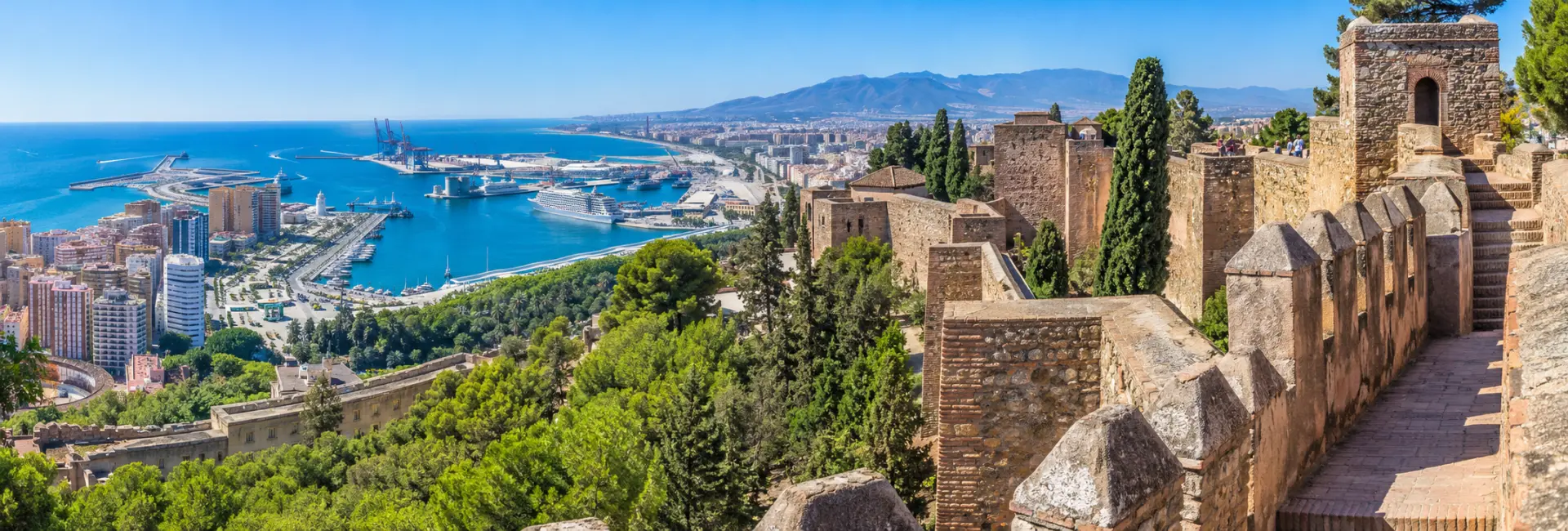
Castillo de Gibralfaro crowns the hill above Málaga’s historic centre. Its appeal lies in the combination of a strongly defended position and the wide view that position provides. Visitors come for the city panorama, but the castle becomes more interesting when the scenery is understood as part of its military purpose.
This is primarily a visit to fortifications and their setting, rather than a tour of richly furnished palace rooms. Walls, changes of level and the relationship with the landscape are central to the experience. The contrast makes it a good companion to the more intimate courtyards of the Alcazaba below.
Allow roughly an hour to an hour and a half within the castle, then add the time needed to reach it. Walking uphill can take a meaningful share of the outing, particularly in warm weather. Visitors who prefer to conserve energy for the walls should investigate road transport to the upper approach.
The hilltop location is the attraction’s great strength and its main practical consideration. Plan around heat, mobility and daylight rather than treating it as another flat old-town stop.
A Fortress Built to Control the High Ground
The development of Gibralfaro is closely connected with the protection of the Alcazaba. A palace-fortress on the lower slope remained vulnerable if an opposing force controlled the hill above it. Strengthening the summit helped address that problem and extended the defensive system overlooking Málaga.
The Nasrid ruler Yusuf I is associated with the castle’s fourteenth-century development. The fortified connection known as the coracha linked the two strongholds, making their relationship visible in the surviving landscape. It is an important historical feature, but it should not be assumed to form an open visitor passage today.
After the conquest of Málaga in 1487, Gibralfaro continued to serve military functions. That long use helps explain why its story extends beyond a single medieval episode. The interpretation centre develops the later garrison and coastal-watch history as well as the fortress’s place within the city.
Keep the historical purpose in mind while exploring. A commanding view was a tool for observation and defence before it became a reason to take photographs, and the castle’s shape makes more sense when seen through that lens.
Reading the Walls and the Castle Plan
The most revealing details are often structural rather than decorative. Look at how the walls follow the hill, how towers interrupt the line of the defences and how access is managed between areas. These features show how the builders responded to an irregular site.
A good first step is to consult the visitor plan before following the most obvious staircase. Knowing where the main route, interpretation area and exits lie helps avoid unnecessary backtracking. It also lets companions with different levels of stamina agree on a realistic circuit.
Notice how the character of the visit changes between enclosed sections and more exposed wall walks. A narrow passage limits your view, while an open stretch reveals the surrounding city. That alternation is part of the experience of a fortress and provides natural places to slow down.
Do not confuse a ruin’s open appearance with unrestricted access. Some surfaces and edges are not intended for visitors, and conservation or maintenance may close particular sections. Stay within the marked route even when an unofficial position appears to offer a slightly better photograph.
Water supply is another key to understanding the fortress. The Pozo Airón was cut into the rock, and the castle also used a system for collecting rainwater in cisterns. These features address a problem that the panoramic walls alone cannot solve: people stationed on a hill need a dependable supply within the defended space.
Look for interpretation of the water system during the visit and connect it with the practical demands of the garrison. Food preparation mattered too, and surviving ovens belong to the castle’s later military history. These less spectacular elements can be especially revealing because they shift attention from a fortress as a silhouette to a fortress as a place where people had to live. They also explain why open ground inside the walls was not simply empty space.
Panoramas and Understanding Málaga from Above
Gibralfaro provides a useful geographical overview of the city. From suitable viewpoints, visitors can connect the harbour, urban shoreline and dense historic centre with the hills behind. This makes the castle particularly rewarding early in a stay, when the city’s layout is still unfamiliar.
Use the panorama as a reading exercise rather than only a backdrop. Identify a place already visited, then follow the streets or green spaces towards the waterfront. Seeing those relationships from above can make later walks more intuitive and gives scale to places that felt close together at ground level.
For photographs, choose a composition that includes something of the fortress. A section of wall or the curve of the route provides context and distinguishes the image from a generic city view. Leave space for other visitors rather than occupying a narrow lookout for an extended session.
Visibility varies with weather, haze and light. A clear forecast does not guarantee a perfectly sharp distant horizon, and sunset plans must account for actual closing times. The view is best treated as one part of the visit, not a promise of a particular photographic result.
The Interpretation Centre and Later Military Life
The castle’s interpretation centre occupies a former powder magazine. Its subject includes the fortress’s service as a garrison and lookout after 1487, using objects and explanatory material to connect the surviving walls with the people who worked within them.
Military dress, plans, models and related material help turn an apparently empty enclosure into a place of activity. Consider what daily life required: observation, communication, supplies and routines, rather than only moments of conflict. This gives the architecture a more human scale.
The centre is especially useful if you arrive knowing little about the castle. A short visit before the walls can provide context; returning afterwards can help answer questions raised by the route. Follow the current layout and do not assume every object mentioned in older descriptions remains on display.
Families can use the models and visual material as a starting point for discussing why the hill mattered. Asking where a guard would look or how supplies might reach the summit is often more engaging than trying to remember a sequence of rulers and battles.
Getting Uphill and Choosing a Comfortable Visit
The climb from the central area is a genuine uphill walk, not simply a short transfer between neighbouring ticket desks. Before setting out, consider temperature, footwear and the energy required for the castle itself. A slow ascent with rests can be enjoyable, but it should be a choice.
Road access offers an alternative for visitors who want to avoid the steepest walking approach. Check current municipal transport information or arrange a taxi, confirming the correct destination as the castle entrance. Transport arrangements can change, so avoid relying on an old route number without verification.
If you walk up, carry water and start before the hottest part of the day when possible. The return can also be tiring, especially for knees or on surfaces with poor grip. Reaching the summit is only half the journey.
Plan the direction of the day around your companions. Taking transport uphill and deciding later whether to walk down may be more comfortable than committing to both climbs and descents in advance. Mobility limitations should be discussed with the operator because avoiding the approach does not remove steps inside the monument.
Tickets, Conditions and Responsible Exploring
Consult the municipal Alcazaba and Gibralfaro website for current admission, opening times and combined-ticket conditions. If visiting both monuments, confirm how the ticket works and whether it imposes any timing requirements. An admission package does not include an automatic transfer between them.
Earlier visits can be useful in warm weather, while cooler seasons require closer attention to daylight and closing. Wind or rain may affect comfort on exposed sections, and the appropriate decision is sometimes to shorten the route. Treat weather as part of planning rather than something to ignore once tickets are purchased.
- Use shoes suitable for uneven paving and stairs.
- Keep hands free where a handrail is useful.
- Supervise children closely along elevated routes.
- Carry water rather than depending on a particular refreshment outlet.
- Follow temporary barriers and staff instructions.
Visitors seeking step-free access should request precise information about the sections they want to see. A vehicle reaching the entrance does not make an ancient defensive circuit fully accessible. A smaller, well-chosen visit can still be worthwhile if the available route suits the visitor’s needs.
Combining Gibralfaro with Other Málaga Attractions
The Alcazaba is the most obvious historical companion, but combining both requires more energy than their position on a map may suggest. Give each its own time allocation and plan the transfer explicitly. Their different characters make the pairing rewarding when it is not rushed.
For a less demanding continuation, descend towards the waterfront and choose Málaga Park, the Palmeral de las Sorpresas or Muelle Uno. These places provide a change of scale and pace after the enclosed and elevated castle route. Looking back towards the hill also helps place the fortress within the cityscape.
The Roman Theatre can fit into the same historical theme, especially if your route passes Calle Alcazabilla. Its relationship with the Alcazaba is immediate at street level, while Gibralfaro provides the broader landscape context from above. Together they make a coherent introduction to different periods of Málaga’s history.
Avoid attaching a fixed museum booking too closely to the end of the castle visit. The descent, transport wait or an unexpected rest can take longer than planned. A flexible lunch or waterfront walk is often the more comfortable next step.
FAQs about visiting Castillo de Gibralfaro
Is Gibralfaro worth visiting for the views? +
Yes, the elevated setting is a principal attraction, although visibility and access depend on conditions.
Can I walk directly through from the Alcazaba? +
Do not plan on an internal visitor connection. Use the separate public approaches and allow transfer time.
How strenuous is the walk? +
The approach is steep enough to require planning, particularly in heat. Road transport can reduce the uphill effort.
How long is the castle visit? +
Allow around one to one and a half hours inside, plus the journey up and down.
Does a combined ticket include transport? +
Do not assume so. Verify the ticket terms and arrange the transfer separately.
Is it a furnished palace? +
No. The main experience is the fortification, wall routes, views and military interpretation.
