
Table of Contents
Overview
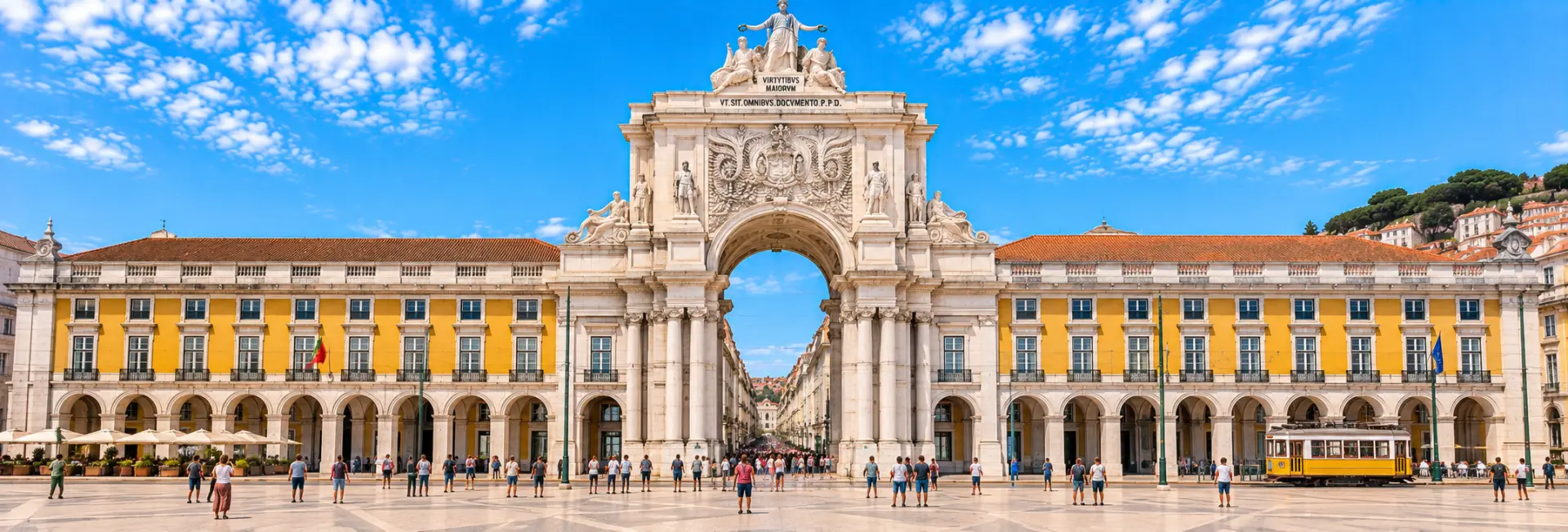
The Rua Augusta Arch, known in Portuguese as the Arco da Rua Augusta, is the ceremonial doorway between Lisbon's grandest riverside square and its busiest shopping street. Stand in Praça do Comércio and it frames the long straight run of Rua Augusta heading inland; turn around at the top of that street and it frames the Tagus. Few city monuments work this hard as a piece of urban theatre.
It is also one of the few triumphal arches in Europe that visitors can climb. Since 2013 a lift and a short stair take people up to a narrow terrace beside the rooftop statues, where the view sweeps the whole of the lower city. The arch matters for what it commemorates as much as for how it looks: it was raised to mark Lisbon's recovery from the earthquake, fire and tsunami that destroyed the city centre in 1755.
Seeing it from the square costs nothing and takes two minutes. Climbing it takes about half an hour and gives one of the most central, most affordable panoramas in Lisbon.
History
A monument born from catastrophe
On 1 November 1755, a massive earthquake followed by fire and a tsunami flattened much of Lisbon. King José I handed reconstruction to his chief minister, the future Marquis of Pombal, who oversaw the rebuilding of the entire lower city on a rational grid. The arch was conceived as the finishing flourish of that plan, closing off the new square at the point where the main axis met the river.
A century of stops and starts
The first design came from Eugénio dos Santos, the architect behind much of the Pombaline grid, and work was planned from 1759. Progress then stalled repeatedly. Pombal lost power in 1777, and the political upheaval and financial strain of the following decades left the structure unfinished for generations. Its great composite columns went up in 1815, and for years afterwards the arch rose no higher than its entablature, standing incomplete above an otherwise finished square.
Completion at last
A competition was eventually held to finish the job. Veríssimo José da Costa won it, and his revised scheme turned what had started out as a frame for the king's statue into a monument in its own right. The completed arch was finally unveiled in 1873, roughly a century after the project began, with the sculptural programme wrapping up by 1875.
Architecture & Design
The arch is neoclassical in its bones, with a heavy debt to the triumphal arches of ancient Rome, but the detailing leans towards the theatrical. It rises around 30 metres above the pavement and spans a single wide central opening flanked by smaller side passages, so pedestrian traffic flows through it rather than around it.
Six composite columns of roughly 11 metres carry the entablature, giving the monument its weight and rhythm when seen across the square. Above that sits the attic storey and the crowning sculptural group, which is what turns a large gateway into a landmark visible from the far side of the Tagus.
Two details reward a closer look:
- The Latin inscription running across the attic, VIRTVTIBVS MAIORVM, dedicates the monument to the virtues of those who came before, framed as a lesson for everyone who passes beneath.
- A large clock set into the face looking up Rua Augusta, added in the final building phase, which gave the monument a practical civic role alongside its symbolic one.
The pale limestone changes character through the day, washed flat at midday and picking up warm tones in late afternoon light. Floodlighting after dark makes the rooftop figures read sharply against the sky.
The Sculptures and What They Mean
The crowning group
The figures at the very top are the work of the French sculptor Célestin Anatole Calmels. They show Glory placing crowns on Genius and Valour, an allegory that reads as a statement about what the nation believed had carried it through disaster: inventiveness and courage, rewarded by lasting renown. Seen from the square the group is a silhouette; seen from the terrace it is startlingly large up close.
The four historical figures
Lower down, on the lateral plane, stand four statues by the Portuguese sculptor Vítor Bastos. Each represents a different chapter of the country's past:
- Viriato, leader of Lusitanian resistance against Roman expansion, standing for ancient defiance.
- Nuno Álvares Pereira, the medieval commander tied to Portugal's securing of independence from Castile.
- Vasco da Gama, the navigator whose sea route to India opened the age of Portuguese maritime expansion.
- The Marquis of Pombal, the minister who rebuilt the city the arch stands in.
Flanking allegorical figures represent the Tagus and the Douro, the two rivers that anchor Portugal's north and south. Taken together, the programme compresses roughly two thousand years of national self-image into a single facade.
Climbing to the Terrace
The entrance is not in the archway itself but through a side door on Rua Augusta, where the ticket desk sits inside a small shop at street level. From there a lift carries visitors up to the intermediate floor.
That middle level, sometimes called the clock room, holds a compact exhibition on how the arch was built and how the clock mechanism worked. It is worth a few minutes, partly for the context and partly because it breaks up the climb.
The last stretch is on foot: a tight spiral staircase of around seventy-odd steps leads out onto the terrace. Space at the top is limited, with room for only a small number of people at once, which keeps the atmosphere calmer than the numbers below might suggest.
What you get from up there is a genuine 360-degree view. Praça do Comércio lies directly below with the equestrian statue of José I seen from an angle almost nobody photographs. The Tagus opens out to the south, São Jorge Castle sits on its hill to the east, and Rua Augusta runs north in a straight line of patterned cobblestone towards Rossio, with the grid of Baixa spread out on either side.
Ways to Experience It
The arch suits several different kinds of visit, and they are not mutually exclusive.
- From the square: free, and the best place to take in the full facade and its sculptures at a distance.
- Through the archway: walking beneath it between Praça do Comércio and Rua Augusta is how most people first encounter it, often without stopping.
- The terrace visit: a paid ticket that combines the small exhibition with the rooftop panorama, usually done in twenty to forty minutes.
- Walking tours: many guided tours of Baixa and the Pombaline downtown pause here to explain the reconstruction story, though not all include terrace access.
- Combined passes: the arch is included on the Lisboa Card, which can make sense if several paid sights are planned in one day.
Tickets can be bought at the door or online in advance. On-site purchase is usually straightforward outside peak periods, but booking ahead is useful on weekends and during summer, when queues form at the small ground-floor counter. Current opening hours, admission prices and any temporary closures should be confirmed on the official site before setting out, as these change from season to season.
Best Time to Visit
Time of day
Arriving at opening time is the reliable strategy for a quiet terrace, since tour groups and cruise passengers tend to reach the square later in the morning. Late afternoon into early evening is the other strong option: the light is warmer, the river takes on colour, and sunset over the Tagus from the terrace is the reason many visitors come. The trade-off is company, as the last hour is often the busiest.
Time of year
Spring and autumn are the most comfortable seasons in Lisbon, with mild temperatures and clear skies that make the panorama worthwhile. Summer brings the largest crowds and a terrace with almost no shade, which can be punishing in the middle of the day. Winter is quiet and often surprisingly bright, though rainy spells can flatten the view and the terrace offers no shelter.
One practical note: the arch is a short, weather-exposed visit at the top, so it is easy to slot into a day around the forecast rather than committing to it in advance.
Visitor Tips
- Allow around thirty minutes for the full visit, longer if the exhibition floor holds your attention or if there is a wait for the stairs.
- The final ascent is a narrow spiral staircase with no alternative route, so the terrace is not reachable for visitors with reduced mobility, even though a lift covers the lower part of the climb.
- Terrace space is tight and the parapet is at a comfortable height, but large bags are awkward on the spiral stairs and best left behind.
- Last admission falls shortly before closing, so do not arrive in the final few minutes expecting entry.
- Bring a hat and water in summer; there is no shade at the top and the stone reflects a lot of heat.
- For photographs of the arch itself, stand well back in Praça do Comércio or shoot up the length of Rua Augusta. From the terrace, a wide lens helps more than a zoom.
- Getting there is easy: Terreiro do Paço is the closest metro station on the blue line, Baixa-Chiado is a short walk, and tram 28 and several bus routes stop nearby.
Nearby Attractions
The arch sits at the centre of Lisbon's most walkable cluster of sights, so almost everything worth pairing it with is within ten or fifteen minutes on foot.
- Praça do Comércio: the vast riverfront square the arch opens onto, with arcaded buildings on three sides and the Tagus on the fourth.
- Rua Augusta: the pedestrian spine running north from the arch, lined with shops, cafés and street performers.
- Santa Justa Lift: a wrought-iron elevator a few streets west, offering a second and very different downtown viewpoint.
- Lisbon Cathedral: the city's Romanesque Sé, uphill to the east on the way towards Alfama.
- São Jorge Castle: the hilltop fortress visible from the terrace, reachable on foot or by tram for a broader view over the same rooftops.
- MUDE, the Design and Fashion Museum: close by on Rua Augusta, a good indoor option when the weather turns.
A natural route is to climb the arch first for orientation, then walk up Rua Augusta and work outwards into Baixa and Alfama with the layout already fixed in your head.
FAQs about visiting the Rua Augusta Arch
What is the Rua Augusta Arch and why is it famous? +
It is a 19th-century triumphal arch linking Praça do Comércio with Rua Augusta in central Lisbon, built to commemorate the city's rebuilding after the 1755 earthquake. It is known for its rooftop sculptures and for the terrace that visitors can climb.
Can you go to the top of the arch? +
Yes. A terrace at the top has been open to the public since 2013, reached by a lift to an intermediate exhibition floor and then a spiral staircase.
Is there an entry fee? +
Viewing the arch from the square is free, but climbing to the terrace requires a paid ticket. Admission is included with the Lisboa Card, and young children generally enter free. Check current pricing before you go.
How long does a visit take? +
Most people spend around half an hour, covering the small exhibition on the clock room floor and time on the terrace. Add extra during busy periods, as the terrace holds only a limited number of visitors at a time.
Is it accessible for visitors with reduced mobility? +
Only partly. A lift reaches the exhibition level, but the final ascent to the terrace is a narrow spiral staircase with no alternative route.
What is the best time of day to climb it? +
Right at opening for the quietest experience, or late afternoon and early evening if you want warm light and sunset over the Tagus, accepting more company at the top.
Do I need to book tickets in advance? +
Not usually, since tickets are sold on site at the shop on Rua Augusta. Booking online is worth considering on weekends and in high summer, when queues build at the small entrance.
What can you see from the terrace? +
A full 360-degree panorama taking in Praça do Comércio and the statue of José I below, the Tagus to the south, São Jorge Castle to the east, and the straight line of Rua Augusta running north through the Baixa grid.
How do I get there by public transport? +
Terreiro do Paço on the blue metro line is the nearest station, with Baixa-Chiado also within easy walking distance. Tram 28 and several bus routes stop close to Praça do Comércio.
