Table of Contents
Overview
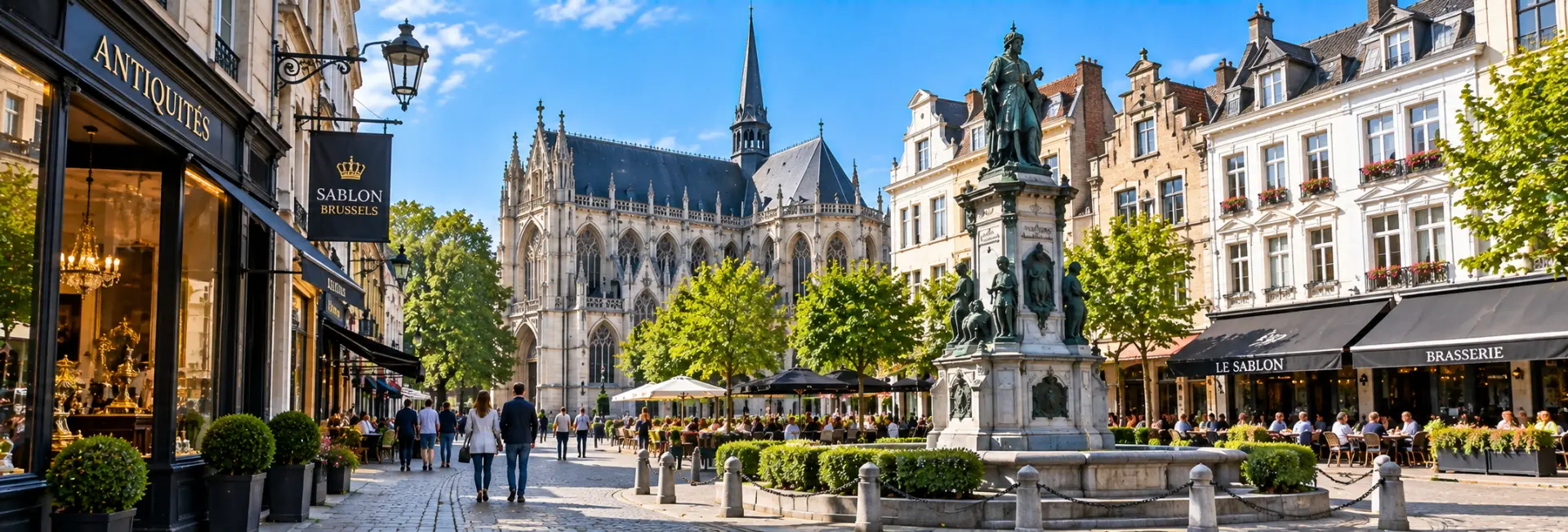
The Sablon is Brussels at its most polished: cobbled streets lined with antique shops, chocolate windows arranged like jewelry displays, and a Gothic church anchoring a square that fills with market stalls every weekend. Sitting between the Grand Place and the Palace of Justice, it has long been one of the city's more affluent corners, and it still carries that reputation today.
The district splits naturally into two connected squares, the larger Grand Sablon and the smaller, garden-like Petit Sablon, each with a distinct character but joined by the same streets of galleries, cafes, and specialty shops that make the neighborhood a favorite for slow, browsing walks rather than checklist sightseeing.
History
A Name from the Sand
The district takes its name from the fine sand that once covered the hills overlooking the nearby Senne valley, a landscape detail that gave the area its identity long before it became a fashionable neighborhood.
A Market Square Turned Guild Quarter
For centuries, the area functioned as a single district connecting the city's lower and upper towns, hosting a horse market and serving as home to the Guild of Crossbowmen, whose religious devotion led to the construction of a chapel on the site in 1304. That chapel eventually grew into the Gothic church that still dominates the district today.
Split by 19th-Century Planning
Through the 19th century, large-scale urban planning projects reshaped much of central Brussels, and the once-unified Sablon district was divided into two separate squares, the Grand Sablon and the Petit Sablon, each developing its own character over the following decades.
From Antique Dealer's Idea to a City Tradition
The neighborhood's now-famous antiques market began modestly in the late 1950s, when a local antique dealer asked a parish priest for permission to display prints to worshippers leaving Sunday Mass. That informal arrangement grew into an organized market bringing together multiple dealers, formally established by 1960 and running ever since.
Architecture & Streetscape
The Grand Sablon is lined with elegant townhouses whose facades mix Gothic and Renaissance influences, many dating back several centuries and still bearing carved details worth pausing to look up at while walking the square. The Petit Sablon, by contrast, has a quieter, more intimate feel, framed by 17th-century houses in a Baroque style around a small, formally landscaped garden.
Connecting the two squares, narrow streets such as Rue Rollebeek offer a change of pace, with a more human scale than the grander squares on either end, packed with small shopfronts rather than monumental facades.
Key Areas
Place du Grand Sablon
The larger of the two squares serves as the district's commercial heart, ringed by restaurants, cafe terraces, and some of Brussels' best-known chocolatiers, with the weekend antiques market spreading across much of the open space.
Place du Petit Sablon
Just across Rue de la Regence from the church, this smaller square centers on a formal garden enclosed by an ornamental fence, offering a quieter counterpoint to the busier Grand Sablon nearby.
Rue Rollebeek and Surrounding Lanes
Leading away from the main squares, these narrower streets continue the district's mix of antique shops, art galleries, and small restaurants, rewarding visitors willing to wander beyond the two main squares.
Notable Landmarks
- Notre-Dame du Sablon, a late-Gothic church with origins tracing back to a 1304 chapel built by the Guild of Crossbowmen, known for its stained glass and sculpture
- The formal garden of the Petit Sablon, enclosed by a decorative fence topped with small statues representing historic Brussels guilds
- A fountain in the Petit Sablon associated with the Counts of Egmont and Horn, two noblemen executed in the 16th century and commemorated in the district
- The weekend antiques market on Place du Grand Sablon, one of the longest-running markets of its kind in the city
Ways to Experience It
Most visitors treat the Sablon as a place to wander rather than tour on a fixed schedule, drifting between antique shop windows, art galleries, and chocolate boutiques at their own pace. Weekend mornings add another layer, with the antiques market turning the Grand Sablon into a browsing destination in its own right, drawing collectors and casual visitors alike.
A stop inside Notre-Dame du Sablon offers a quieter contrast to the shopping streets outside, while the surrounding cafes make it easy to build in a break between exploring the district's two main squares.
Best Time to Visit
Saturday and Sunday mornings are the best time to catch the antiques market in full swing, before the busiest midday crowds arrive. Outside market hours, weekday visits offer a calmer, less crowded version of the same streets, better suited to lingering over a coffee or browsing shop windows without competing for space.
Around Christmas and Easter, the district's chocolate shops decorate their windows with elaborate seasonal displays, adding an extra reason to visit during those periods even for those not planning to buy.
Visitor Tips
- The antiques market runs only on weekends, so plan a Saturday or Sunday visit if browsing the stalls is a priority
- Comfortable shoes are worth wearing, since much of the district is cobbled rather than smoothly paved
- The Louis metro station and nearby tram lines make the district easy to reach without a car, and it's roughly a ten-minute walk from the Grand Place
- Chocolate shops here can be pricier than elsewhere in the city, reflecting the neighborhood's upscale reputation, so it's worth comparing before making a larger purchase
FAQs about visiting the Sablon district
Why is it called the Sablon? +
The name comes from the fine sand that once covered the hills in this part of Brussels, long before the area became a fashionable district.
What's the difference between Grand Sablon and Petit Sablon? +
Grand Sablon is the larger, busier square known for its antiques market and chocolate shops, while Petit Sablon is a smaller, quieter square centered on a formal garden.
When is the Sablon antiques market held? +
The market runs on Saturdays and Sundays on Place du Grand Sablon, drawing dealers and collectors from across the region.
Is Notre-Dame du Sablon free to visit? +
Yes, entry to the church is free during regular opening hours.
Is the Sablon good for chocolate shopping? +
Yes, several well-known Belgian chocolatiers have shops on or near Place du Grand Sablon, making it a popular stop on chocolate-focused tours of the city.
How far is the Sablon from the Grand Place? +
It's about a ten-minute walk, making it an easy addition to a day exploring central Brussels.
Is the Sablon district walkable? +
Yes, it's compact and best explored on foot, though the cobbled streets make comfortable shoes worth wearing.
What's the best time to visit the Sablon? +
Weekend mornings are ideal for the antiques market, while weekdays offer a quieter experience for browsing shops and cafes.