Table of Contents
Overview
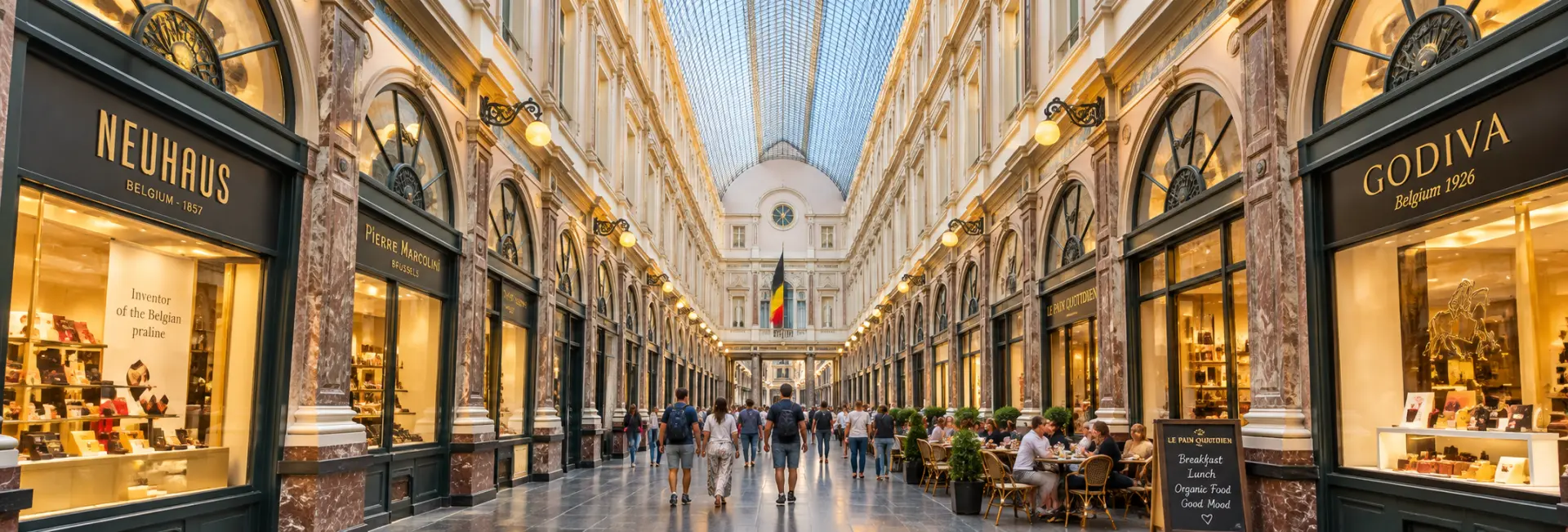
Tucked between the Grand Place and the old theater district, the Royal Galleries of Saint Hubert are a glass-roofed passage that turned shopping into spectacle when they opened in the 1840s. Three linked arcades run in a gentle line through the city center, their arched iron-and-glass ceiling filtering daylight onto marble floors lined with chocolate shops, bookstores, cafes, and boutiques.
More than an elegant place to shop, the galleries are considered one of the earliest examples of a covered shopping arcade built at this scale anywhere in Europe, a model that would later influence shopping arcades and malls built around the world.
History
A Slum Cleared for a New Kind of Street
Before the galleries existed, the site was a tangle of narrow, run-down alleys, including one called the Rue Saint-Hubert, wedged between the busy Marche aux Herbes and the streets leading toward the old theater and exchange quarter. In the 1830s, young architect Jean-Pierre Cluysenaar proposed clearing this district to build a grand covered passage connecting the two areas.
The project needed government backing, since it was too large for a private developer to fund and required expropriating the people and businesses living on the site. Convincing property owners and financing authorities took nearly a decade, delaying construction well beyond Cluysenaar's original plans.
Construction and Opening
King Leopold I, persuaded that the project symbolized the prosperity of the newly independent Belgian state, laid the first stone in May 1846. Construction moved quickly once underway, and the galleries opened to the public in June 1847, roughly eighteen months after ground was broken.
From Passage to Landmark
The ensemble was originally known as the Passage Saint-Hubert and only formally took on its present name, the Galeries Royales Saint-Hubert, in 1965. Over the following century and a half, the galleries evolved from a fashionable 19th-century retail experiment into one of the defining images of historic Brussels.
Architecture & Design
Scale and Materials
The galleries stretch roughly 213 meters end to end and are unusually wide for an arcade of their era, giving the space the feel of an indoor street rather than a narrow passage. A continuous iron-and-glass vault rises high overhead, letting in natural light along the entire route, while floors are laid in blue limestone paired with dark Belgian marble.
Italianate Facades
Cluysenaar drew his design vocabulary from Italian Renaissance architecture, lining the arcade with tiers of arched bays, columns, and decorative cornices more commonly seen on Renaissance palaces than commercial buildings. Upper floors, originally built as apartments and offices above the ground-level shops, continue the same rhythm of arches up to roof level.
An Influential Model
At the time of construction, the galleries were considerably larger and more elaborately finished than earlier covered shopping streets in Brussels or Paris, and their combination of scale, light, and upper-floor housing set a template that later arcades and shopping galleries elsewhere would follow.
Key Areas
Galerie du Roi
The King's Gallery forms one end of the ensemble and has long been associated with media and cultural history, having once housed newspaper offices among its shops and apartments.
Galerie de la Reine
The Queen's Gallery continues the arcade toward the Grand Place side and is typically the busiest stretch, lined with chocolate makers, jewelers, and fashion boutiques.
Galerie des Princes
A shorter side branch, the Princes' Gallery breaks off from the main axis and has a slightly more intimate scale than the two principal arcades it connects to.
Notable Landmarks
- A commemorative plaque marking one of the first film screenings in Belgium, held in a first-floor room above the arcade in the 1890s
- The Theatre Royal des Galeries, a historic theater built into the arcade complex
- The Arenberg cinema, one of the arcade's long-running entertainment venues
- Taverne du Passage, a historic cafe that once served as a meeting place for local artists and writers
- A museum dedicated to letters and manuscripts, holding correspondence linked to figures such as Vincent van Gogh and Belgian singer Jacques Brel
Ways to Experience It
Most visitors simply walk the length of the galleries as part of a stroll between the Grand Place and the cathedral or theater district, pausing to browse chocolate shops, bookstores, and boutiques along the way. Because the arcade is fully covered, it also works well as a rainy-day route through the city center without giving up architectural interest.
For a slower visit, sitting at one of the arcade's cafes offers a good vantage point to appreciate the glass roof and facades overhead, while an evening screening at the Arenberg cinema or a performance at the Theatre Royal des Galeries turns a walk-through into a longer visit.
Best Time to Visit
Daytime hours bring out the arcade's main appeal: sunlight filtering through the glass vault onto the marble floors below, an effect that is muted after dark when interior lighting takes over. Weekday mornings are quieter for photography, while afternoons and early evenings bring more foot traffic from shoppers and people cutting through en route elsewhere in the city center.
Because the galleries are fully enclosed, they're a reliable option in poor weather, making them worth prioritizing on a rainy day in Brussels when outdoor sightseeing is less appealing.
Visitor Tips
- The arcade is free to walk through at any time it's open, with no ticket required simply to browse or pass through
- Shops generally follow standard Brussels retail hours, so an early morning visit is better for photography than for shopping
- The galleries connect naturally to a walk toward the Grand Place on one end and the cathedral area on the other, making them easy to fold into a longer route rather than visiting in isolation
- Chocolate shops here tend to be tourist-priced compared to shops further from the center, so it's worth comparing before buying if budget is a concern
FAQs about visiting the Royal Galleries of Saint Hubert
When did the Royal Galleries of Saint Hubert open? +
The galleries opened to the public in June 1847, after King Leopold I laid the first stone the previous year.
How long are the galleries? +
The full arcade runs roughly 213 meters, divided into three connected sections under a continuous glass-and-iron roof.
Is it free to visit? +
Yes, walking through the galleries costs nothing; you only pay if you shop, dine, or attend a show at one of the venues inside.
What are the three sections called? +
The Galerie du Roi, the Galerie de la Reine, and the smaller Galerie des Princes make up the full ensemble.
Is the arcade a good option in bad weather? +
Yes, since the entire route is covered by a glass roof, it's a popular way to keep sightseeing going during rain without stepping outside.
What kind of shops are inside? +
The galleries are known for chocolate makers, jewelers, bookshops, fashion boutiques, and cafes, alongside a historic theater and cinema.
Is the Royal Galleries close to the Grand Place? +
Yes, the arcade connects directly to the streets around the Grand Place, making it easy to visit both in the same walk through central Brussels.
Why are they called "Royal" galleries? +
The name reflects King Leopold I's personal support for the project and his role in laying the first stone, along with the royal associations of two of its three named sections.