Table of Contents
Overview
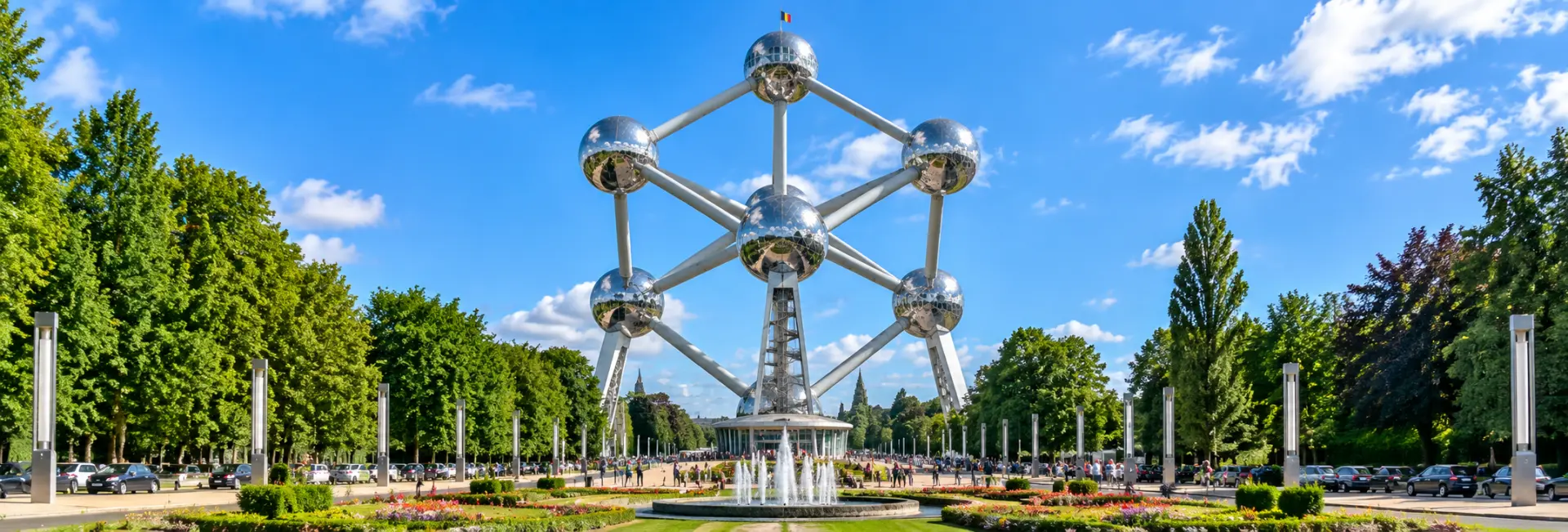
The Atomium is the strangest silhouette on Brussels' skyline: nine gleaming metal spheres, each large enough to hold an exhibition hall, linked by tubes and lifted more than 100 metres into the air. It was built as a temporary showpiece for a single event, a 1958 world's fair, and was never meant to outlast that summer — yet nearly seventy years later it remains the city's most recognisable modern landmark.
The structure is a giant model of an iron crystal, blown up billions of times its actual size, and it doubles as a functioning building: several of its spheres hold exhibitions, a restaurant, and event spaces, all reachable by escalators and Europe's fastest lift at the time of construction. Set apart from the historic centre in the northern district of Laeken, it rewards the short trip out with something Brussels has nowhere else — a piece of retro-futurist optimism turned into a genuine icon.
History
Built for Expo 58
The Atomium was designed as the centrepiece of the 1958 Brussels World's Fair, the first major international exposition held after the Second World War, and it was conceived as a monument to scientific progress and to Belgium's engineering ambitions in the atomic age. Nuclear power was still associated with hope and modernity rather than anxiety in the mid-1950s, and the fair's organisers wanted a structure that would capture that optimism in a single unmistakable image. Engineer André Waterkeyn came up with the concept of an enlarged crystal lattice, and architects André and Jean Polak translated it into a buildable structure, with construction running from 1956 to 1958 using engineering techniques that were themselves considered cutting-edge at the time.
Meant to Be Temporary
Like most world's fair pavilions, the Atomium was originally planned as a temporary installation to be dismantled once the exposition closed at the end of 1958. Its immediate popularity with visitors, who queued for the novelty of riding an escalator through a giant metal tube, changed those plans almost as soon as the fair ended. The city chose to keep it standing rather than demolish it, and over the following decades it gradually shifted from a fairground curiosity into a permanent civic symbol woven into how Brussels presents itself to the world.
Decline and Renovation
Decades of Belgian weather took a toll on the original steel-clad structure, and by the turn of the millennium the building had become worn, dated inside, and increasingly expensive to maintain. A major renovation between 2004 and 2006 replaced the aging steel cladding on the spheres with new aluminium panels, modernised the interior exhibition spaces, and updated the building's mechanical systems, all while preserving its exact original silhouette. The Atomium reopened to the public in 2006 in essentially the form visitors see today, and it has been treated as a protected heritage structure ever since.
Architecture & Design
The Atomium represents the unit cell of an iron crystal, magnified around 165 billion times, arranged as nine spheres at the eight corners and the centre of an imaginary cube standing balanced on one of its points. Each sphere measures 18 metres across, and steel tubes 3 metres in diameter connect them along the cube's edges and its diagonals, doubling as corridors that hold staircases, escalators, and a central lift shaft running through the vertical axis up to the top sphere.
Engineering a structure this large and this top-heavy was a considerable challenge for the mid-1950s. The whole assembly rests on three angled support pillars rather than a single central column, distributing the immense weight of the steel and, later, aluminium-clad spheres outward rather than straight down. Inside, the tubes were sized generously enough to double as functional circulation space rather than purely decorative connectors, which is part of why the building still works as a place to walk, ride, and linger rather than just a sculpture to look at from outside.
- Total height of about 102 metres, making it one of the tallest structures in Belgium
- Six of the nine spheres are open to the public and connected by what was, at the time of Expo 58, the longest escalator in Europe
- The 2004–2006 renovation replaced the original steel skin with aluminium, refreshing the exterior while preserving the building's exact original form and proportions
- The structure rests on three angled support pillars rather than a single central column
- The design has no true precedent in architecture; it borrows its form directly from crystallography rather than from any earlier building style
Recognition & Status
The Atomium is officially protected as a heritage landmark in Belgium and is consistently ranked as Brussels' single most visited paid attraction, drawing a wider international audience than any of the city's museums or historic squares. It has become such a widely used shorthand for the city that its silhouette appears throughout Belgian tourism branding, souvenirs, and postcards, occupying roughly the same symbolic role for Brussels that the Eiffel Tower holds for Paris or the Space Needle holds for Seattle.
Part of its enduring appeal is that it belongs to a very small club of world's fair structures that outlived the event that created them; most Expo pavilions around the world were dismantled within months of closing. That survival, combined with its instantly recognisable shape, has made it a fixture of films, album covers, and news broadcasts set in Brussels, well beyond its original role as a temporary exhibit.
- Legally protected as a listed monument in the Brussels-Capital Region
- Regularly cited by international press as one of the world's most unusual buildings
- Operated today as a museum, exhibition venue, and cultural centre rather than purely a viewing platform
- One of the few surviving structures from Expo 58, alongside the nearby exhibition halls
What to See There
The Permanent Expo 58 Exhibition
One sphere is devoted to the history of the building itself and the world's fair that produced it, with archival photographs, models, and artifacts that place the Atomium in the context of postwar optimism and the Space Race era.
Design and Architecture Exhibits
Other spheres rotate through temporary exhibitions on design, architecture, and popular culture, giving repeat visitors a reason to return even after they've seen the permanent displays.
The Panorama Sphere
The top sphere holds a restaurant and a viewing area with sweeping views over Brussels and the surrounding Heysel plateau, best appreciated on a clear day or after dark when the city lights spread out below.
The Tubes and Escalators
Even between the exhibition spaces, the connecting tubes are part of the attraction: several have windows angled to frame views of the spheres from unusual angles, and the escalator rides themselves have become one of the most-photographed parts of any visit.
Ways to Experience It
- Book timed-entry tickets online in advance, since queues at the door can be long on weekends and during school holidays
- Ride the central escalator up through the tubes for the full effect of moving through the structure rather than just viewing it from outside
- Have a meal or a drink at the top-sphere restaurant for a panoramic view that most day visitors skip
- Combine a ticket with nearby Mini-Europe or the Brussels Expo halls for a full day out in the Heysel/Laeken area
- Return after sunset to see the sphere connections lit up, a very different look from the daytime silver finish
Best Time to Visit
The Atomium is an indoor-and-outdoor experience, so weather matters less here than at open-air attractions, but crowd levels and light still shape the visit. Clear days give the best views from the top sphere, while golden hour and early evening are popular times for photography of the exterior.
- Weekday mornings tend to have the shortest queues, especially outside summer and school holidays
- Summer afternoons draw the heaviest crowds, both for the Atomium itself and for nearby Mini-Europe
- Evening visits let you see the structure illuminated, which is a highlight for many first-time visitors
- Check the official website before visiting, since opening hours shift seasonally and the building occasionally closes for private events
Visitor Tips
- The Atomium sits outside the historic centre in Laeken, so plan roughly 20–30 minutes of travel time each way from downtown Brussels
- The nearest transit stop is Heysel/Heizel, reachable by metro, making the trip straightforward without a car
- Lines form quickly at peak times, so a pre-booked timed ticket saves the most waiting
- Only six of the nine spheres are open to visitors; the rest are structural or used for building systems
- Photographers should note that the surrounding plaza offers unobstructed views for exterior shots without needing a ticket
- Combination tickets with Mini-Europe, located right next door, can be better value for a full day in the area
Nearby Attractions
- Mini-Europe — a miniature park recreating European landmarks at 1:25 scale, directly adjacent to the Atomium
- Brussels Expo — the exhibition and convention halls built for Expo 58, still in active use for trade fairs and events
- Design Museum Brussels — a museum of design and decorative arts a short walk from the Atomium
- Bruparck / Kinepolis and Océade — a leisure complex with a cinema multiplex and indoor water park, part of the same Heysel plateau development
- Laeken Royal Domain — the royal family's residence and greenhouses, a short trip away in the same northern district
FAQs about visiting the Atomium
What is the Atomium and why was it built? +
It's a giant model of an iron crystal, magnified billions of times, built as the centrepiece of the 1958 Brussels World's Fair to showcase scientific progress and Belgian engineering.
Is the Atomium free to visit? +
No, entry to the spheres requires a paid ticket. The exterior and surrounding plaza can be viewed and photographed without buying a ticket.
How long does a visit take? +
Most visitors spend around 1.5 to 2 hours inside, longer if you plan to eat at the top-sphere restaurant or linger over the exhibitions.
How do I get to the Atomium from central Brussels? +
Take the metro to the Heysel/Heizel stop; the Atomium is a short walk from there, and the trip from the city centre takes roughly 20 to 30 minutes.
Can you go inside all nine spheres? +
No, only six of the nine spheres are open to the public; the remaining three are used for structural support and building systems.
Is the Atomium worth visiting with kids? +
Yes — the building's shape and escalator ride are a novelty for children, and it pairs well with the neighbouring Mini-Europe park, which is aimed squarely at families.
What's the best time of day to visit? +
Weekday mornings have the shortest queues, while an evening visit lets you see the structure illuminated after dark, which many visitors find just as memorable as the daytime view.
Should I book tickets in advance? +
It's recommended, especially in summer and around school holidays, since walk-up queues can be long and timed tickets guarantee entry at a set slot.