Table of Contents
Overview
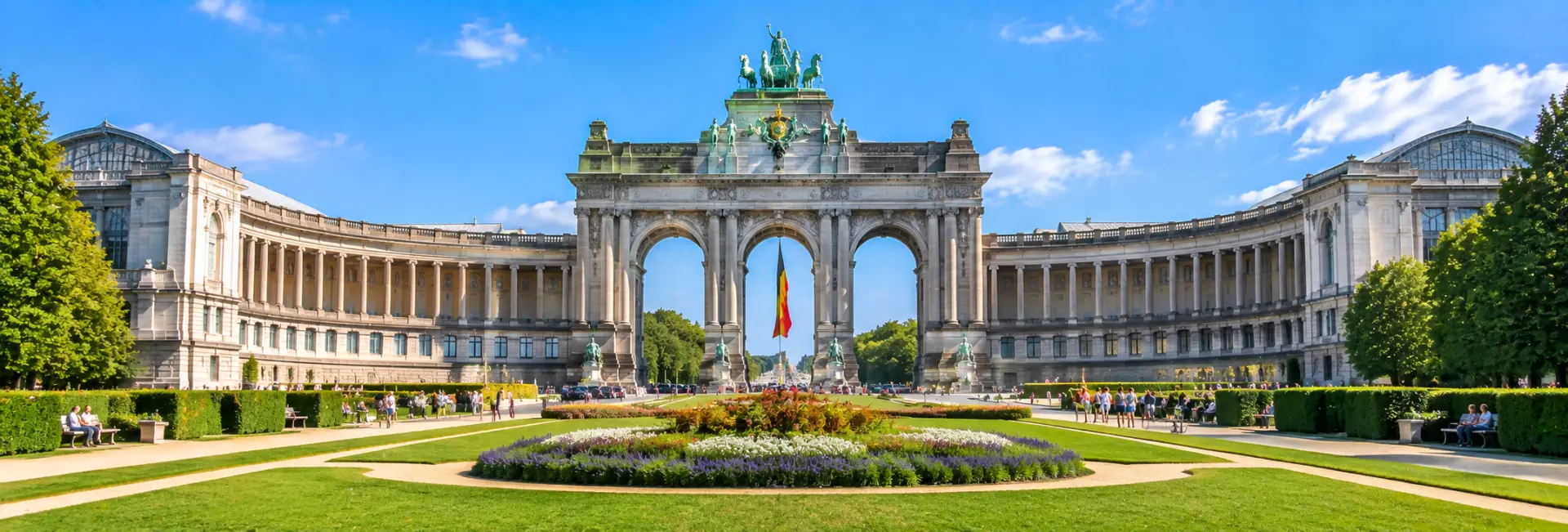
Cinquantenaire Park is one of the largest and most formal green spaces in Brussels, built around a monumental triple arch that has become one of the city's most photographed landmarks. Laid out in the European Quarter, its broad avenues, manicured lawns, and museum wings turn a simple park visit into a walk through more than a century of Belgian history and architecture.
Locally known as Jubelpark, the park takes its name from the anniversary it was built to celebrate, and it remains as much a working cultural complex, with three national museums on site, as it is a place to relax outdoors.
History
Built for a Golden Anniversary
The park takes its name from the French word for fiftieth anniversary, since it was created to mark fifty years of Belgian independence in 1880. The site, previously used as a military exercise ground, was transformed into an exhibition park for the national celebrations of that year.
A Long, Interrupted Construction
Architect Gedeon Bordiau led the project for close to two decades, designing the museum wings and an early version of the central arch in iron, glass, and stone to showcase Belgium's industrial capabilities. Funding problems halted construction in 1890, and Bordiau's death in 1904 left the project unfinished. King Leopold II then brought in French architect Charles Girault to complete the complex.
Completing the Arch
Girault's redesigned triumphal arch was completed in 1905, replacing Bordiau's earlier, more temporary version and finally giving the park the unified monumental centerpiece it had lacked for the 1897 Brussels International Exposition, when the surrounding wings were extended but the arch itself remained incomplete.
From Exhibition Ground to Public Park
For the following decades, the site hosted trade fairs, exhibitions, and festivals rather than functioning purely as a park. In 1930, the government formally reserved the Cinquantenaire for public leisure use, cementing its role as one of the city's major green spaces rather than an event ground.
Architecture & Design
The Triumphal Arch
The park's centerpiece is a triple memorial arch flanked by long colonnaded wings that curve outward on either side, forming a wide U-shaped composition. At the top, a bronze quadriga, a four-horse chariot sculpture, depicts the province of Brabant raising the national flag, while statues at the base of the colonnades represent Belgium's other provinces.
Materials and Symbolism
True to its original industrial-age purpose, the complex was built using iron, glass, and stone in combination, intended to showcase Belgian engineering and craftsmanship at a time when the country was positioning itself as a modern industrial power in Europe.
Formal Gardens and Avenues
Surrounding the arch, the park is laid out with wide straight avenues, geometric lawns, and an open esplanade rather than the winding paths typical of English-style parks, giving the whole complex a formal, ceremonial character suited to its origins as a grand exhibition site.
Key Areas
The Esplanade
A large open area in front of the arch hosts events throughout the year, including festivals, open-air concerts, and markets, and serves as the starting point for one of Brussels' major annual running events.
The Northern Wing
The northern half of the complex has housed the Royal Museum of the Armed Forces and Military History since the park's founding in 1880, covering Belgian and international military history across multiple eras.
The Southern Wing
The southern half is occupied by the Art and History Museum, formerly known as the Cinquantenaire Museum, alongside Autoworld, a large vintage car museum that moved into the space in the 1980s.
Notable Landmarks
- The triumphal arch and its bronze quadriga, visible from across much of the park
- The Temple of Human Passions, a small pavilion in the northwest corner designed by noted architect Victor Horta
- The Great Mosque of Brussels, located in the same corner of the park since the late 1970s
- A monument commemorating Belgian pioneers who worked in Congo, dating from the early 1920s
- Sweeping views over the surrounding European Quarter from the top of the arch's viewing platform
Ways to Experience It
Many visitors simply walk or jog the park's wide avenues, taking in the arch and surrounding lawns without setting foot inside a museum. For those interested in going further, climbing to the top of the arch offers a wide view over the park and the surrounding district, while the three museums provide a deeper look at military history, decorative arts and archaeology, and vintage automobiles respectively.
The esplanade also hosts seasonal events, from markets to open-air concerts, so checking the local calendar before a visit can turn a simple park walk into something livelier.
Best Time to Visit
Spring and early summer bring the park's lawns and trees to their fullest, making this the most popular season for picnics and long walks. Weekday mornings are quieter for those who prefer fewer crowds around the arch, while weekends tend to draw more joggers, families, and event-goers to the esplanade.
Visiting on a clear day is worth prioritizing if climbing the arch for the view is part of the plan, since the payoff is largely about visibility across the surrounding rooftops.
Visitor Tips
- The park itself is free and open daily, while the three museums on site charge separate admission and keep their own opening hours
- The Schuman and Merode metro stations sit at opposite ends of the park, making it easy to enter from either side depending on where a visit starts
- Wide paved avenues make the park generally easy to navigate for strollers and wheelchairs, though museum accessibility varies by building
- Combining a museum visit with time on the esplanade makes for a fuller day, since the park alone can be seen in under an hour
Nearby Attractions
Cinquantenaire Park sits close to the heart of Brussels' European Quarter, making it a natural stop for visitors also touring the European Parliament and surrounding institutional buildings.
Further into the city center, Mont des Arts and the Grand Place are a short metro ride away, allowing the park to be combined with the historic core of Brussels on the same day if time allows.
FAQs about visiting Cinquantenaire Park
What does Cinquantenaire mean? +
It's French for "fiftieth anniversary," reflecting the park's origin as a project to celebrate fifty years of Belgian independence in 1880.
Is Cinquantenaire Park free to visit? +
Yes, the park itself is free and open daily; only the museums inside the complex charge separate admission.
What museums are in Cinquantenaire Park? +
The park houses the Royal Museum of the Armed Forces and Military History, the Art and History Museum, and Autoworld, a vintage car museum.
Can you climb the triumphal arch? +
Yes, the arch has a viewing platform accessible to visitors, offering a wide view over the park and surrounding European Quarter.
How do you get to Cinquantenaire Park? +
The Schuman and Merode metro stations sit at either end of the park, making both convenient entry points depending on the direction you're arriving from.
Is Cinquantenaire Park good for a picnic? +
Yes, its wide lawns and avenues are popular for picnics and casual outdoor time, especially in spring and summer.
How old is the triumphal arch? +
The current arch was completed in 1905, replacing an earlier, more temporary version built for the park's 1880 opening.
Is the park close to other Brussels attractions? +
It's a short metro ride from the historic center, including Mont des Arts and the Grand Place, making it easy to combine with a broader day of sightseeing.