Table of Contents
Overview
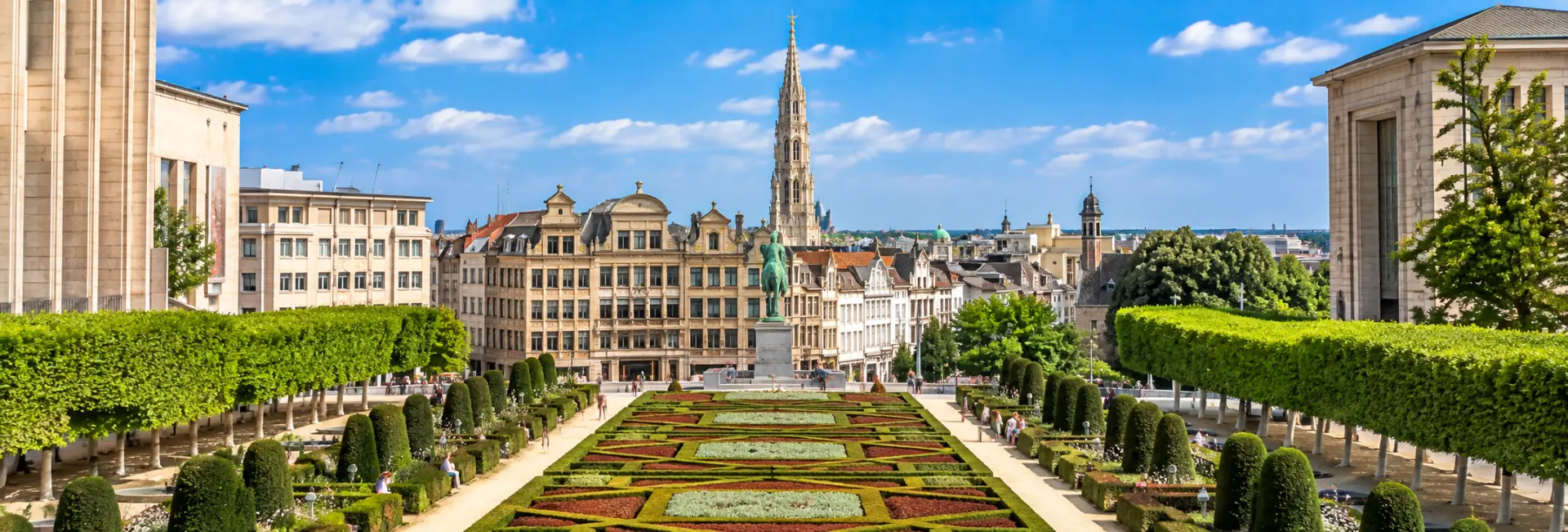
Mont des Arts, or the "Hill of the Arts," is the terraced garden and cultural complex that stitches together Brussels' aristocratic upper town and its busy medieval lower town. Climbing the slope between the Royal Palace area and the Grand Place, its geometric hedges and staircases lead up to a wide viewing terrace that frames one of the best skyline shots in the city, with the Town Hall's spire rising above the rooftops below.
Beyond the view, the surrounding complex is home to some of Belgium's major cultural institutions, making Mont des Arts as much a gateway to museums and archives as it is a garden to pass through.
History
An Old Neighborhood Cleared for a New Vision
Before it became a garden, the site was home to a dense working-class district known as the Saint-Roch quarter, wedged onto the slope connecting the upper and lower parts of the city. In the late 19th century, King Leopold II set out to replace the district with a grand quarter devoted to the arts, buying up the neighborhood over the objections of Brussels' mayor at the time, who favored preserving the old streets rather than demolishing them.
The council ultimately backed the king's plan, and the old buildings were torn down in the late 1890s, leaving the hillside as an undeveloped void for years afterward while funding for the project stalled.
The First Garden, 1910
To give the site a presentable face for the 1910 Brussels International Exposition, a temporary garden with a monumental staircase, fountains, and terraces was laid out on the slope. Although meant to be short-lived, the garden proved popular with residents and remained in place for decades after the exhibition closed.
Postwar Redesign
By the late 1930s, plans for a permanent cultural quarter resurfaced, and the original garden was eventually cleared to make way for a new design. Construction of the complex seen today ran through the 1950s and 1960s, coinciding with Brussels hosting the 1958 World's Fair, and gave Mont des Arts its current combination of formal garden, staircases, and surrounding cultural buildings.
Design & Layout
The garden follows a formal, geometric plan, with clipped hedges, boxwood-edged flower beds, and small circular pools arranged in symmetrical rows along the slope. Broad staircases and terraces step down the hillside, guiding visitors' eyes toward the panorama at the bottom rather than toward any single building.
The most recent layout sits on a concrete platform built over an underground car park and congress center, a practical solution that allowed the garden to be rebuilt above active infrastructure without disturbing what lies beneath it. In the early 2000s, the garden underwent a further renovation while keeping its original geometric character intact.
Key Areas
The Garden and Terrace
The main garden occupies the upper section of the site, while a lower terrace opens onto the panoramic view over the city center that draws most visitors to the site in the first place.
The Royal Library of Belgium
Flanking the garden, the Royal Library of Belgium (KBR) holds the country's national manuscript and book collections and is one of the anchor institutions of the surrounding cultural quarter.
The National Archives and Square Complex
Nearby buildings house the National Archives of Belgium and the Square, a modern meeting and exhibition center built into the same hillside complex, reflecting the site's origins as a planned home for the country's cultural and administrative institutions.
Notable Landmarks
- A wide viewing terrace overlooking the rooftops of the lower town, with the Town Hall spire visible in the distance
- A hidden carillon clock built into an arcade nearby, featuring dozens of bells and a mechanical figure that strikes the hour
- Formal gardens with clipped hedges, fountains, and a small children's play area
- A statue of King Albert I, who inaugurated the site's first garden in 1910
Best Time to Visit
Late afternoon and early evening are popular times to visit, when the low sun lights up the rooftops and towers visible from the terrace and the crowds thin out compared to midday. Because the garden is outdoors and unshaded in most areas, visiting outside the hottest hours of summer afternoons makes for a more comfortable walk.
Visiting on the hour offers a chance to hear the nearby carillon clock strike, with its mechanical figures performing a short display that many visitors walk right past without noticing.
Visitor Tips
- The garden and terrace are open to the public at no charge, while the Royal Library and nearby museums charge separate admission
- Steps and slopes throughout the site can be uneven underfoot, so visitors with mobility concerns should look for the accessible routes connecting the upper and lower levels
- The viewing terrace gets busy with tour groups around midday, so early morning or evening visits are better for photography
- Brussels-Central train station sits at the base of the hill, making Mont des Arts an easy stop right after arriving by train
Nearby Attractions
The Grand Place and Town Hall are a short walk downhill from the garden, making Mont des Arts a natural starting or ending point for a walk through the historic center. In the other direction, the Royal Palace and Place Royale sit at the top of the slope, alongside additional museums covering fine arts and Belgian history.
The Cathedral of St. Michael and St. Gudula is also within easy walking distance, allowing visitors to combine a garden visit with several of Brussels' major landmarks in a single afternoon.
FAQs about visiting Mont des Arts
What does Mont des Arts mean? +
The name translates to "Hill of the Arts," reflecting its role as a planned cultural quarter linking Brussels' upper and lower towns.
Is Mont des Arts free to visit? +
Yes, the garden and viewing terrace are open to the public at no cost; only the surrounding museums and library charge separate admission.
When was Mont des Arts built? +
Its first garden opened in 1910 for the Brussels International Exposition, and the current layout dates mainly from a major redesign carried out through the 1950s and 1960s.
What's the best view from Mont des Arts? +
The lower terrace offers a wide panorama over the rooftops of central Brussels, with the Town Hall's spire visible above the historic center.
Is there anything to see besides the garden? +
Yes, a hidden carillon clock with dozens of bells and moving figures sits in a nearby arcade, and the surrounding buildings house the Royal Library and National Archives of Belgium.
How do you get to Mont des Arts? +
It's a short walk from Brussels-Central train station, making it one of the easiest major sights in the city to reach right after arriving.
Can you combine a visit with the Grand Place? +
Yes, the Grand Place is just downhill from Mont des Arts, making the two an easy pair on the same walking route.
Is Mont des Arts good for photography? +
Yes, especially in the late afternoon when low sunlight highlights the rooftops and towers visible from the terrace.