Table of Contents
Overview
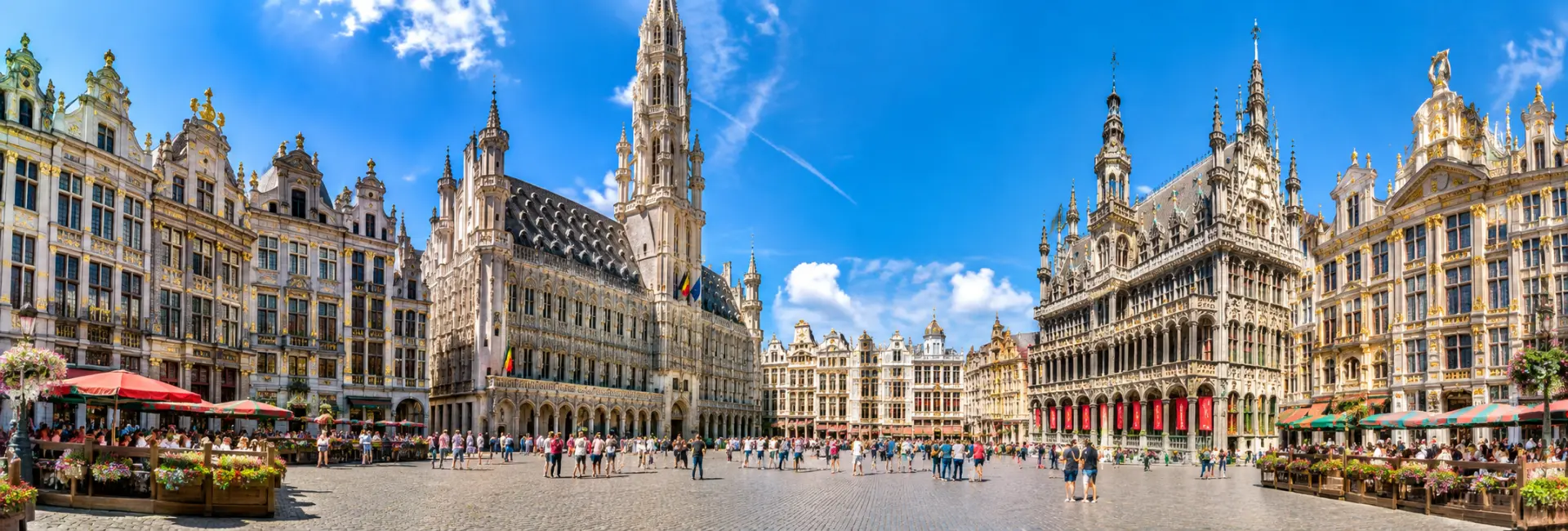
What makes the square remarkable is how much history is packed into so small a space. A soaring Gothic town hall stands beside baroque guildhalls dripping in gold leaf and allegorical statuary, and across from them sits a neo-Gothic building that once housed the city's bread market. Nearly everything visible today dates from a single furious burst of rebuilding after the square was flattened by cannon fire in 1695, which is part of why the ensemble feels so unified despite its mix of styles.
History
The square began as marshy ground beside the Senne river, drained and paved over by the late 11th century so traders could set up stalls on what was then called the Nedermerckt, or "Lower Market." Its position alongside the Steenweg, a trade route linking Flanders to the Rhineland, made it a natural gathering point for merchants, and by the 13th century covered halls for bread, meat, and cloth had grown up along its northern edge.
Guilds and Grandeur
Brussels' craft guilds, from brewers and bakers to boatmen and archers, gradually built their headquarters around the square's perimeter, each house carved and gilded to broadcast the wealth and status of its trade. The city's Gothic town hall rose on the square's south side across the 15th century, a slow, decades-long construction that gave the building its famously off-centre tower.
The 1695 Bombardment
In August 1695, during the Nine Years' War, French forces under Marshal de Villeroy shelled Brussels from a nearby hilltop, and the incendiary bombardment reduced most of the square's wooden and stone houses to rubble. Only the town hall's stone shell and tower, ironically the target of the attack, survived largely intact. Rather than let the destruction stand, the city's guilds rebuilt their houses in stone within about four years, which is why so many facades share a similar late-Baroque vocabulary today.
Into the Modern Era
The square kept functioning as a working market into the 20th century, only losing that role in 1959, and it endured further shocks along the way, including a German bombing raid in 1979. It was pedestrianised in 1990, and the guild houses that once stored butter, herring, and coal have since become restaurants, chocolate shops, and museums, even as street names nearby still recall the goods once traded there.
Recognition & UNESCO Status
- Listed under UNESCO's cultural criteria (ii) and (iv), recognising both artistic influence and its illustration of a historical building type
- Reference number 857 on the World Heritage List
- Long before UNESCO, Brussels itself had already declared the square and its facades protected monuments
- Regularly cited in surveys and travel rankings as one of the most beautiful public squares in Europe
Architecture & Notable Buildings
Built in phases between 1401 and 1455, the town hall is the only structure on the square to predate the 1695 bombardment, and its Gothic facade is lined with statues of dukes, saints, and biblical figures. Its asymmetrical tower climbs about 96 metres and is topped by a gilded weathervane statue of the Archangel Michael, the city's patron, slaying a demon; local legend claims the architect was so distressed that the tower didn't sit at the building's centre that he threw himself from the top.
The King's House (Maison du Roi / Broodhuis)
Facing the town hall from across the square, this building occupies the site of a 13th-century bread hall, which is why its Dutch name, Broodhuis, simply means "bread house." Despite the French name, no king ever lived here; the current neo-Gothic structure is largely a late-19th-century reconstruction meant to echo an earlier 16th-century building, and it now houses the Brussels City Museum, including an extensive collection of costumes for the Manneken Pis statue.
The Guildhalls
Running around the remaining sides of the square, the guildhalls are a showcase of late-Baroque facade design, each named for a symbol carved or painted on its front. Le Cygne, the former butchers' hall marked by a swan, is where Karl Marx is said to have drafted parts of the Communist Manifesto in the late 1840s. Next door, the brewers' guildhall carries an equestrian statue and today holds a small brewing museum. Nearby, a single monumental facade built in 1697 fronts seven separate buildings once occupied by different trades, unified under the name the Duke's House.
Cultural Traditions & Events
Each July, the square hosts the Ommegang, a torch-lit pageant that re-enacts the 1549 "joyous entry" of Emperor Charles V and his son into Brussels. Hundreds of costumed performers, riders, and folkloric groups process roughly two kilometres through the historic centre before gathering on the square for an evening spectacle. Its roots stretch back to a 14th-century religious procession, and UNESCO recognised the modern Ommegang as intangible cultural heritage in 2019.
The Flower Carpet
In even-numbered years, for a few days every August, the entire square is covered by a vast carpet of cut begonias arranged into an intricate design, drawing crowds who view the pattern from the town hall's balcony and surrounding windows. The tradition dates back to the early 1970s and has become one of the square's signature spectacles.
Markets and Winter Light
In winter, the square anchors a Christmas market with stalls, an ice rink, and an evening sound-and-light display projected onto the town hall's facade, drawing crowds well after dark. Smaller seasonal markets and cultural events pop up through the rest of the year as well, keeping the square in near-constant use.
Ways to Experience It
- Walk the square slowly at least twice: once by daylight to study the facade carvings, and once after dark when the gold leaf catches the floodlights
- Join a guided walking tour of the historic centre, since much of the square's storytelling — guild rivalries, hidden symbols, the 1695 bombardment — rewards a bit of context
- Book ahead for one of the limited public tours of the town hall's interior, which includes tapestry-lined council chambers not visible from outside
- Visit the Brussels City Museum inside the King's House for artifacts, paintings, and the Manneken Pis costume collection
- Duck into the small brewery museum in the former brewers' guildhall for a quick look at historic equipment and a included tasting
- Take a seat at one of the café or brasserie terraces lining the square for a coffee, beer, or plate of mussels while people-watching
Best Time to Visit
- Spring (April–May) and early autumn (September) bring milder weather and thinner crowds than peak summer
- Summer is liveliest and busiest, and coincides with the Ommegang in July and, every other even year, the August flower carpet
- Winter transforms the square with Christmas market stalls, an ice rink, and nightly illuminated shows, though days are short and often damp
- Weekday mornings tend to be calmer than weekend afternoons, when day-trippers and tour buses converge on the centre
Visitor Tips
- The square itself is free and open at all hours; only the interior sites, such as the town hall tour and the City Museum, charge admission
- Cobblestones can be uneven and slippery when wet, so comfortable, flat shoes are worth the trade-off against style
- The nearest public transport stop is Bourse/Beurs, served by premetro tram lines, with several bus routes also stopping close by
- Keep valuables secure in the immediate area, as any dense tourist crowd can attract pickpockets
- Restaurants directly on the square tend to charge a premium for the view; wandering a block or two into the surrounding lanes often turns up better value
- If visiting for the flower carpet, arrive early or reserve a balcony viewing spot, since the square becomes extremely crowded during the display's short run
Nearby Attractions
- Manneken Pis — the famous small bronze fountain statue, a short walk south-west through the Rue Charles Buls
- Galeries Royales Saint-Hubert — an elegant 19th-century glass-roofed shopping arcade just north of the square, among the oldest covered shopping galleries in Europe
- Mont des Arts — a terraced garden and viewpoint a few minutes' walk uphill, with museums including the Royal Museums of Fine Arts nearby
- Belgian Comic Strip Center — a museum dedicated to Belgium's comic art tradition, including Tintin, housed a short walk north-east
- Sablon district — an antiques and chocolate quarter centred on a Gothic church, a pleasant walk south of the square
FAQs about visiting Grand Place
What is Grand Place famous for? +
It's known for its ensemble of gilded 17th-century guildhalls surrounding the Gothic town hall and the former King's House, and for being one of Europe's best-preserved historic market squares, a status recognised by UNESCO in 1998.
Is Grand Place free to visit? +
Yes, the square itself is a public space with no entry fee. You only pay to enter specific sites around it, such as the guided town hall tour or the Brussels City Museum inside the King's House.
How much time should I spend at Grand Place? +
Give the square itself 30 to 45 minutes to walk around and take in the facades, but budget two to three hours if you also want to tour the town hall interior, visit the City Museum, or stop for a meal at one of the surrounding cafés.
When is the best time of day to visit? +
Early morning offers the fewest crowds and clearest photos, while evening brings out the illuminated facades and a livelier café atmosphere. Both are worth experiencing if your schedule allows.
How do I get to Grand Place? +
The square sits in Brussels' pedestrianised historic centre. The closest stop is Bourse/Beurs on the premetro tram network, and it's an easy walk from Brussels Central Station.
Is Grand Place suitable for children and visitors with mobility needs? +
It's generally family-friendly, though the cobblestones can be uneven for strollers or wheelchairs and get slippery in wet weather, so plan accordingly. Nearby cafés and shops make it easy to take breaks.
What else can I combine with a visit to Grand Place? +
The Manneken Pis statue, the Galeries Royales Saint-Hubert shopping arcade, and the Mont des Arts viewpoint are all within a short walk, making it easy to build a half-day itinerary around the square.
Does Grand Place host special events? +
Yes — highlights include the torch-lit Ommegang pageant each July, a flower carpet made of begonias every other August, and a Christmas market with an ice rink and nightly light show in winter.