Table of Contents
Overview
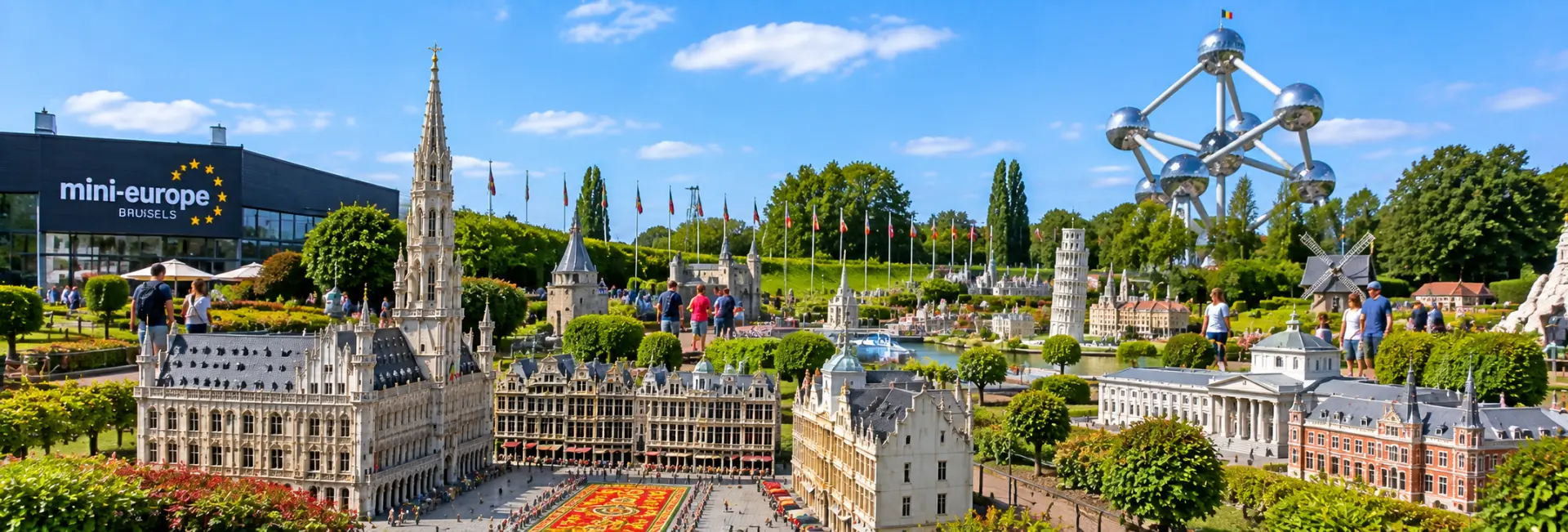
Mini-Europe packs an entire continent into a garden you can walk in an afternoon. Scale models of roughly 350 landmarks from around 80 European cities sit among flowerbeds, fountains, and winding paths, letting visitors stand beside a knee-high Eiffel Tower one minute and a miniature Acropolis the next.
Set at the foot of the Atomium in the Bruparck leisure complex, the park treats its models as more than static replicas: trains run past mini stations, a volcano erupts on schedule, and short scenes bring pieces of European history and current events to life at a scale small enough to take in with a single glance.
History
An Idea from Another Miniature Park
The concept for Mini-Europe came from Dutch businessman Johannes Lorijn, who had already built similar miniature parks elsewhere in Europe. In the mid-1980s, he proposed creating one on Brussels' Heysel plateau, the same area already home to the Atomium from the 1958 World's Fair.
A Change of Ownership
Lorijn's original venture ran into financial trouble before the park was built, even though the models had already been designed and ordered. A regional investment company that had backed the project brought in the Walibi amusement park group, led by Eddy Meeus, to take over as developer and complete the plan.
Opening in 1989
Mini-Europe opened to the public in June 1989, inaugurated by the future King Philippe of Belgium, then still a young prince. The park's models were largely funded by the countries and regions they represent, giving the collection a genuine international character from the start rather than being built entirely on a single company's budget.
Key Areas
The Model Landscape
Covering roughly 2.4 hectares, the park's main area groups its miniature buildings loosely by country and region, so a walk through the park roughly traces a route across the European map rather than jumping randomly between landmarks.
The Gardens
Around and between the models, planted beds echo the regions being represented, with plants chosen to match their real-world settings, such as lavender near southern European scenes and grasses reflecting other climates. Fountains, small waterfalls, and pools are worked into the landscaping alongside the buildings themselves.
The Spirit of Europe Exhibition
Near the end of the walking route, an interactive exhibition space uses multimedia displays and games to give visitors a broader overview of the European Union, tying the miniature landmarks back to the larger political and cultural project they represent.
Models & Animated Scenes
- Landmark buildings such as the Eiffel Tower, Big Ben, the Leaning Tower of Pisa, and Brussels' own Grand Place, all built at 1:25 scale
- An erupting miniature Mount Vesuvius, timed to go off at intervals throughout the day
- Working models including small trains, windmills, and cable cars set into the surrounding scenery
- Historical and current-events scenes worked into the display, from the fall of the Berlin Wall to more recent moments in European politics
- Miniature figures of well-known public figures placed among certain scenes, adding a playful, changing layer to the park's more permanent buildings
Ways to Experience It
Most visitors walk the park at their own pace using the included guidebook, available in multiple languages, which explains the history and significance behind each featured landmark. A single visit typically takes a couple of hours, making it easy to pair with a stop at the neighboring Atomium on the same day.
Combination tickets covering both Mini-Europe and the Atomium are available for visitors planning to see both attractions, since they sit right next to each other in the same leisure complex.
Best Time to Visit
Mini-Europe operates seasonally rather than year-round, generally running from spring through the end of the year with the busiest crowds in July and August. Arriving early in the morning during peak summer months helps avoid the largest tour groups and midday heat on the mostly outdoor walking route.
Some summer evenings bring extended hours with illuminated models and occasional fireworks, offering a different atmosphere from a standard daytime visit for those able to time a trip around one of these events.
Visitor Tips
- The park's pathways are fully accessible for visitors with reduced mobility, making it a comfortable option for families with strollers or visitors using wheelchairs
- Large bags and suitcases are generally not permitted inside, so plan luggage accordingly if arriving directly from a train or flight
- The closest metro stop is Heysel, a short walk from the park entrance, and the area is also served by Brussels' hop-on hop-off bus routes
- Because the park is seasonal, check operating dates and hours before planning a visit outside the main summer season
Nearby Attractions
Mini-Europe sits within the Bruparck leisure complex, directly next to the Atomium, whose observation deck offers a full-scale view over the city to contrast with the miniature landmarks below. The complex also includes a planetarium and a water park, making the area a natural stop for a full day out with children.
The historic center of Brussels, including the Grand Place and Cinquantenaire Park, is a short metro ride away for visitors wanting to combine Mini-Europe with the real-scale versions of some of its featured landmarks.
FAQs about visiting Mini-Europe
What scale are the models at Mini-Europe? +
All the buildings are built at 1:25 scale, meaning they stand at roughly one twenty-fifth the size of the real landmarks they represent.
How many landmarks are on display? +
The park features around 350 models representing roughly 80 cities from across Europe.
Is Mini-Europe open year-round? +
No, the park operates seasonally, generally from spring through the end of the year, with its busiest period in July and August.
How long does a visit take? +
Most visitors spend around two to three hours walking the park at a relaxed pace with the included guidebook.
Is Mini-Europe suitable for young children? +
Yes, its manageable size, animated scenes, and fully accessible pathways make it a popular choice for families with young children.
Can you combine Mini-Europe with the Atomium? +
Yes, combination tickets covering both attractions are available, since they sit next to each other in the same leisure complex.
How do you get to Mini-Europe? +
The Heysel metro station is a short walk from the entrance, and the park is also served by Brussels' hop-on hop-off bus tours.
Is Mini-Europe wheelchair accessible? +
Yes, the park's pathways are designed to be fully accessible for visitors with reduced mobility.