Table of Contents
Overview
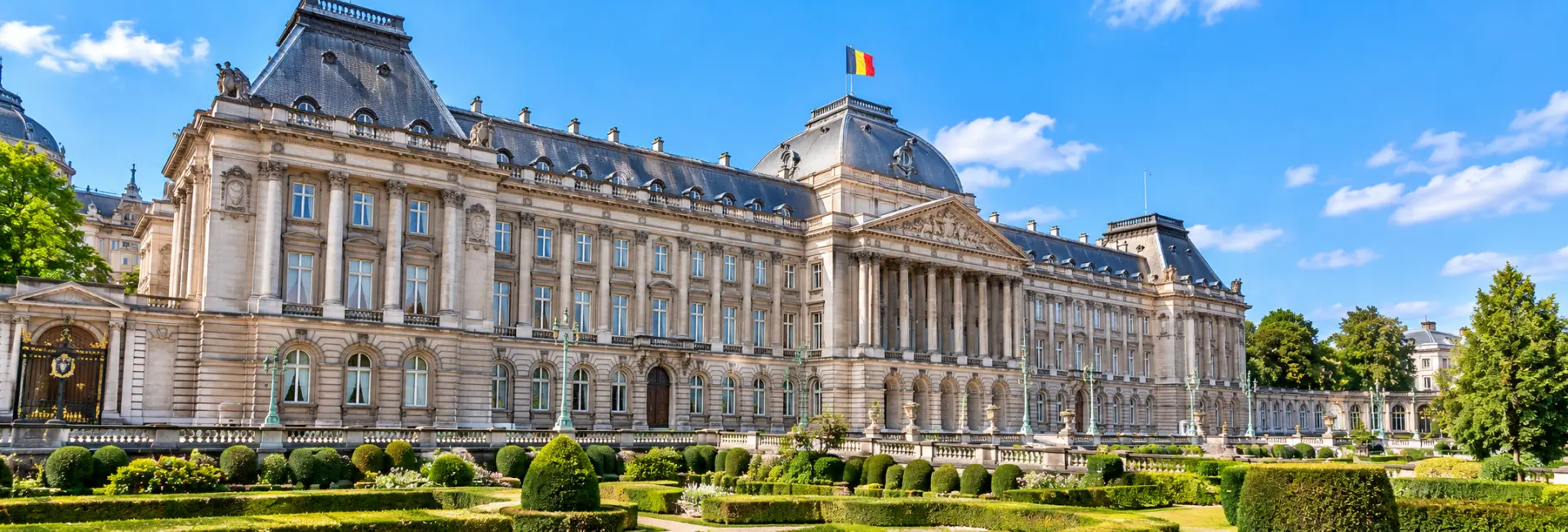
The Royal Palace of Brussels is the ceremonial face of the Belgian monarchy: a long, pale neoclassical facade facing Brussels Park, used for state receptions and official business rather than as anyone's actual home. The King and Queen live elsewhere, at the Royal Palace of Laeken, which makes this building something closer to a grand office than a private residence, though it's every bit as opulent inside as that description undersells.
What makes a visit worthwhile is the contrast between the restrained exterior and the interior's occasional bursts of extravagance, most famously a ceiling covered entirely in iridescent beetle wings. The catch is timing: unlike most European palaces, this one only opens its doors to the public for a few weeks each summer, so seeing the inside takes some planning rather than simply showing up.
History
From Coudenberg to Ruin
The site has held a palace in one form or another since the 11th or 12th century, when the medieval Coudenberg complex first rose on this hill overlooking what would become central Brussels. Coudenberg grew over the centuries into a major residence of the Dukes of Brabant and later the Habsburg rulers of the Low Countries, hosting courts, treaties, and the everyday business of governing the region for roughly seven hundred years. Emperor Charles V himself lived there for stretches of his reign, and the complex expanded repeatedly to keep pace with the scale of the court it housed, until a catastrophic fire in 1731 destroyed the complex almost entirely in a single night, reducing centuries of accumulated building work to ruins.
A Slow Rebuild
The site sat largely abandoned and overgrown for decades afterward, its ruined foundations eventually buried beneath new streets and squares. It wasn't until 1820, under King William I of the United Netherlands, that serious rebuilding began on a new palace on adjoining land, incorporating some existing 18th-century structures and giving the complex its first coherent modern form under the direction of architects including Charles Vander Straeten and Tilman-François Suys. Later in the 19th century, after Belgian independence, King Leopold II commissioned architect Alphonse Balat to enlarge the palace substantially, adding grand reception spaces including the Throne Room, the Grand Staircase, and the Grand Gallery, roughly doubling the building's footprint.
The Modern Facade
Balat's design for a new principal facade, modelled loosely on French royal architecture, was never built during his lifetime, and it fell to architect Henri Maquet to complete an altered version of it in 1904, giving the palace the long, formal front that visitors see today. Further work continued into the early 1930s under architect Octave Flanneau, meaning the building's present form is really the product of more than a century of overlapping construction phases layered on top of a medieval foundation that most visitors never see.
Architecture & Notable Rooms
The palace presents a restrained, symmetrical neoclassical face to Brussels Park, all pale stone and evenly spaced columns, but the state rooms behind that facade shift into a much richer register, drawing heavily on the model of French royal residences that Balat admired and studied closely before drawing up his designs.
The Throne Room
The largest of the state rooms, used for official receptions and ceremonies, features oversized chandeliers and bas-relief sculptures contributed by the French sculptor Auguste Rodin, giving an otherwise formal hall a surprising touch of fine art. Its scale alone signals its purpose: this is a room built to host heads of state and formal ceremony, not a space designed for everyday comfort.
The Mirror Room
The palace's most talked-about space is a hall of mirrors whose ceiling was transformed in 2002 into an artwork called Heaven of Delight, created by Belgian artist Jan Fabre at the invitation of Queen Paola, continuing a long royal tradition of commissioning contemporary artists to leave their mark on the palace. Over a million iridescent jewel beetle wing cases were individually applied across the ceiling by Fabre and a team of assistants over several months, producing a shimmering green surface unlike anything else in a European royal palace and turning a formal reception room into something closer to an art installation.
The Empire Room and Grand Staircase
The Empire Room is considered the oldest surviving interior of the complex, originally built as a ballroom for the Austrian government's representative in the 18th century, predating even the fire that destroyed the original Coudenberg palace. The Grand Staircase, designed by Balat in white and coloured marble, connects the ceremonial floor and sets the tone for the state rooms that follow, its sweeping proportions meant to impress visitors before they've even reached the main reception halls.
Grounds & Surroundings
The palace faces Brussels Park across a wide formal square called the Place des Palais, giving the building an open, ceremonial approach rather than a walled courtyard. The park itself, laid out in a formal French style, was designed as a complementary green space to the palace and remains a popular spot for a stroll before or after a visit.
- Two matching pavilions flank the ends of the palace's side wings, one historically tied to the civil list and the other now housing the BELvue Museum of Belgian history
- Beneath parts of the surrounding area lie the excavated remains of the original medieval Coudenberg complex, accessible separately as an archaeological site
- The formal square in front of the palace is used for state ceremonies and ceremonial changing of the guard
Cultural Significance & Royal Ties
As the monarch's official working palace rather than a residence, the building functions as the physical seat of the Belgian constitutional monarchy, hosting state receptions, diplomatic audiences, and official ceremonies throughout the year even when it's closed to the public. Its role is symbolic as much as practical: a flag raised over the palace signals that the King is in the country, a small but visible piece of royal ritual that Brussels residents still watch for as they pass by on their daily routines.
The building also carries the weight of national continuity in a way few other structures in Brussels do, standing on ground that has hosted the region's rulers, in one form or another, for close to a thousand years. That layered history, from medieval dukes through Habsburg emperors to the modern constitutional monarchy, is part of why the palace remains such a central reference point in how Belgium presents its own story to visitors.
- Used for state visits, official audiences, and national ceremonies rather than private royal life
- Adjacent to the BELvue Museum, dedicated to the history of Belgium and its monarchy
- Connected underground to the archaeological remains of the medieval Coudenberg Palace it replaced
Ways to Experience It
- Book a free timed slot online during the annual summer opening, since reservation is required and space is limited
- Follow the signed, one-way route through the state rooms, taking time in the Mirror Room to look closely at the beetle-wing ceiling
- Combine the palace visit with the neighbouring BELvue Museum for deeper context on Belgian royal history
- Walk the palace's exterior and Place des Palais year-round, since the facade and changing of the guard can be seen even outside the summer opening
- Check the palace's virtual tour online if your visit doesn't align with the summer opening dates
Best Time to Visit
Because interior access is strictly seasonal, timing matters more here than at almost any other Brussels landmark. The exterior and surrounding park can be enjoyed at any time of year, but the interior state rooms are only reachable during a short annual window.
- The palace typically opens to visitors from around the national holiday in late July through early September, closing on Mondays
- Reservations open in advance of the opening and tend to fill quickly, so booking early in the window is worth the effort
- Weekday mornings during the open period tend to be calmer than weekend afternoons
- Outside the summer opening, exterior views are best in late afternoon light, when the pale facade catches a warm glow
Visitor Tips
- Interior visits require online reservation in advance; walk-up entry isn't guaranteed even during the summer opening
- Admission during the summer opening is free, though some special exhibitions inside may carry a small charge
- Security screening applies at entry, and large bags or backpacks may be restricted
- Photography rules can vary by room, so check signage as you move through the state rooms
- The palace is generally accessible for wheelchair users, though it's worth confirming current arrangements before visiting
- Renovation work has occasionally closed the palace for an entire season, so confirm current-year opening dates before planning a trip around it
Nearby Attractions
- Brussels Park (Parc de Bruxelles) - the formal park directly facing the palace, ideal for a walk before or after a visit
- BELvue Museum - a museum of Belgian history housed in a pavilion beside the palace
- Coudenberg archaeological site - the excavated remains of the medieval palace that once stood on this site
- Royal Museums of Fine Arts of Belgium - a major art museum a short walk away
- Grand Place - Brussels' historic main square, about a 15-minute walk through the city centre
FAQs about visiting the Royal Palace of Brussels
Do the King and Queen actually live at the Royal Palace of Brussels? +
No. It's their official working palace for ceremonies and state business, but the royal family's actual residence is the Royal Palace of Laeken, on the northern edge of the city.
When can you visit the inside of the palace? +
The interior is open to the public only for a few weeks each summer, typically from late July to early September, and closed the rest of the year.
Is entry to the Royal Palace free? +
Yes, entry during the summer opening is free, though online reservation for a timed slot is required.
What's the famous "beetle wing" ceiling? +
It's an artwork called Heaven of Delight in the Mirror Room, created by artist Jan Fabre using over a million iridescent jewel beetle wing cases, commissioned by Queen Paola in 2002.
How long does a visit take? +
Most visitors spend about an hour walking the signed route through the state rooms, longer if temporary exhibitions are also on display that year.
Can I see the palace if I visit outside summer? +
You can still view and photograph the exterior facade and the surrounding Place des Palais year-round; only the interior state rooms are seasonal.
Is the palace accessible for visitors with mobility needs? +
It's generally wheelchair accessible, though it's worth checking current arrangements on the official site before your visit.
What else is nearby worth visiting? +
Brussels Park sits directly across from the palace, and the BELvue Museum and the Coudenberg archaeological remains are both just steps away.