Table of Contents
Overview
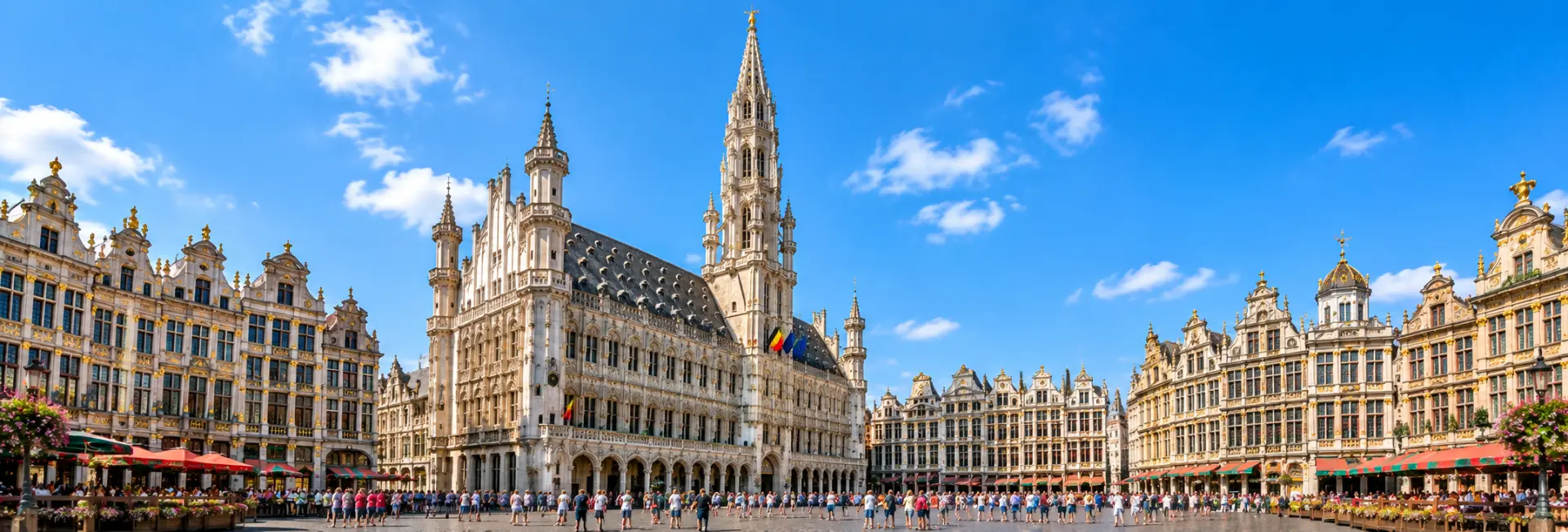
Rising above the cobblestones of Brussels' Grand Place, the Town Hall is the single building that gives the square its silhouette. Its lace-like stone facade and needle-thin spire have watched over the city center since the 1400s, surviving a devastating bombardment and outlasting nearly every building that once stood around it in its original medieval form.
Unlike most of Europe's grand civic buildings, the Town Hall still does the job it was built for: it remains the seat of the City of Brussels' municipal government, hosting council meetings and civil wedding ceremonies inside the same halls where medieval guild leaders once debated city affairs.
History
Origins and Construction
Work on the Town Hall began in 1401 with its eastern wing, generally credited to the master mason Jacob van Thienen. At the time, the building was conceived as a single, modest wing paired with a short belfry, without any grand plan for further expansion.
That changed once craft guilds gained a formal role in the city's traditionally patrician government, creating demand for a much larger seat of power. A second, longer wing rose on the opposite side starting in 1444, and the connecting tower and spire followed over the next decade, bringing the building close to its present form by 1455.
Destruction and Rebuilding
The Town Hall's toughest test came in 1695, when French forces bombarded Brussels during the Nine Years' War. Troops reportedly used the tower itself as a targeting point, and the surrounding Grand Place was reduced to rubble within days. Remarkably, the tower and much of the main structure withstood the attack, and the guildhalls around it were rebuilt within a few years in the Baroque style visible today.
Later Additions
Three classicist rear wings were added in the early 1700s to give the growing city government more working space, and a long run of 19th-century restorations replaced weathered stonework and added the ranks of statues that now cover the facade. These changes updated the building's fabric without altering the Gothic character of its original front.
Architecture & Design
Brabantine Gothic Style
The Town Hall is considered one of the finest surviving examples of Brabantine Gothic civil architecture, a regional style known for tall pointed windows, dense tracery, and richly decorated stonework applied to a secular rather than religious building. Its facade is organized in tight vertical bays that draw the eye straight up toward the tower.
The Tower and Spire
The building's defining feature is its 96-meter openwork spire, designed by Jan van Ruysbroeck and completed in the 1450s. At its summit stands a gilded statue of the Archangel Michael, patron saint of Brussels, shown slaying a demon; the figure also doubles as a weathervane, turning slowly with the wind.
The Famous Asymmetry
Look closely and the facade is noticeably off-center: the tower does not sit in the middle of the building, and the two wings differ subtly in length and detailing because they were built decades apart by different architects. A popular legend claims the builder threw himself from the tower in despair upon noticing the mismatch, though most historians view the asymmetry simply as the practical result of a project completed in stages rather than from a single unified plan.
The Facade Statues
Between 1844 and 1902, close to 300 stone figures were added across the exterior, carved from imported French stone by a range of sculptors. They depict dukes, duchesses, saints, and allegorical figures, effectively turning the building's skin into a stone chronicle of Brussels' history and civic values.
Recognition & UNESCO Status
The Town Hall was officially classified as a protected historical monument in 1936, recognizing it as an irreplaceable piece of Brussels' medieval fabric. It is the only building on the Grand Place to have survived the 1695 bombardment in something close to its original medieval form.
In 1998, UNESCO inscribed the Grand Place as a whole onto the World Heritage List, citing the square as an outstanding example of the eclectic architectural styles that shaped a major European trading city between the 15th and 18th centuries. The Town Hall, as the square's oldest and most architecturally significant building, sits at the center of that recognition.
What to See There
The Exterior
Even without going inside, the Town Hall rewards a slow look: gargoyles jut from the roofline, hundreds of carved figures fill the facade niches, and the spire's tracery becomes more intricate the higher it climbs. Evening lighting on the Grand Place brings out the depth of the stonework in a way that's easy to miss in daylight.
The Interior
Guided tours give access to the building's ceremonial rooms, including ornately decorated council and reception halls hung with historic tapestries and paintings depicting Brussels' civic and guild history. The Gothic Hall, one of the oldest surviving interior spaces, is a highlight for visitors interested in the building's medieval core rather than its later additions.
- Carved gargoyles and roofline sculpture
- Nearly 300 facade statues of historical and allegorical figures
- Historic tapestries and paintings in the reception rooms
- The Gothic Hall, part of the original medieval structure
- The gilded Saint Michael statue atop the spire
Ways to Experience It
Most visitors take in the Town Hall as part of a walk around the Grand Place, pausing to photograph the facade from across the square or from one of the surrounding cafes. Many Brussels walking tours stop here specifically to explain the building's construction history and the story behind its asymmetry.
For a closer look, guided interior tours run in French, Dutch, and English and cover the council chambers, historic artwork, and architectural details not visible from outside. Some city discount passes include interior access, which is worth checking before planning a visit, since the building operates on a limited public tour schedule around its ongoing use as a working government office.
Best Time to Visit
Early morning is the quietest time to see the facade before tour groups and market stalls fill the square. Late afternoon and evening are popular for photography, since the Town Hall and surrounding guildhalls are illuminated after dark, giving the stonework a different character than in daylight.
Visiting in August of an even-numbered year adds a bonus: the Grand Place hosts its biennial Flower Carpet, when thousands of begonias are laid out directly in front of the Town Hall. Expect much larger crowds during this event, so arrive early if seeing the flower carpet is a priority.
Visitor Tips
- Interior visits are only possible on a guided tour, so check current tour days and languages before arriving rather than expecting walk-in access
- Because the building remains an active seat of government, tours can be cancelled on short notice for official events or ceremonies
- Accessibility inside the building is limited due to its historic staircases, so travelers with mobility needs should confirm options in advance
- The Grand Place is pedestrian-only, so the closest useful public transport is the Bourse/Beurs premetro stop or Brussels-Central train station, both a short walk away
- Photographers get the least crowded shots of the full facade early in the morning, before market stalls or event setups fill the square
Nearby Attractions
The Town Hall sits directly across the square from the King's House, a neo-Gothic building now home to the Brussels City Museum, which displays artifacts and artwork tracing the city's history, including the extensive wardrobe of the Manneken Pis statue.
The Manneken Pis statue itself is a short walk from the Grand Place, as are the elegant glass-roofed Galeries Royales Saint-Hubert, one of Europe's oldest shopping arcades. The guildhalls ringing the Grand Place, each with its own carved facade and history, make for a natural extension of a Town Hall visit.
FAQs about visiting Brussels Town Hall
How old is Brussels Town Hall? +
Construction began in 1401 and the building reached its present form by 1455, making it well over 600 years old and the only surviving medieval building on the Grand Place.
Can you go inside Brussels Town Hall? +
Yes, but only as part of a guided tour, since the building remains a working seat of government; interior visits are not available as casual walk-ins.
Is Brussels Town Hall part of a UNESCO World Heritage Site? +
Yes, it is included in the Grand Place's UNESCO World Heritage listing, granted in 1998 for the square's exceptional architectural ensemble.
Why is the Town Hall's facade asymmetrical? +
The two wings and the tower were built decades apart by different architects without an original master plan, resulting in a tower that is off-center and wings of slightly different lengths and detailing.
How tall is the Town Hall's tower? +
The spire reaches 96 meters and is topped by a gilded statue of the Archangel Michael slaying a demon.
Is Brussels Town Hall free to visit? +
Viewing the exterior on the Grand Place is free at any time, but interior guided tours typically require a ticket or inclusion in a city discount pass.
Is the Town Hall wheelchair accessible? +
Accessibility is limited due to the building's historic staircases and layout, so visitors with mobility needs should confirm current options before planning an interior visit.
What's the best time to photograph the Town Hall? +
Early morning offers the fewest crowds, while evening brings out the facade's detail once the Grand Place is illuminated.