
Table of Contents
Overview
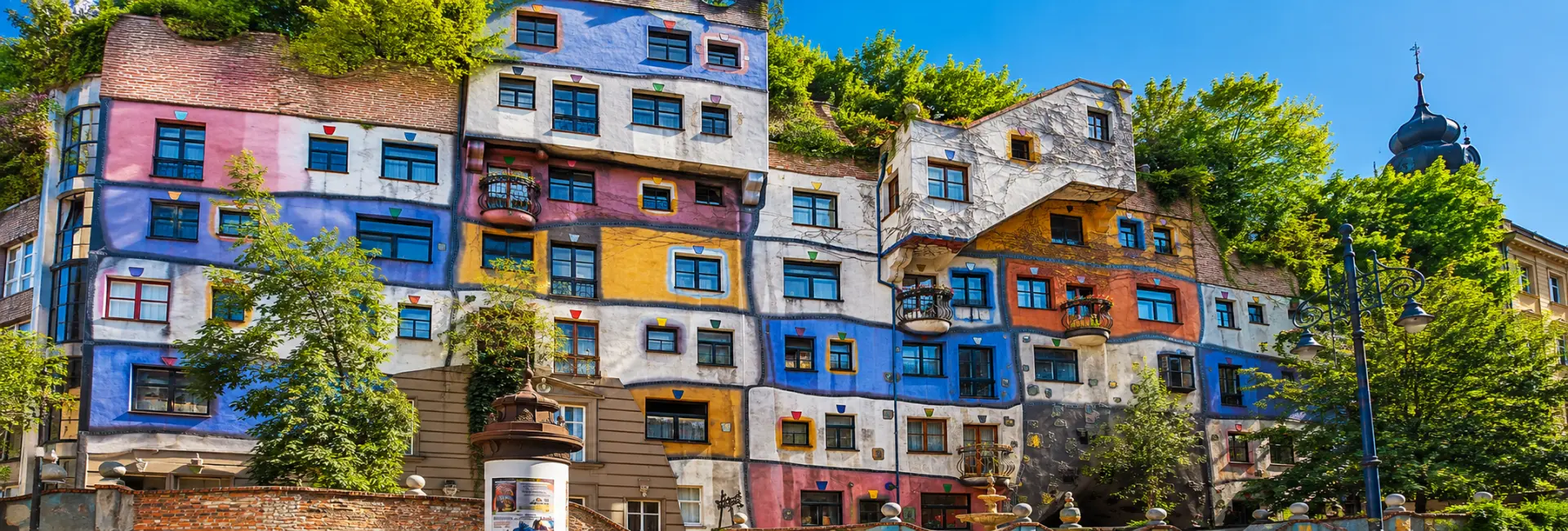
The Hundertwasserhaus is a municipal apartment building in Vienna's Landstraße district, instantly recognizable for its uneven floors, irregular windows, rooftop trees, and patchwork of bright colors. Designed by Austrian artist Friedensreich Hundertwasser, it stands as a direct rejection of the straight-line, uniform apartment blocks common in mid-20th-century urban housing.
Since its completion in 1985, the building has become one of Vienna's most photographed sights, even though it remains a working residential building that visitors can only view from the outside. Its playful, almost storybook appearance has made it a landmark well beyond Austria, and it continues to draw comparisons to the organic architecture of Antoni Gaudí.
History
From Political Suggestion to Building Project
The project began in 1977, when Austrian Federal Chancellor Bruno Kreisky wrote to Vienna's mayor, Leopold Gratz, suggesting that Hundertwasser be given the chance to realize his architectural ideas through a housing project. Gratz followed up with a formal invitation later that year, asking Hundertwasser to design an apartment building based on his own vision of architecture in harmony with nature.
Bringing the Design to Life
Architect Josef Krawina was brought in to help translate Hundertwasser's ideas into a workable design and produced early drawings and a model. When Krawina proved unwilling to draft the detailed facade plans Hundertwasser wanted, architect Peter Pelikan of the city's town planning department took over the technical execution of the project.
Construction and Opening
The foundation stone was laid in August 1983, and the building was substantially complete by 1985, when it opened to public visitors for a widely attended open house that September. Its formal inauguration followed in February 1986, by which point the building had already begun attracting international press attention for its unconventional design.
Architecture & Design Philosophy
No Straight Lines
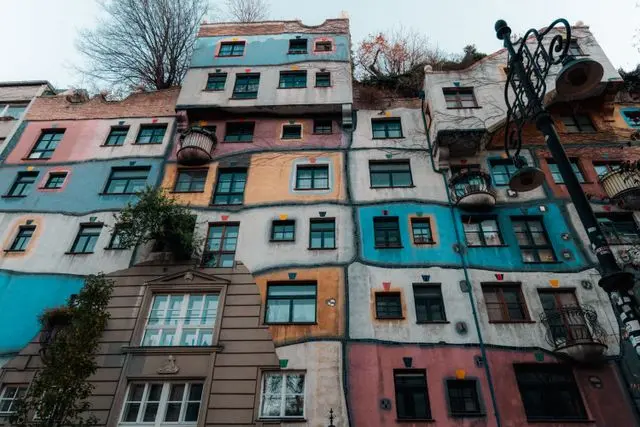
Hundertwasser believed strongly that straight lines and rigid grids were unnatural and alienating, and the building reflects that conviction throughout: floors undulate rather than lie flat, window frames vary in shape and color from one apartment to the next, and facades ripple rather than run in even planes.
Individuality by Design
Residents were given the right to decorate the area immediately around their own windows however they liked, reinforcing Hundertwasser's belief that individual expression should be visible even within a shared building, rather than smoothed over into architectural uniformity.
Nature Built In
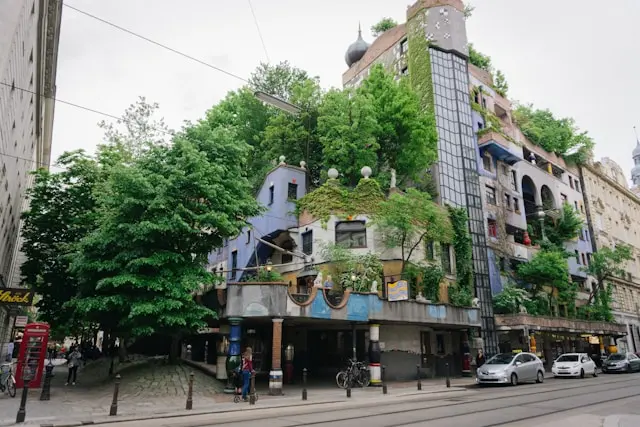
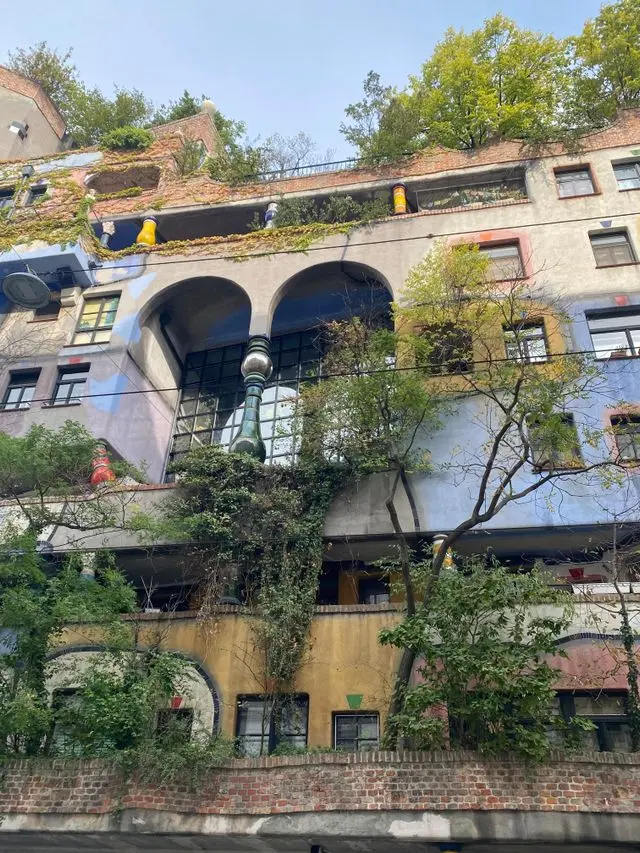
Around 250 trees and shrubs were planted across the building's rooftops and terraces, some rising directly out of interior rooms with their branches extending through openings in the facade, a feature Hundertwasser referred to as giving the building its own "tree tenants."
Notable Features & Highlights
A few details capture what makes the Hundertwasserhaus distinct even among Vienna's other architectural landmarks:
- Uneven, gently sloping floors throughout the building reflect Hundertwasser's belief that irregular ground underfoot connects residents more directly to nature.
- No two windows on the facade are identical, with varied shapes, colors, and frames giving each apartment its own visible identity from outside.
- Roof and terrace greenery includes trees growing from within apartments, their branches and leaves visible poking through the building's exterior.
- The building includes not just apartments but a doctor's practice and a small café, blending everyday functions into its eccentric design.
Cultural Significance
The Hundertwasserhaus remains part of Vienna's public housing stock, owned by the city and rented out to residents rather than operated as a museum or hotel. That combination, ordinary municipal housing wrapped in one of the most unconventional building designs of the 20th century, is central to its appeal and to Hundertwasser's own belief that beautiful, humane architecture shouldn't be reserved for the wealthy.
The building helped cement Hundertwasser's reputation as an architect as well as a painter, and it remains his best-known built work, cited alongside his other design that give ordinary infrastructure, like a district heating plant elsewhere in Vienna, the same imaginative treatment.
Ways to Experience It
Since the building itself is private housing, most visitors experience it from the outside rather than stepping inside apartments.
- Walk around the exterior at the corner of Kegelgasse and Löwengasse to take in the building's colors, curves, and rooftop greenery from different angles.
- Visit the Hundertwasser Village, a small shopping arcade directly across the street, designed in a similar style and open to the public.
- Continue on to the KunstHausWien museum, a short walk away, which is dedicated to Hundertwasser's paintings and architectural projects and occupies a building he also redesigned.
- Stop at the building's small terrace café for a closer look at part of the structure open to visitors.
Visiting Etiquette & Tips
A few practical points help visitors make the most of a stop here.
- Remember that this is an occupied residential building, so keep noise down and avoid entering areas reserved for residents.
- The building isn't directly served by a metro station, so plan for a short walk from the nearest stop or a tram ride to Hetzgasse.
- Visiting the nearby Hundertwasser Village adds an accessible, walkable extension to a visit, since the house itself can't be entered.
- Combine a visit with the KunstHausWien museum if you want to see more of Hundertwasser's work beyond the building's exterior.
- Photographs of the building are best taken from across the street, where the full facade and rooftop greenery are visible at once.
Best Time to Visit
Because the building is only viewed from outside, weather and light matter more here than crowd levels: a sunny day brings out the building's colors most vividly, while the rooftop trees and shrubs look their fullest during spring and summer.
Weekday visits tend to mean a quieter street to photograph from, though the Hundertwasserhaus rarely gets as crowded as Vienna's larger indoor attractions, making it a flexible stop to fit into a broader day of sightseeing.
Nearby Attractions
The Hundertwasserhaus sits in a quieter residential pocket of Vienna's third district, with a few related sights close by.
- The Hundertwasser Village, directly across the street, offers shops and cafés designed in a complementary style.
- KunstHausWien, a museum dedicated to Hundertwasser's art and architecture, is about a 400-meter walk away.
- The Stadtpark and the Wien Mitte transit hub are both within easy walking distance for those continuing on to the inner city.
- The Prater and its Giant Ferris Wheel are a short tram or transit ride away for those combining sights in the surrounding districts.
FAQs about visiting the Hundertwasserhaus
Can I go inside the Hundertwasserhaus? +
No, it remains an occupied residential building, so visitors can only view it from the outside; the nearby Hundertwasser Village, however, is open to the public.
Who designed the Hundertwasserhaus? +
Austrian artist Friedensreich Hundertwasser conceived the design, working with architects Josef Krawina and later Peter Pelikan to turn his ideas into a buildable structure.
When was the Hundertwasserhaus built? +
Construction began with the foundation stone laid in 1983, the building was substantially complete by 1985, and it was formally inaugurated in February 1986.
Why doesn't the building have straight lines? +
Hundertwasser believed straight lines and rigid grids were unnatural, so he designed the building with uneven floors, varied window shapes, and rippling facades instead.
Is the Hundertwasserhaus still used as housing today? +
Yes, it remains part of Vienna's municipal housing stock, with residents renting apartments inside a building otherwise known mainly as a tourist attraction.
What else is nearby related to Hundertwasser? +
The Hundertwasser Village sits directly across the street, and the KunstHausWien museum, dedicated to his art and architecture, is about a 400-meter walk away.
How do I get to the Hundertwasserhaus? +
The nearest U-Bahn stations, Landstraße-Wien Mitte and Rochusgasse, are roughly a 10-minute walk away, or tram line 1 stops at Hetzgasse just a short distance from the building.
