Table of Contents
Overview
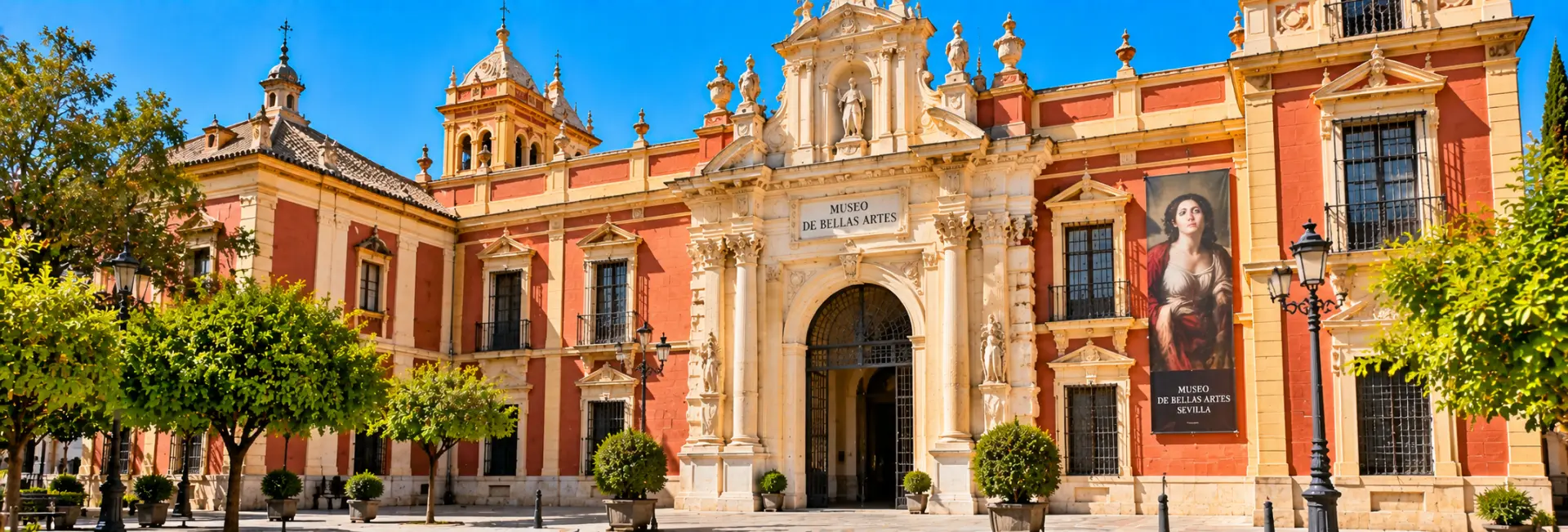
The Museum of Fine Arts is Seville's principal art gallery and, by most accounts, the second most important fine arts museum in Spain after Madrid's Prado. It occupies a former 17th-century convent arranged around three quiet cloistered courtyards, so a visit doubles as a walk through a striking piece of Andalusian architecture as much as a tour of the paintings themselves.
The collection leans heavily on Sevillian painting of the 17th-century Golden Age, with entire rooms devoted to homegrown masters such as Bartolomé Esteban Murillo and Francisco de Zurbarán, alongside earlier Gothic-era religious art and later works stretching into the 20th century. Because the building itself was never designed as a museum, the experience feels layered: gilded altarpieces sit in a former convent church, and canvases line galleries that were once monastic cells and cloister walks.
History of the Museum
A Convent Built on Reconquest-Era Land
The site's story predates the museum by centuries. Shortly after Seville was retaken from Muslim rule in 1248, King Ferdinand III granted land here to the Order of Mercy, and the friars established the Convento de la Merced Calzada, dedicated to the Assumption. For roughly three and a half centuries the site functioned purely as a working monastery, home to a religious community rather than any kind of public gallery, and it commissioned altarpieces and devotional paintings for its own use from the leading Sevillian artists of the day.
The convent that visitors see today largely dates from a major rebuilding campaign in the early 1600s, ordered by the head of the order, Fray Alonso de Monroy, and carried out under the architect and sculptor Juan de Oviedo y de la Bandera. The older Mudéjar-era convent was pulled down to make way for it, and the new church was completed by 1612, with associated cloister and support buildings finished over the following decades. The result was considered one of the finest examples of Andalusian Mannerist architecture built in Seville during that period.
From Suppressed Convent to Public Museum
The convent's religious life ended abruptly in the 1830s, when Spain's liberal government under Prime Minister Mendizábal seized church properties nationwide in a wave of confiscations known as the desamortización. Convents and monasteries across the region were closed, their communities dispersed, and their artworks nationalized rather than left to be sold off piecemeal or lost. A royal decree of September 1835 established a "Museum of Paintings" specifically to gather and display the works pulled from Seville's suppressed religious houses, and the collection opened to the public within the former Merced building by the early 1840s.
For part of its early life the building did double duty: pieces recovered from Roman-era excavations at nearby Itálica were also kept here, and it was not until the early 1940s, when Seville's archaeological collections moved into a purpose-built pavilion left over from a 1929 exhibition, that the Merced building became dedicated solely to painting and sculpture.
Later Restorations
Since then the building has gone through several rounds of restoration rather than one single renovation. Work in the late 19th century repaired arches and floors and relaid the cloisters with salvaged convent tiles; a mid-20th-century campaign opened a new courtyard on the site of the old vestry and relocated the convent's grand Baroque facade to face Calle Bailén; and a lengthy restoration completed in the early 1990s brought the whole complex up to modern museum standards, improving climate control and visitor circulation while preserving its historic fabric.
Architecture & Building
The museum is built around three separate courtyards rather than a single central patio, each with its own character, ranging from quiet cloister walks lined with orange trees to the more formal space created during the 1940s remodel. Slender columns, coloured tilework, and softly worn stone give the courtyards a hushed, monastic feel that survives despite the building's change of purpose, and each one offers a place to pause and look back at the paintings just seen before moving on to the next wing.
A monumental staircase, capped with a decorated dome, connects the ground and upper floors and is considered one of the finest examples of its kind in Andalusian Mannerist architecture. The undisputed centrepiece, though, is the former convent church, which keeps its coffered ceiling and gilded retable and now serves as the museum's grandest single gallery, purpose-built centuries ago for exactly the kind of large devotional canvases it now displays.
Later restorers went out of their way to preserve small physical traces of the building's monastic past rather than smoothing them over: sections of exposed brickwork, old cell doorways repurposed as gallery entrances, and even lime-covered fresco fragments uncovered during 20th-century repair work were left visible in places, giving attentive visitors glimpses of the convent underneath the museum.
Collections & Exhibits
The permanent collection traces Spanish art from the medieval period through to the early 20th century, but its heart is unmistakably the 17th-century Sevillian school. Major holdings include work by Murillo, Zurbarán, Juan de Valdés Leal, Francisco de Herrera the Elder, and Francisco de Herrera the Younger, much of it originally painted for the very convents and churches that were later suppressed and stripped of their altarpieces.
Because the founding collection was assembled from confiscated religious houses rather than purchased with a single collector's taste in mind, the range on display is broader than the Baroque focus might suggest. Earlier rooms hold Gothic and early Renaissance devotional panels, some of them among the oldest paintings in any Andalusian public collection, while later galleries carry the story forward into 19th- and 20th-century Spanish painting, added well after the original 1830s confiscations through donations and later acquisitions.
- Gothic and early Renaissance devotional panels, some of the oldest works on display
- An entire former church gallery dedicated to Sevillian Baroque masterpieces
- Sculpture, ceramics, gold and silverwork, and period furniture alongside the paintings
- A smaller but notable group of 19th- and early 20th-century Spanish works added long after the original confiscated collection
- Decorative arts drawn from the region's convents, including vestments, liturgical silver, and carved woodwork
Must-See Highlights
A dedicated room built around Murillo's work is usually the first stop for most visitors, gathering several of his large religious canvases in one setting close to how they might once have been viewed inside a church. Just outside the museum's entrance, a bronze statue of Murillo stands in the small square, marking his enduring association with the building.
The former convent church itself is worth treating as a highlight in its own right rather than simply a room to pass through: its scale, coffered ceiling, and gilded altarpiece give a sense of how these paintings were originally meant to be seen, lit from above rather than under gallery spotlights. According to local tradition, Murillo used to sit and rest on a stone in the convent's courtyard during his years working in Seville, a stone said to survive today within one of the museum's patios.
Beyond the Murillo room, look out for the canvases by Francisco de Zurbarán, whose stark, sculptural treatment of monks and saints offers a deliberate contrast to Murillo's softer style, and for the dramatic, almost theatrical religious scenes by Juan de Valdés Leal in the adjoining galleries. Together the three painters make the museum's central rooms a compact but thorough introduction to what set Seville's 17th-century school apart from painting being produced elsewhere in Spain at the same time.
Ways to Experience It
Most visitors move through the museum independently, following the numbered route of galleries around the courtyards, with information panels in Spanish and English posted throughout the building.
- Self-guided visits using the posted gallery information, the most common way to see the museum
- Occasional temporary exhibitions that draw on the permanent collection or bring in loaned works
- Group and school visits, which can be arranged in advance through the museum
- Late opening hours on several weekday evenings, useful for avoiding the midday heat in summer
Best Time to Visit
The museum keeps notably long hours on weekday afternoons and evenings, which makes early evening a comfortable time to visit outside of the summer's hottest midday hours. Weekday mornings tend to be quieter than weekends, when the museum draws more of a mix of locals and visitors.
Because several of the galleries and courtyards are open-air or unheated, spring and autumn offer the most comfortable temperatures for lingering in the cloisters between rooms, while a summer visit is best planned for the cooler parts of the day.
Visitor Tips
Admission has traditionally been kept deliberately low, and free for citizens and residents of the European Union, though policies and prices can change, so it's worth checking the current rules before visiting, especially if paying at the door.
- Bring cash, since the ticket desk has historically not accepted cards
- Check the museum's weekly schedule in advance, as it is closed on Mondays
- Bag lockers are available near the entrance for larger bags and backpacks
- The collection is overwhelmingly religious in subject matter, worth knowing if that isn't of interest
- Galleries are spread across two floors around three courtyards, with lifts available between levels
Nearby Attractions
The museum sits just outside the busiest tourist core of Seville's old town, close enough to combine with a wider day of sightseeing in the historic centre.
- Metropol Parasol, the large wooden structure and public square in La Encarnación
- Seville Cathedral and the Giralda tower, a short walk into the old town
- The Real Alcázar, the city's royal palace and gardens
- Plaza de la Magdalena and the surrounding shopping streets of the historic centre
FAQs about visiting the Seville Museum of Fine Arts
What is the Seville Museum of Fine Arts known for? +
It's known for its collection of 17th-century Sevillian Golden Age painting, especially works by Murillo and Zurbarán, displayed inside a former convent building.
Is it free to visit? +
Admission has traditionally been free for European Union citizens and residents, with a small charge for other visitors, though it's worth checking current pricing before your visit.
How much time should I plan for a visit? +
Around one to two hours is enough to see the main galleries and courtyards without rushing, longer for anyone keen to read every information panel.
Do I need to book tickets in advance? +
Advance booking generally isn't required, though it's worth arriving earlier in the day during busy seasons to avoid any queue at the entrance.
What days and hours is the museum open? +
The museum is typically closed on Mondays and keeps long hours on other weekdays, including evening openings; Sunday hours usually run shorter than the rest of the week, so it's worth confirming the current schedule before visiting.
Is the museum suitable for children? +
It can work well for older children interested in art or history, though the collection is largely religious painting from past centuries, which may hold less appeal for very young visitors.
Is the building itself accessible? +
The main galleries are arranged across two floors with lifts available, though the older courtyards and thresholds typical of a historic convent mean some paths are less level than a purpose-built modern museum.
What's nearby if I want to combine it with other sights? +
It's a short walk from Metropol Parasol, the Seville Cathedral and Giralda, and the Real Alcázar, making it easy to fit into a wider day in the historic centre.