
Table of Contents
Overview
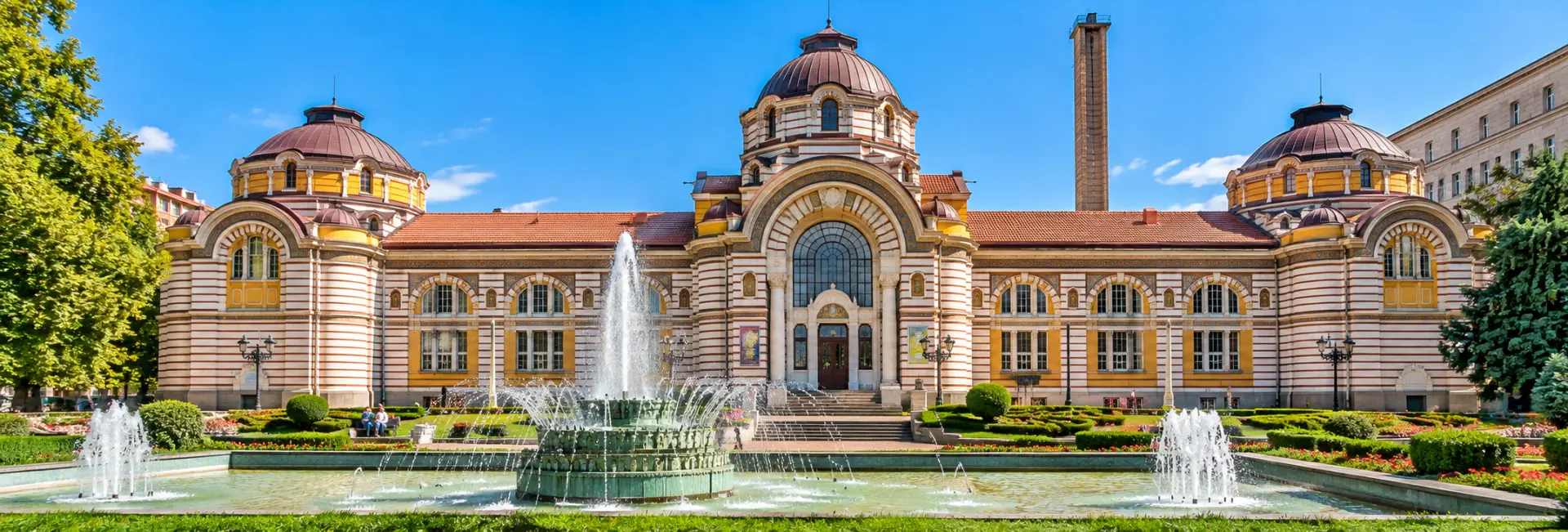
The Central Mineral Baths is one of the most eye-catching buildings in central Sofia. With its patterned brickwork, colourful ceramic decoration and rounded forms, it looks unlike the neoclassical and socialist buildings around it. For decades it was where the city's residents came to bathe in hot spring water, and today it houses the Sofia History Museum.
The building stands on Banski Square, right beside the Banya Bashi Mosque, in a part of the city that has been associated with hot springs since Roman times. That long link between the city and its mineral water is the key to understanding both the building and the neighbourhood.
A visit combines several things in one stop: a close look at a landmark of early twentieth-century Bulgarian architecture, a museum that tells the story of Sofia from prehistory to the 1940s, and a chance to see the public fountains where locals still fill bottles with warm mineral water. The sections below explain the history, the design and how to plan your time.
History
Roman and Ottoman Roots
Hot mineral springs have been used in this part of Sofia since the days of Roman Serdica, and the water became part of the city's identity. Under Ottoman rule, public baths were an important part of town life. A Bohemian traveller who visited Sofia in the mid-sixteenth century described a large domed bath near the square, richly covered in white marble, with clay pipes carrying the water inside. The old Ottoman bath that stood nearby was later destroyed.
Planning a New Bathhouse
After Sofia became the capital of modern Bulgaria, the authorities wanted a modern public bath in the centre. Earlier proposals were set aside, and the plan that was approved in January 1906 was the work of the architects Petko Momchilov and Friedrich Grünanger. Raw construction was finished in 1908, and a smaller part of the complex began to serve the public in the following years.
Opening and Popularity
The baths were officially opened on 13 May 1913, and the surrounding garden and remaining work were completed about two years later. The complex included large swimming pools, family baths and Roman-style baths, all fed by the mineral springs beneath the building. It quickly became a popular gathering place where residents bathed, relaxed and caught up with friends.
Damage, Decline and Closure
During the Second World War, the north wing was badly damaged in the bombing of Sofia. It was restored in the following years and the baths continued to operate. By 1986 the building was in poor condition, with concerns about the stability of the roof, and it was closed to the public.
A New Life as a Museum
Restoration began in the 1990s and continued for many years. The building became the home of the Sofia History Museum, which opened its permanent exhibition officially on 17 September 2015. The museum itself had been founded in 1928 but had lacked a suitable building for decades, so the former baths gave it a long-awaited permanent home.
Architecture & Design
A Secession Landmark with Bulgarian Character
The building was designed in the Vienna Secession style, a modern fashion of its time, but its creators blended it with Bulgarian, Byzantine and Orthodox decorative motifs. The result is a building that feels both contemporary for the early twentieth century and rooted in local tradition. Scholars note the layered composition, the dynamic changes of form across the facade and the flexible interior spaces that were typical of Secession design.
Majolica and Brickwork
The most striking details are the colourful glazed ceramics, known as majolica, that decorate the exterior. The artists Haralampi Tachev and St. Dimitrov designed these panels, which include friezes and medallions with sacred images. They sit within walls that mix stone and brick in alternating bands, a technique that gives the facade its lively, rhythmic texture. Layered arched openings and stone pillars recall the architecture of early medieval Bulgaria.
Layout and Setting
The complex is arranged with a main entrance block, wings on either side and a garden in front. The garden, with benches and open space, makes the building easy to view from a distance and gives the square a calm, civic feel.
The Sofia History Museum Inside
The Sofia History Museum tells the story of the city across thousands of years, and the building itself adds to the experience. The permanent exhibition runs from the Neolithic period, in the sixth millennium BC, to the 1940s, and is arranged across a series of halls. Exact hall counts differ between sources, but the structure is chronological and thematic.
- Ancient Legacy: archaeological finds that show how people lived in the area from prehistory through the Roman period, including a reconstructed Neolithic house.
- Revival and the modern capital: displays covering the Bulgarian Renaissance and the years after Sofia became the national capital.
- A Sofia Street: a recreated slice of everyday urban life, with shops and details such as an old newsstand.
- State and municipal institutions: displays on how the capital was governed and how it grew after the Liberation.
- Home and clothing: costumes and household items that show how residents dressed and lived.
- Culture and leisure: exhibits about entertainment, public life and social habits in the modern city.
- Temporary exhibitions: a dedicated space with changing displays on different aspects of Sofia's past.
Among the items visitors often mention are costumes and carriages, a clock reportedly given to Prince Ferdinand and short films about the city shown inside a model of an old tram. The museum holds a very large collection overall, with many thousands of artefacts in its care, so the displays are selective and rotate over time.
Mineral Springs and Fountains
The mineral water is as much a part of the attraction as the building. Sofia is known for its many mineral springs, and the area around Banski Square is the best place to see how that water is still used in daily life.
The Public Fountains
Near the building you will find fountains where hot or warm mineral water flows from the tap. Locals come with bottles and containers to fill them, and the queue can be long on busy days. A small fountain beside the baths building offers a chance to taste the water, and larger fountains are located across the street.
Why the Baths Are Closed
Although the building is named for its baths, they no longer operate as public baths. They closed in 1986, and the building is now a museum. Many residents have discussed whether it should have been restored as a working bathhouse instead, a debate that shows how much the city's mineral water culture still matters to people.
Tasting and Using the Water
The water is warm, mineral in taste and not like normal drinking water, so try a small amount first. Use the fountains respectfully, avoid blocking the line for local users and follow any notices posted about the water.
Ways to Experience It
- Visit the museum: allow time for the permanent exhibition, which gives a clear overview of Sofia's history and makes a good starting point for a day of sightseeing.
- Admire the exterior: walk around the building to study the majolica panels, arches and brickwork from different angles.
- Sit in the garden: the benches in front of the building are a pleasant place to rest and watch city life.
- Try the mineral water: see the public fountains and, if you wish, taste the water or fill a bottle like the locals do.
- Build a walking route: combine the baths with the Banya Bashi Mosque, the Central Market Hall and the Serdica ruins to explore Sofia's old centre on foot.
The museum visit takes about an hour and a half for most people, while a quick exterior look and a stop at the fountains can be done in half an hour.
Best Time to Visit
Time of Year
The museum is open throughout the year, so it works well in any season and is especially useful on cold or rainy days. Late spring and early autumn are the best seasons for enjoying the garden, the fountains and the exterior details in comfortable weather. Winter can be cold and damp, but the museum interior makes it a comfortable season for indoor sightseeing.
Time of Day
Mornings are usually quieter inside the museum, and the light is good for photographing the facade. The fountains are used by locals throughout the day, so if you see a long queue, it is easy to look around the building first and return later.
Visitor Tips
- Check the opening hours: the museum has generally opened daily during the warmer months and has had a weekly closing day in winter, so confirm the current schedule on the official website before you go.
- Look for ticket options: admission is charged, and reduced rates or free days have been offered at times, but these arrangements change.
- Do not expect to bathe: the building is a museum, not a spa, so you cannot use the baths themselves.
- Bring a bottle if you want to fill up: the public fountains are used by locals, and a small container makes it easy to take some water away.
- Try the water in small amounts: the mineral content and warmth are different from normal tap water.
- Look up and around: much of the beauty is in the exterior ceramics and the details of the entrance, so take time outside as well as inside.
- Combine with nearby sights: the mosque, market hall and Roman remains are all within a few minutes on foot.
Nearby Attractions
The baths stand at one of the most interesting corners of the old centre, with several major sights within a short walk.
- Banya Bashi Mosque: the sixteenth-century Ottoman mosque right next door, and the only functioning mosque in Sofia.
- Central Market Hall: a historic covered market built between 1909 and 1911, across the boulevard and a good stop for local food.
- Sofia Synagogue: one of the largest synagogues in Europe, close to the same cluster of places of worship.
- St Nedelya Church: a well-known Orthodox church near the start of Vitosha Boulevard.
- Serdica Archaeological Complex: Roman streets, houses and an early Christian basilica around the Serdika metro station.
- Vitosha Boulevard: Sofia's main pedestrian street for shopping, cafes and strolling.
FAQs about visiting the Sofia Central Mineral Baths
What are the Sofia Central Mineral Baths? +
They are a landmark early twentieth-century bathhouse in central Sofia, opened in 1913 and designed in the Vienna Secession style. The building served as the city's public baths until 1986 and is now home to the Sofia History Museum.
Can I bathe in the Central Mineral Baths today? +
No. The baths closed to the public in 1986 and the building now serves as a museum. You can, however, see the mineral water at the public fountains nearby.
What can I see inside the building? +
The Sofia History Museum displays a chronological exhibition of the city from the Neolithic period to the 1940s, with archaeological finds, recreated street scenes, costumes and changing temporary exhibitions.
When was the building constructed? +
The design was approved in 1906 and the main construction was completed in 1908, but the official opening took place on 13 May 1913. The garden and remaining work were finished a couple of years later.
Who designed it? +
The architects Petko Momchilov and Friedrich Grünanger created the design, and the artists Haralampi Tachev and St. Dimitrov designed the ceramic decoration on the facade.
Is the mineral water safe to drink? +
Locals regularly fill bottles at the public fountains nearby, but the water has a distinctive warmth and mineral taste, so try a small amount first and follow any notices posted at the fountains.
How much time should I spend here? +
Plan on about an hour and a half for the museum, plus a little extra for the garden and fountains. A short stop for photographs and a look at the exterior can take as little as half an hour.
What else can I visit nearby? +
The Banya Bashi Mosque, the Central Market Hall, the Sofia Synagogue, St Nedelya Church and the Serdica Archaeological Complex are all within a short walk.
