
Table of Contents
Overview
Sparrow Hills, known in Russian as Vorobyovy Gory, is a high, wooded bluff on the right bank of the Moskva River in southwestern Moscow. It rises roughly 80 metres above the water and carries one of the best-loved viewpoints in the capital, a platform from which much of the city spreads out below.
The hills are more than a lookout. They are a protected green corridor of slopes, ravines and springs, crowned by the monumental main building of Moscow State University and a small, much older church. Cable-car cabins glide down toward the river, and winding trails lead through the trees to the water's edge.
Because the area combines open views, forest walks, sports history and landmark architecture, it appeals to a wide range of visitors. It is a natural choice for first-time sightseeing, a sunset photo stop or a long, relaxed afternoon outdoors.
History
Village and Name
The hills take their name from the village of Vorobyovo, which was acquired in 1453 by Grand Duchess Sophia of Lithuania from the boyar family of Vorobyov. For centuries the slopes were countryside, with a royal palace and estates, and the area long served as a scenic escape from the crowded city below.
Napoleon and the Planned Cathedral
A popular tradition holds that Napoleon looked out over Moscow from these hills in 1812, and the wooden palace here was lost in the great fire of that year. Afterwards Tsar Alexander I planned to build the Cathedral of Christ the Saviour on the hill, and the first stone was laid in 1817. His successor halted the project, and the cathedral was eventually built near the Kremlin instead.
Lenin Hills
In 1935 the hills were renamed Lenin Hills, a name that stayed in use for decades. The historic name was restored in 1999. During the Soviet period the ridge became home to the university campus and sports venues, reshaping the area into the mix of nature and landmarks seen today.
Nature Reserve & Landscape
The slopes are protected as a nature reserve, created in 1998 and managed since 2013 as part of the Gorky Park group of parks. Despite being only minutes from busy avenues, the reserve supports more than 400 plant species and well over 100 kinds of animals and birds, along with springs and natural ravines.
Trails and Terrain
Three ecological trails climb from the river toward the top, passing through woodland, past small streams and across steep slopes. The walk up is rewarding but can be tiring, so many people choose to ride the cable car down instead. Paths are shaded in summer, which makes them a pleasant break from the heat of the city.
Wildlife and Seasons
Birdsong fills the trees in spring, while summer brings dense foliage and autumn turns the slopes gold. In winter the hillsides are used for walking and, when conditions allow, for simple outdoor recreation.
The View from the Platform
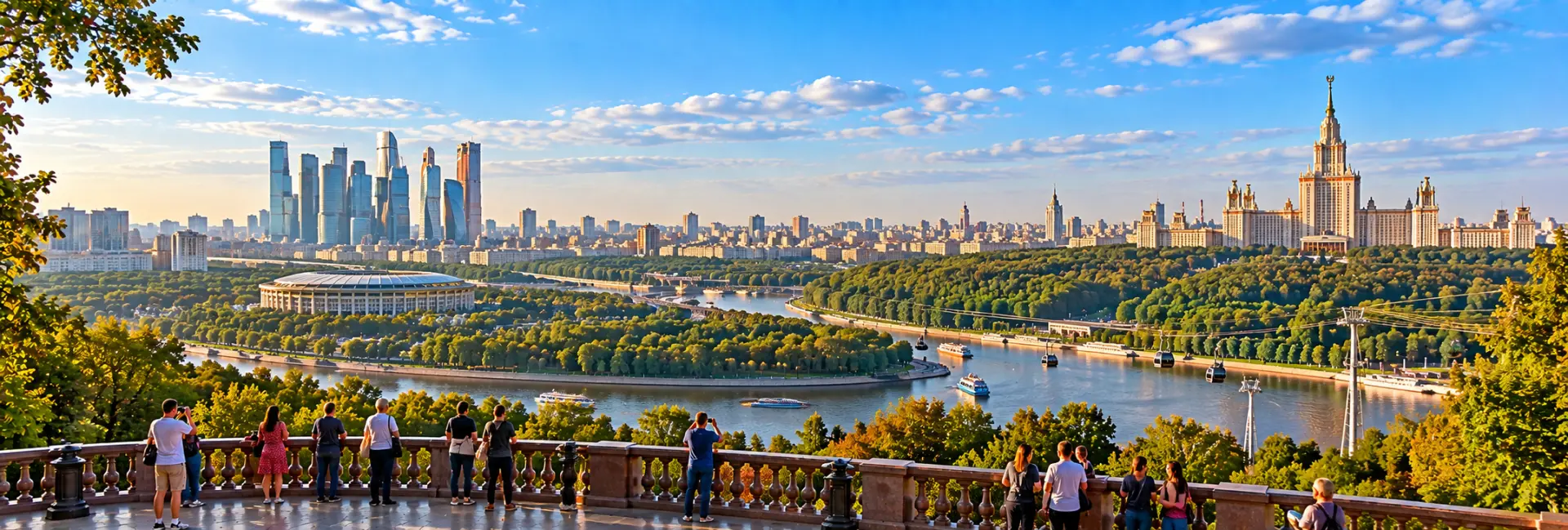
The observation platform sits on the bluff about 85 metres above the river and roughly 200 metres above sea level. From here you look across the Moskva toward the green fields of Luzhniki, the large stadium that hosted the opening and closing ceremonies of the 1980 Summer Olympics.
In clear weather the panorama takes in the golden domes of Novodevichy Convent, the distant towers of the Kremlin, the Cathedral of Christ the Saviour and several of Stalin's Seven Sisters skyscrapers. On the horizon you can also spot the glass towers of Moscow-City, giving a striking contrast between old and new Moscow.
The University Behind You
Turn around and the view changes completely. The main building of Moscow State University rises in tiers toward a central spire, a showpiece of postwar Soviet ambition that was completed in 1953. For a time it was the tallest building in Europe, and it still dominates the hilltop. Its scale is best appreciated from the lawns and avenues that lead up to the entrance, where the symmetry of the wings becomes clear.
Day and Night
The view works equally well in daylight and after dark. By day the colours of the domes and forest stand out, while at night the city lights shimmer below and the university building glows behind you. Sunset is especially popular, so the platform can fill with photographers on clear evenings.
Key Areas & Landmarks
- Observation Platform: the main viewpoint on Kosygina Street, with railings, benches and open space for photographs.
- Moscow State University: the huge main building completed in 1953, one of the Seven Sisters and for years the tallest building in Europe, which rises just behind the viewpoint.
- Trinity Church: a small Empire-style church painted in soft green, the last surviving building of the original village of Vorobyovo and still used for worship.
- Cable Car: enclosed cabins carry passengers from the top of the hill down to the Luzhniki embankment, and the line operates year-round.
- Luzhniki Metro Bridge: a two-level bridge with a glass-walled metro station, Vorobyovy Gory, on its lower level, and one of the more unusual stations in the system.
- Ski Jump: a large jump built in the 1950s as part of the Luzhniki sports complex, visible on the slope near the cable car.
- Picnic Areas: designated spots in the park where barbecues are permitted.
Literary & Cultural Significance
Sparrow Hills have long inspired Russian poets and writers, who saw the slopes as a place to look out over the city and reflect on its life. The most famous literary connection comes from Mikhail Bulgakov's novel The Master and Margarita, in which the devilish company bids farewell to Moscow from this hill before riding away on black horses.
A proposed sculpture honouring Bulgakov was once planned for a small park between the river embankment and Kosygina Street, showing how deeply the author is tied to this landscape in the city's imagination. The hills still feel like a threshold, a place where the capital's bustle falls away and the whole skyline can be seen at once.
The area also reflects Moscow's modern identity. The university building stands for Soviet-era ambitions in education and science, while the nearby stadium recalls the 1980 Olympics. Today the hills have become a social gathering place, where street musicians perform on weekends, cyclists and bikers meet, and locals take evening strolls.
Ways to Experience It
Walk Up from the River
For the full experience, arrive at Vorobyovy Gory metro station, cross the glass-enclosed bridge and follow the ecological trails up through the forest. The climb takes roughly 15 to 20 minutes and delivers the view as a reward.
Ride the Cable Car
Take the cable car from the top down to the river, or reverse the journey if you prefer to start with the view. The cabins offer a gentle, scenic ride over the trees and the river.
Linger and Explore
Spend time on the platform at sunset, walk around the university grounds, visit the small church and explore the paths that run along the slope. If you enjoy outdoor activity, the park is also well suited to jogging, cycling and picnics.
Best Time to Visit
By Season
Late spring through early autumn is best, with leafy trails and comfortable temperatures. September and October add rich autumn colour and clear air that improves the long views. Winter has a quiet, snowy beauty and the cable car keeps running, but it can be icy and very cold on the exposed platform.
By Time of Day
Morning is calm and often best for photographs of the city in soft light. Sunset and early evening attract the biggest crowds, so arrive early to secure a spot at the railing. After dark the illuminated skyline makes a memorable finish to a day of sightseeing.
Visitor Tips
- Getting there: take the metro to Vorobyovy Gory station and walk across the glass-sided bridge and up through the park. A trolleybus also serves Kosygina Street near the platform.
- Cost: the platform and park are free to enter, while the cable car and any guided activities charge separately. Check official sources for current fares and operating hours.
- Weather: the platform is exposed to wind, so bring an extra layer even on mild days, and check conditions before you go since views depend on clear skies.
- Footwear: wear sturdy shoes if you plan to hike the trails, as slopes can be steep and slippery after rain or snow.
- Crowds: weekends and sunset are busiest, so for a quieter visit choose a weekday morning.
- Respect the reserve: stay on marked paths, keep the park clean and only use the designated areas for barbecues.
- Before you travel: entry rules and government travel advice for Russia can change, so check the latest requirements for your nationality well in advance.
Nearby Attractions
The hills sit close to several other highlights, making it easy to build a full day. Directly across the river, Luzhniki Park and its large sports complex offer broad walking areas and views back toward the university hill.
Nearby Novodevichy Convent, a UNESCO-listed monastery with elegant white walls and golden domes, is one of the city's most photogenic religious sites and is often visited alongside the viewpoint. Further along the river, Gorky Park provides a livelier riverside atmosphere with cafés, events and open lawns, and it is easy to reach by metro or a pleasant embankment walk.
FAQs about visiting Sparrow Hills
What are Sparrow Hills known for? +
They are known for the classic panoramic view over Moscow, the Moscow State University skyscraper, a protected nature reserve and a literary link to The Master and Margarita.
Is it free to visit Sparrow Hills? +
Yes, the park and the observation platform are free to visit. The cable car and some guided activities require tickets.
How do I get to the observation platform? +
Take the metro to Vorobyovy Gory station, cross the glass bridge and walk up through the park. The climb takes about 15 to 20 minutes.
How long should I spend there? +
One to two hours is enough for the viewpoint and a short walk. Add more time for the trails, the cable car or a picnic.
When is the best time to see the view? +
Clear days give the longest views, and sunset or early evening is especially atmospheric. Night views of the illuminated city are also popular.
Can I visit Moscow State University? +
The main building is a working university, so access to the interior may be limited. Many visitors admire it from the platform and the grounds, and some guided tours may be available.
Is the cable car open in winter? +
Yes, the cable car is reported to operate year-round, though schedules can change with weather and season, so check before you go.
