
Table of Contents
Overview
The Summer Garden is the oldest garden in Saint Petersburg and one of the city's most loved green spaces. Founded in 1704 by Peter the Great, it sits on a small island of its own, surrounded by the Neva, the Fontanka, the Moika and the Swan Canal, and it lies only a short walk from Nevsky Prospect and the Field of Mars.
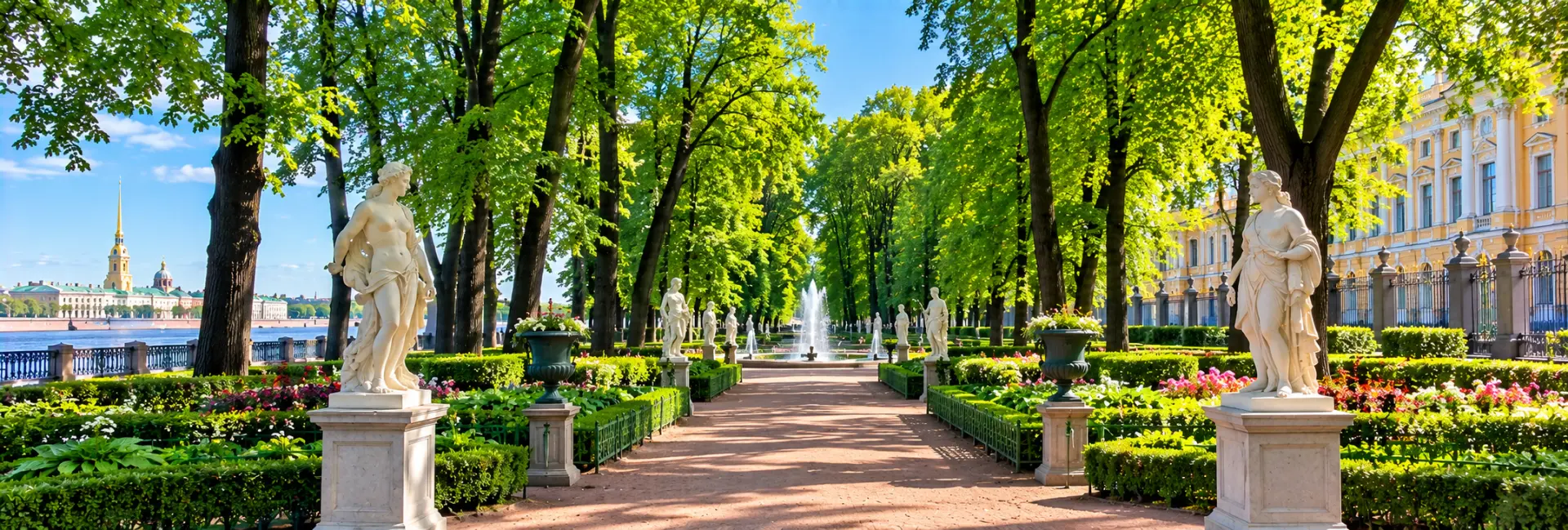
Unlike a modern park, it is a formal garden laid out on strict geometric lines, with straight alleys, clipped hedges, shaded avenues of lindens and marble sculptures standing along the paths. Its most recognizable feature is the delicate cast-iron railing along the Neva side, which is considered one of the symbols of the city.
Today the garden is a branch of the State Russian Museum, which means it is looked after as an open-air heritage site rather than an ordinary public park. It makes an easy and rewarding stop for anyone interested in the early years of Saint Petersburg, in garden history, or simply in a calm walk away from the crowds.
History
Peter's Summer Residence
The garden was begun in 1704 on land that had recently been captured from Sweden during the Great Northern War, on the site of a small Swedish manor. Peter the Great took a personal interest in the design and is said to have drawn up the first plan himself, with help from the Dutch physician and gardener Nicolaas Bidloo. The stone Summer Palace, a modest two-story house, followed in 1710-1712, designed by the architect Domenico Trezzini.
Dutch and French Influences
From 1712 the planting was developed by the Dutch gardener Jan Roosen, who served as chief gardener until 1726. The French architect Jean-Baptiste Le Blond, who arrived in the city in 1716, added the flavor of a formal French garden. By 1719 the garden was largely complete, and it was used for assemblies, receptions and celebrations as well as for quiet walks.
Floods, Change and Public Access
The garden suffered badly in the great floods of 1777 and 1824, losing fountains, trees and statues. Over time it shifted toward a more landscaped look, and from 1755 it was opened to the public on one or two days a week, though initially only to the nobility. In the nineteenth century its sculptures were moved around and the original arrangement was largely forgotten.
War and Restoration
During the Second World War and the Siege of Leningrad the sculptures were buried to protect them, and they were returned to their places in 1945. The garden became part of the Russian Museum in 2004, and a major restoration between 2009 and 2012 recreated many features from Peter's day, including bosquets, fountains and an orangery.
Garden Design & Layout
A Formal Plan
The garden follows the regular style fashionable in early eighteenth-century Europe. Straight alleys cross at right angles, hedges and trellises create green walls, and the whole composition is arranged symmetrically around the Summer Palace and the main paths. The aim was to show off order, wealth and the tsar's taste for Western ideas.
Trees and Planting
The garden's shade comes mainly from lindens and maples, and a few of the oldest lindens are believed to date to Peter's time. Thousands of trees and many thousands of shrubs, including lilac, hawthorn and jasmine, are planted in groups and hedges. In late spring the lilacs add fragrance to many of the paths.
Restored Spaces
- Four recreated bosquets, small enclosed garden rooms framed by hedges
- The Small Orangery and the Red Garden, features of the original design
- Reconstructed fountains and high trellises that serve as backdrops for sculptures
- The Carp Pond, where the porphyry vase given by the King of Sweden was placed in 1839
Sculptures & Fountains
A Collection of Marble Statues
Peter wanted his garden to be filled with sculpture. He had marble statues and busts bought from Italy, many by Venetian sculptors, and by the end of his life the collection numbered more than a hundred works. They represented allegories such as Glory, Architecture, Navigation, Justice and Abundance, together with figures from classical mythology and portrait busts. A group showing Cupid and Psyche, made by a pupil of Bernini, was among the most prized pieces.
Originals and Replicas
After nearly three centuries outdoors, the marble began to deteriorate beyond repair. Beginning in the late twentieth century, the surviving originals were moved indoors, with many now kept at St Michael's Castle, and carefully made copies took their places in the garden. In winter the statues are traditionally covered with wooden cases to protect them from frost, and they are uncovered again in spring.
The Fountains
Peter loved water features, and the garden once had dozens of fountains decorated with scenes from Aesop's fables. The Fontanka River is said to take its name from the garden's fountains. The original fountains were wrecked in the flood of 1777 and not rebuilt for a long time, but the recent restoration brought back a number of them, so that water once again plays among the sculptures in the warmer months.
Buildings & Monuments in the Garden
The Neva Railing
Along the garden's northern edge stands the celebrated railing, designed by the architect Yuri Felten with Pyotr Egorov and installed in the late eighteenth century. Made of slender cast-iron bars topped with gilded ornaments and supported by granite pillars with urns, it has been admired by generations of poets and artists. It is best viewed from the embankment, with the Neva flowing beside it.
The Summer Palace of Peter the Great
The small palace near the Fontanka was the tsar's summer home and one of the oldest surviving buildings in Saint Petersburg. Its simple, practical design reflects Peter's preference for modest comfort over grandeur. It is a branch of the Russian Museum, but it has been closed for restoration at various times, so check whether it is open before you plan to go inside.
Pavilions and Cafes
Several small buildings in the garden, such as the former grotto pavilion rebuilt in the 1820s as a coffee house, add to the atmosphere. The garden has also hosted a tea house with a museum shop, an archaeology display in the Dovecote Pavilion and seasonal cafes, though these arrangements change.
Monument to Ivan Krylov
The statue of the fabulist Ivan Krylov, unveiled in the 1850s and sculpted by Peter Klodt, shows the writer seated among animals from his fables. It was an early monument to a writer in Russia and suits the garden well, since Krylov loved to walk here and Peter's fountains also depicted Aesop's tales.
Ways to Experience It
Walking the Alleys
The simplest and best way to enjoy the Summer Garden is to stroll. A circuit takes around an hour at a relaxed pace, longer if you stop to look at statues and the pond. Benches along the paths invite you to sit and enjoy the shade.
Following Themes
- Look for the allegorical statues and try to identify the figures from their attributes
- Seek out the fountains and the places where the garden's original layout has been recreated
- Walk the length of the Neva railing on the outside for the best photographs
- Pause at the Krylov monument and the Carp Pond
Events and Guided Visits
The Russian Museum arranges excursions and lectures connected with the garden and hosts occasional concerts and festivals there. Check the museum's official calendar if you would like to join a guided visit or see a seasonal event.
Best Time to Visit
Late Spring to Early Autumn
The garden is at its liveliest from late spring to early autumn, when the statues are uncovered, the fountains play, the leaves are full and the lilacs are in bloom. Early summer, with its long white nights, is a particularly atmospheric time for a late walk.
Autumn and Winter
Autumn brings golden light and fallen lime leaves, while winter turns the garden into a quiet, snowy landscape, though the sculptures are boxed up and the fountains are switched off. The garden has traditionally been closed in April while the grounds dry out and the statues are prepared for the new season, and it usually closes on Tuesdays for maintenance.
Time of Day
Mornings are usually the calmest, and the soft evening light is lovely for photographs of the railing. Weather can affect opening, as the garden may close in strong winds, so check conditions before you set out.
Visitor Tips
- Check opening days, hours and any entry conditions on the Russian Museum's official website before you go, as these vary by season and are not fixed here
- Remember the traditional April closure and the weekly closing day when planning your trip
- Entry has generally been free for ordinary visits, but special events can bring different arrangements, so confirm in advance
- Wear comfortable shoes, as the paths are gravel and sand and can be muddy after rain
- Allow about one to two hours, and longer if you plan to visit the Summer Palace or linger in the cafes
- The garden is quite flat and compact, but check the museum's accessibility information if you have mobility needs
- Confirm current travel advisories from your own government and how payments work for foreign visitors, as arrangements for international travelers to Russia can change
The nearest metro stations are Gostiny Dvor, Nevsky Prospect and Chernyshevskaya, each a walk of roughly 20 minutes or more, so many visitors combine the walk with a stroll through the city center.
Nearby Attractions
The Summer Garden sits in a compact area packed with sights, so it fits easily into a wider day of exploring.
- Mikhailovsky Garden and Mikhailovsky Castle: another historic garden and the castle of Emperor Paul, both close by and part of the Russian Museum complex
- The Russian Museum: the country's largest museum of Russian art, a short walk away in the Mikhailovsky Palace
- Church of the Savior on Spilled Blood: the colorful, mosaic-covered church near the Griboedov Canal
- Field of Mars: a broad memorial park just beside the garden
- Fabergé Museum: a stroll along the Fontanka in the other direction
- The Neva embankment: a scenic walk with views across the river
FAQs about visiting the Summer Garden
What is the Summer Garden famous for? +
It is the oldest garden in Saint Petersburg, laid out in 1704 for Peter the Great, and is known for its formal design, marble statues, Peter's small Summer Palace and the beautiful cast-iron railing along the Neva.
Where is the Summer Garden located? +
It sits on an island between the Neva, the Fontanka, the Moika and the Swan Canal in central Saint Petersburg, with its address given as Kutuzov Embankment, 2.
Is entry to the Summer Garden free? +
Ordinary visits have generally been free, but special events or temporary arrangements can change this. Check the Russian Museum's official website for current conditions.
When is the Summer Garden open? +
It has traditionally been open daily except Tuesday, with longer hours in summer and shorter ones in winter, and a closure in April for maintenance. Hours can change, so check the official schedule before you go.
How long does a visit take? +
Plan about one to two hours for a relaxed walk. You may want longer if you visit the Summer Palace, a cafe or the pavilions.
Are the statues in the garden original? +
Most of the statues now outdoors are copies. The surviving originals were moved indoors to protect them, with many displayed at St Michael's Castle.
What is the best season to visit? +
Late spring to early autumn is best, when the fountains run, the statues are uncovered and the trees are in leaf. Winter is quiet and snowy but the statues are covered.
Can I go inside the Summer Palace? +
The Summer Palace of Peter the Great is a museum, but it has been closed for restoration at various times. Check its current status before planning to go inside.
What can I see nearby? +
You can easily combine a visit with the Mikhailovsky Garden, Mikhailovsky Castle, the Russian Museum, the Field of Mars and the Church of the Savior on Spilled Blood, all within a short walk.
