Table of Contents
Overview
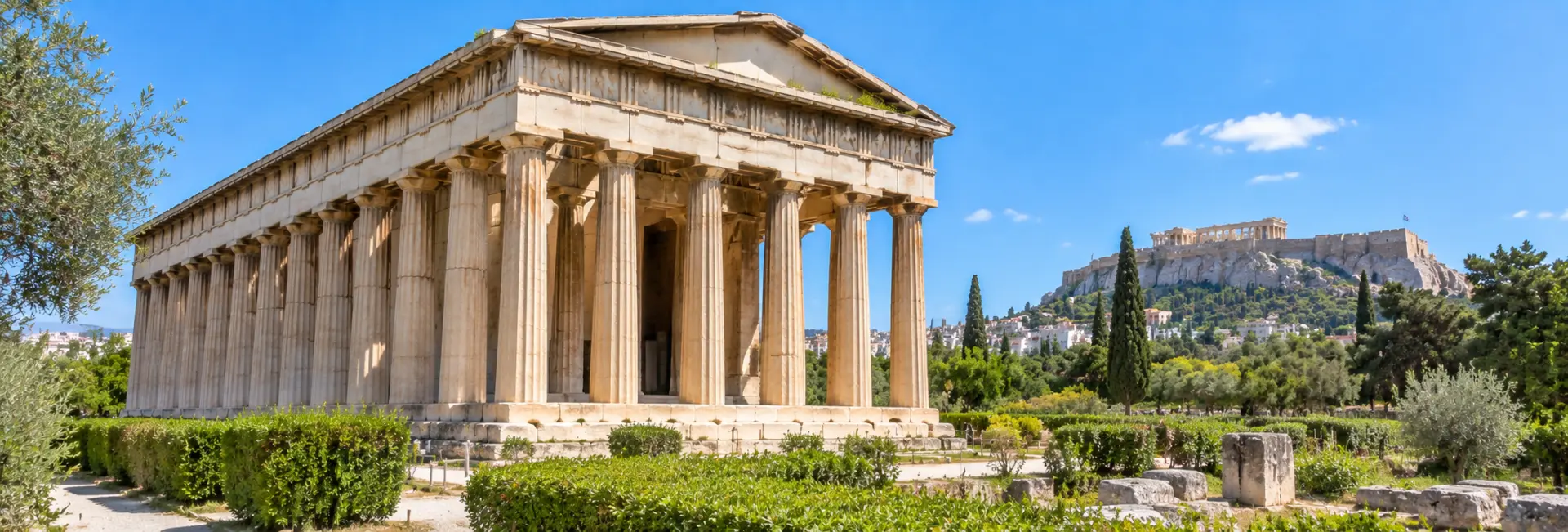
The Temple of Hephaestus, also known as the Hephaisteion, stands on a low hill overlooking the Ancient Agora of Athens. Built in the 5th century BC, it is widely considered the best-preserved ancient Greek temple anywhere in the world, still largely intact with its columns, roof, and sculptural decoration in place, a rarity among monuments of its age.
Dedicated to Hephaestus, the god of fire and metalworking, and to Athena Ergane, patroness of craftsmen, the temple once stood among the workshops of blacksmiths and potters who plied their trades nearby. Its remarkable condition today owes as much to centuries of reuse, first as a Christian church and later as a museum, as it does to the quality of its original construction.
History
A Temple for the Age of Pericles
Construction began around 449 BC, during the same building program that produced the Parthenon under the statesman Pericles. The temple was largely complete by 430 BC, though its roof and cult statues took longer to finish, and it was likely formally consecrated around 415 BC, after roughly three decades of work.
A Site Chosen for Its Craftsmen
The temple was built on the hill of Agoraios Kolonos, overlooking the bustling Agora that served as the commercial and civic heart of ancient Athens. The surrounding area was home to numerous foundries, forges, and pottery workshops, making the hill a fitting home for a sanctuary dedicated to the god of the forge and the goddess of craft.
Centuries of Continuous Use
Unlike many ancient temples that fell into ruin after the decline of pagan worship, the Hephaisteion was converted into a Christian church, dedicated to Saint George Akamates, sometime around the 7th century AD. It continued to function as a place of worship for well over a thousand years, a continuity of use that is largely responsible for its exceptional state of preservation compared to other temples of its era.
During the Ottoman period, the church and its surroundings were incorporated into the daily life of the neighborhood that had grown up around the ancient Agora, and burials took place both inside and around the building over the centuries. Excavations in the modern era have uncovered graves from this later period alongside the ancient remains, layering the site's Byzantine and Ottoman history directly on top of its classical origins.
Architecture & Design
A Doric Masterwork
The Temple of Hephaestus is a peripteral Doric temple, meaning it is fully surrounded by a colonnade, in this case 34 columns in total, with six columns across each of the short ends and thirteen along each of the longer sides. Built primarily of Pentelic marble, with some elements in Parian marble, it measures roughly 13.7 by 31.8 meters, a modest scale compared to the Parthenon but striking for how completely it survives.
Sculpture and Decoration
The temple's metopes and friezes are carved with scenes from Greek mythology, including the labors of Heracles and the exploits of Theseus, a hero whose association with the building led to its long-mistaken identity as the "Theseion." The eastern frieze depicts a battle scene whose exact subject is still debated by scholars, while other sculptural panels reflect the same civic pride in heroic myth found across Athens' major public buildings of the period.
Inside, the temple originally housed bronze cult statues of Hephaestus and Athena, created by the sculptor Alkamenes, though neither survives today. The building's interior layout followed the standard plan of a Greek temple, with a cella housing the cult statues set behind a shallow porch, all enclosed within the surrounding colonnade that gives the structure its enduring silhouette.
- Architectural order: Doric peripteral
- Columns: 34 total, six on each short end and thirteen on each long side
- Material: primarily Pentelic marble, with some Parian marble elements
- Dimensions: approximately 13.7 by 31.8 meters
From Temple to Church to Museum
The temple's conversion into the Church of Saint George Akamates preserved its roof, walls, and colonnade largely intact through the medieval period and into the modern era, at a time when many other ancient structures in Athens were stripped for building material or left to collapse. It remained an active church until 1834, shortly after Greek independence, when it was repurposed.
From 1834 until 1934, the building served as an archaeological museum, housing artifacts before the establishment of dedicated museum spaces elsewhere in Athens. It has since been managed as a protected monument within the Ancient Agora archaeological site, studied and conserved rather than actively used, though its long institutional history is part of why so much of the original structure remains standing today.
Archaeological excavation of the surrounding Agora began in earnest in the 1930s, led by the American School of Classical Studies at Athens, gradually clearing centuries of later construction to reveal the ancient marketplace as it appears today. The temple itself required comparatively little intervention, since its long functional history had already kept it largely free of the collapse and quarrying that affected so many neighboring structures.
Cultural & Religious Significance
As a temple, the Hephaisteion reflected the everyday concerns of a working city as much as its religious life, honoring a god associated with craftsmanship and industry rather than the more prominent civic deities celebrated on the Acropolis above. Its dedication to both Hephaestus and Athena Ergane paired the patron of the forge with the patroness of applied skill, a combination that spoke directly to the artisans and metalworkers who worked in its shadow.
Its later centuries as a Christian church added a second layer of meaning, transforming a pagan sanctuary into a place of continuous worship that outlasted the religion it was originally built to serve. Few buildings in Athens illustrate as clearly how a single structure can be reinterpreted and revalued across radically different eras while still remaining, physically, largely the same.
Today the temple is often treated as a counterpoint to the Parthenon in discussions of ancient Athenian architecture: smaller and less visited, but arguably more informative for understanding what a complete Doric temple actually looked like, since so little of comparable buildings elsewhere has survived intact.
Ways to Experience It
The Temple of Hephaestus is included within the Ancient Agora archaeological site, and most visitors reach it as part of a broader walk through the Agora's ruins rather than as a standalone stop. Its elevated position on Agoraios Kolonos hill makes it visible from much of the surrounding site, so it often serves as a natural point of reference while exploring the rest of the Agora's scattered foundations and reconstructed stoas.
- Explore the Ancient Agora on foot, using the temple on its hilltop as a natural high point and orientation landmark
- Walk a full circuit around the exterior colonnade to view the surviving metopes and friezes up close
- Combine the visit with the nearby Stoa of Attalos, which houses the Museum of the Ancient Agora
- Use the combined Athens archaeological ticket, which typically includes the Agora alongside the Acropolis and other major sites
Best Time to Visit
Early morning is the best time to visit, both for softer light on the marble columns and for smaller crowds than later in the day, particularly since the Ancient Agora is a popular stop for visitors also heading to the nearby Acropolis. The hilltop setting offers little shade, so visiting outside the hottest hours of a summer afternoon makes for a more comfortable walk.
Spring and autumn bring milder temperatures and clearer light for photography, while a quiet winter weekday can offer a noticeably calmer experience of the temple and surrounding Agora ruins. Late afternoon light, in the hour or two before closing, can also be particularly striking on the marble columns, though this needs to be weighed against tighter closing times outside the summer season.
Visitor Tips
- Wear comfortable, sturdy shoes, as the paths through the Agora are uneven and often gravel or stone
- Bring water and sun protection, since the temple's hilltop position offers minimal shade
- Allow time to explore the wider Ancient Agora, not just the temple itself, since the site includes extensive ruins and the Stoa of Attalos museum
- Check current opening hours and ticket prices before visiting, as these can change seasonally
- Visit early in the day if arriving during peak summer season, when the site can get busy by midmorning
Nearby Attractions
- The Ancient Agora of Athens, surrounding the temple on all sides
- The Stoa of Attalos and Museum of the Ancient Agora, a short walk across the site
- The Acropolis and Acropolis Museum, roughly a 10 to 15 minute walk southeast
- Monastiraki Square and its flea market, just north of the Agora
- The Roman Agora, a short walk northeast toward Plaka
FAQs about visiting the Temple of Hephaestus
Why is the Temple of Hephaestus so well preserved? +
Its long use as a Christian church from around the 7th century until 1834 protected the structure from the destruction and quarrying that damaged many other ancient temples, keeping its columns, roof, and sculptural decoration largely intact.
Why was it once called the Theseion? +
Its sculptural friezes depict scenes involving the hero Theseus, which led early scholars to mistakenly believe the temple housed his remains and to name it the Theseion, a name still occasionally used today alongside its correct dedication to Hephaestus.
Is the Temple of Hephaestus part of the Acropolis ticket? +
It is included in the Ancient Agora, which is typically covered by the combined Athens archaeological sites ticket alongside the Acropolis and several other locations.
How long does it take to see the temple and the Ancient Agora? +
Most visitors spend around one to two hours exploring the Ancient Agora as a whole, including time at the temple and the Stoa of Attalos museum.
Can you go inside the Temple of Hephaestus? +
No, visitors view the temple from the exterior and surrounding pathways rather than entering the interior, which is closed to protect the structure.
What god was the temple dedicated to? +
It was dedicated to Hephaestus, the god of fire, metalworking, and craftsmanship, and to Athena Ergane, the goddess associated with skilled crafts.
Is the site accessible for visitors with mobility needs? +
Parts of the Ancient Agora have uneven, gravel, or stepped pathways, including the approach to the temple's hilltop position, so visitors with mobility needs should plan for some challenging terrain.
What else is nearby? +
The rest of the Ancient Agora, the Stoa of Attalos, the Acropolis, Monastiraki Square, and the Roman Agora are all within easy walking distance.