Table of Contents
Overview
Tierpark Hagenbeck is one of Hamburg's best-loved family destinations, a landscaped zoo in the Stellingen district where many animals live in open, moated habitats rather than behind cage bars. It opened in 1907 under Carl Hagenbeck, and it is widely credited with popularising the barless zoo, an idea that went on to shape animal parks around the world.
The park covers roughly 19 hectares and is home to more than 1,400 animals from every continent, including a large herd of Asian elephants, Siberian tigers, polar bears, walruses and Sumatran orangutans. Right beside the outdoor grounds stands the Tropen-Aquarium, an indoor world of fish, reptiles, amphibians and insects across about 8,000 square metres.
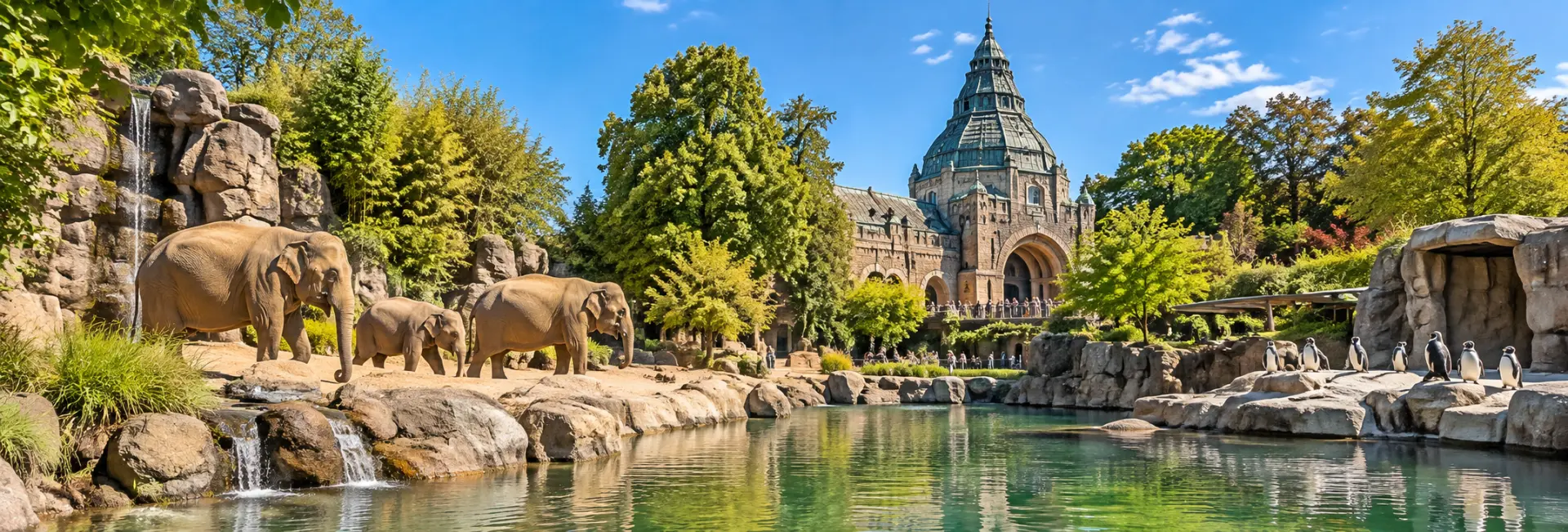
The setting matters as much as the residents. Mature trees, ponds, rock formations, protected panoramas and a restored 1907 gate make the walk feel like a garden stroll with animals built into the scenery. The park is still run by the Hagenbeck family and is unusual among major German zoos for covering its running costs without regular public subsidy.
History
From a fishmonger's seals to a global animal trade
The story begins with Gottfried Hagenbeck, a Hamburg fish dealer who put six seals on show in the city in 1848 and opened an animal shop in 1863. His son Carl took over in 1866 and built the business into the largest animal dealership in the world. Carl later opened a bigger venue in St Pauli, which he called a Thierpark.
The 1907 park in Stellingen
Carl Hagenbeck patented his panorama idea in 1896, arranging animals in layers so that hidden moats made different species look like they shared one landscape. In 1907 he opened a brand-new park in Stellingen designed entirely on this principle, using what he had learned from training animals to work out how high and how far they could jump. It was a sensation, drawing as many as a million visitors a year in its early days.
Destruction and rebuilding
In 1943, during the air raids on Hamburg known as Operation Gomorrah, the whole park was destroyed. The Hagenbeck family invested heavily to rebuild it, and the new layout was larger and gave the animals more space. Some of the park's Indian elephants even helped with clearing rubble in the zoo and in the city centre.
A difficult chapter
The Hagenbeck company also staged more than 70 so-called Völkerschauen between 1875 and 1932, shows in which people from other parts of the world were presented to paying audiences. The last one in Stellingen took place in 1932. Today the park describes these shows as unthinkable and at odds with its values, and it publishes a statement on its website, while critics continue to argue that the history has not been fully addressed.
Panoramas & Design
Layered views without bars
Hagenbeck's signature technique is to use water-filled or dry moats, cleverly hidden from the visitor's line of sight, to separate animals from each other and from the public. The result is a long view in which several species appear to graze or roam in the same landscape. The Africa Panorama is the most famous example and helped set the course for modern zoo architecture.
The Lion Gorge
The rocky Lion Gorge was the first barless enclosure for big predators anywhere in the world. A moat about seven metres wide keeps the animals in, and a cement edge on the far side gives a leaping lion a poor take-off point as an extra safeguard. Behind the rockwork sit the night quarters.
The historic gate and other landmarks
The protected Art Nouveau gate dates from the park's opening in 1907 and has been restored. It is decorated with life-size bronze figures by sculptor Rudolf Franke, including two figures tied to the era of the Völkerschauen, which the park now addresses openly. Elsewhere you will find a light-filled orangutan dome of 5,280 cubic metres, a Japanese garden and a replica Nepalese temple that add cultural touches to the botanical setting.
Recognition / Status
Tierpark Hagenbeck is an official heritage site. It has appeared on Hamburg's list of protected monuments since 1997, which covers the historic panoramas and the wider park layout as well as individual structures such as the 1907 gate.
Beyond monument status, the zoo holds a number of distinctions that it highlights itself:
- Recognition as the birthplace of the moated, barless zoo enclosure that later became a global standard
- The first German zoo to receive an international environmental quality label
- One of the few major German zoos still in family hands that meets its running costs without regular public funding
- Membership of international breeding programmes for endangered species
Because ticket income only covers day-to-day operation, a friends' association founded in 1998 and a separate foundation provide extra support for the park.
Key Areas & Animal Worlds
Eismeer, the Arctic Ocean
Opened in 2012, this polar zone offers a circular route of about 750 metres through rock landscapes and ice-like formations. Polar bears, walruses, king penguins and fur seals can be watched from above and below the waterline, and the path also passes through a large seabird aviary. It is often called one of the coolest places in Hamburg, in every sense.
Elephants and the African panorama
The herd of Asian elephants is a highlight, and the moderated feeding sessions, where keepers explain the animals' habits and diet, are described by the park as unique in this form in Germany. Nearby, zebras, antelope and other savannah species roam behind the barless moats of the Africa Panorama.
Tropical worlds and the Orangutan dome
In the tropical house you can watch free-roaming ring-tailed lemurs, colourful mountain lories and large reticulated pythons. The Sumatran orangutans live in a bright dome with climbing structures, ropes and natural vegetation.
Tropen-Aquarium
The aquarium takes visitors on a journey through several continents and climate zones, from steamy rainforest and dark cave worlds to a village of venomous snakes and a glowing underwater realm. It holds more than 350 species, and its Sumatra river tank is the largest planted freshwater aquarium in Germany, with 28,000 litres of water and about 1,000 aquatic plants.
For younger visitors
Families will find a petting enclosure, a large playground and a fairytale railway that trundles through the grounds.
Conservation & Research
Behind the visitor experience sits a serious conservation programme. Around 29 threatened or rare species live in the park, and their populations are monitored scientifically and coordinated with international breeding schemes such as the European Endangered Species Programmes.
The zoo also supports research and protection projects in the countries where its animals originate, and its ecolabel reflects a focus on using resources efficiently, for instance by relying on service water where possible. Education is part of the mission too, through a zoo school that runs programmes for school classes, families and adults, including topics such as species protection and local biodiversity like wild bees.
Ways to Experience It
Explore at your own pace
Most visitors simply wander the park with a map, which can be picked up free at the entrance or downloaded in advance, and an interactive park plan is available online. Enclosures are numbered, so it is easy to find a particular animal or plan a loop around your favourites.
Time your visit around feedings
Scheduled feeding sessions are a good way to see animals at their most active and to hear keepers share facts about diet and behaviour. Schedules change with the season, so check the daily programme on the park's website or at the entrance.
Add the Tropen-Aquarium
The aquarium is ticketed separately from the outdoor park on the official price list, so decide early whether you want to include it. It is an especially good choice for a wet or cold day.
Guided programmes and events
The zoo school offers guided tours and family rallies, and the park runs holiday programmes and lectures. In summer the zoo has hosted late-opening evening events, so it is worth checking the calendar before you go.
Best Time to Visit
The park is open all year, and each season has its own appeal. Spring and summer bring long days, lively animals and access to seasonal extras, including the Gazellenkamp side entrance and the summer restaurant at the Eismeer, both of which open in the warmer months. Autumn and winter are quieter, and the indoor Tropen-Aquarium and animal houses offer a warm refuge when the Hamburg weather turns grey.
Weekday mornings, outside school holidays, usually feel calmer than weekends and holiday periods. Arriving close to opening time gives you space to enjoy the popular enclosures before crowds build. Opening hours change by season, so check the official schedule before you plan your day.
Visitor Tips
- Tickets: Prices for the park and the Tropen-Aquarium are listed separately, with lower rates for children aged 4 to 16. Confirm current prices and any combination options on the official ticket shop before you go.
- Timing: Cash desks close one hour before the park does, and last admission is earlier still, so avoid arriving late in the day.
- Getting there: The U2 metro line and several bus routes stop at Hagenbecks Tierpark. By car, take the A7 through the Elbtunnel and leave at Stellingen. There is a car park at the main entrance with accessible spaces.
- Entrances: The main entrance is on Lokstedter Grenzstraße, and a second entrance at Gazellenkamp opens in the summer season.
- Accessibility: Wheelchairs can be reserved by phone with the guest service team. Assistance dogs are welcome with the proper certificate, but not in the Tropen-Aquarium, animal houses, petting enclosure, Eismeer seabird aviary or penguin areas.
- Food: A summer restaurant at the Eismeer, snack stands around the park and a cafe in the Tropen-Aquarium mean you do not need to bring a full meal.
- Animals: Species can change as enclosures are rebuilt or animals move between zoos, so check the official animal list if you are hoping to see a specific species.
- Comfort: Allow half a day or more, wear comfortable shoes and bring a rain layer for changeable weather.
Nearby Attractions
Altona Volkspark
Just a short journey away, Altona Volkspark is Hamburg's largest public park at around 205 hectares. Its woods, meadows and open lawns make a natural follow-up if you want a quieter walk after the zoo.
Volksparkstadion and the arenas
The park's edges hold the home ground of football club Hamburger SV and two large arenas. Football fans can pair the zoo with a stadium visit, and the stadium precinct is roughly a two-mile trip from the Tierpark.
Central Hamburg
The zoo sits about five kilometres from the city centre, which makes it easy to combine with the harbour district. The Speicherstadt warehouses and Miniatur Wunderland are good choices for a second day in the city.
FAQs about visiting Tierpark Hagenbeck
Why is Tierpark Hagenbeck famous? +
It is widely regarded as the birthplace of the modern barless zoo. When it opened in 1907, its moated, landscaped panoramas offered a revolutionary alternative to cages, and the design has influenced zoos all over the world.
How much time should I allow? +
Plan on at least half a day for the outdoor park. If you also want to see the Tropen-Aquarium, feedings and the Eismeer, a full day is comfortable, especially with children.
Do I need separate tickets for the Tropen-Aquarium? +
On the official price list, the outdoor park and the Tropen-Aquarium have separate ticket prices. Check the official ticket shop for the latest pricing and any combined options.
How do I get to Tierpark Hagenbeck? +
Take the U2 or one of several bus lines to the Hagenbecks Tierpark stop. Drivers can use the A7 through the Elbtunnel and leave at Stellingen, where a car park is available at the main entrance.
Is the zoo suitable for children and wheelchair users? +
Yes, families are well served with a petting enclosure, a large playground and a fairytale railway. Wheelchairs can be reserved by phone with the guest service, and accessible parking is available at both entrances.
What are the main highlights? +
The Eismeer with polar bears and walruses, the elephant herd, the Lion Gorge, the Africa Panorama, the orangutan dome and the Tropen-Aquarium are the most popular stops.
Can I bring my dog? +
Assistance dogs are allowed with the correct certificate, but they cannot enter the Tropen-Aquarium, animal houses, petting enclosure, Eismeer seabird aviary or penguin areas. For any other dogs, check the park's current rules before you travel.
When is the best time to visit? +
Weekday mornings outside school holidays are usually the calmest, and summer brings extra opening options. In cooler months, the indoor aquarium gives you a dry and warm alternative.