Table of Contents
Overview
Városliget, Budapest's City Park, spreads across roughly 302 acres of greenery just beyond Heroes' Square, forming one of the city's most complete recreational and cultural spaces. Within its boundaries sit a fairy-tale castle, one of Europe's largest thermal bath complexes, a zoo, a circus, and a growing cluster of striking new museums, all reachable on foot from a single entrance.
Often described as one of the first public parks in the world, Városliget has spent more than two centuries evolving from swampy outskirts into a genuine green heart of the capital, used equally by joggers, families, museum-goers, and anyone looking to escape central Budapest's traffic for an afternoon.
What sets the park apart from many large urban green spaces is how much cultural weight it carries alongside its recreational role. A single visit can move from a national monument at Heroes' Square, to a mock-medieval castle, to a working thermal bath, without ever leaving the park's boundaries, a density of attractions that keeps Városliget near the top of most Budapest itineraries.
History
From Swampland to Public Park
The land now occupied by Városliget was once known as Ökör-dűlő, or "Oxmeadow," a low-lying, swampy area referenced as far back as 1241. By the 18th century it had passed to the Batthyány family and was known locally as Batthyány Forest. The first organized tree planting on the site took place in 1751, and in the early 19th century the city formally set the area aside as a public park, giving rise to its current name, Városliget, meaning roughly "city grove."
The park's designation as public space predated similar large-scale urban parks in many other major cities, and its early landscaping followed the informal, curving paths and naturalistic plantings typical of English garden design rather than the rigid, geometric layouts more common in continental European gardens of the period.
The 1896 Millennium Celebrations
Városliget's transformation into a national showcase came with Hungary's millennium celebrations of 1896, marking a thousand years since the Magyar conquest of the Carpathian Basin. The park became the main venue for the festivities, timed alongside the construction of Andrássy Avenue, the Millennium Underground railway, and the Grand Boulevard elsewhere in the city. Heroes' Square, at the park's main entrance, and the original temporary version of Vajdahunyad Castle both date from this burst of construction, with the castle later rebuilt in permanent form in the early 1900s.
The scale of the 1896 celebrations left the park with an enduring cluster of monuments and institutions that still anchor a visit today, from the Millennium Monument at Heroes' Square to the museums built to flank it, giving Városliget a civic significance well beyond its role as green space.
The 20th Century and Recent Redevelopment
Through the 20th century, the park absorbed a changing mix of uses, from an amusement park and motorsport events in the 1950s to the steady growth of its zoo, circus, and bathing complex. In 2019, the Hungarian government launched the Liget Budapest project, a large-scale redevelopment aimed at turning the park into a denser cultural precinct. The project has already delivered the House of Music Hungary and the new Museum of Ethnography building, both completed in 2022, with a New National Gallery planned for completion by 2028.
The redevelopment has been debated within Hungary, with supporters pointing to the new cultural institutions and renovated green space, and critics raising concerns about construction encroaching on parkland. Whatever the eventual verdict, the project has already reshaped a significant part of the park's northern half and will continue to do so as the remaining buildings are completed later this decade.
Key Areas & Landmarks
Vajdahunyad Castle
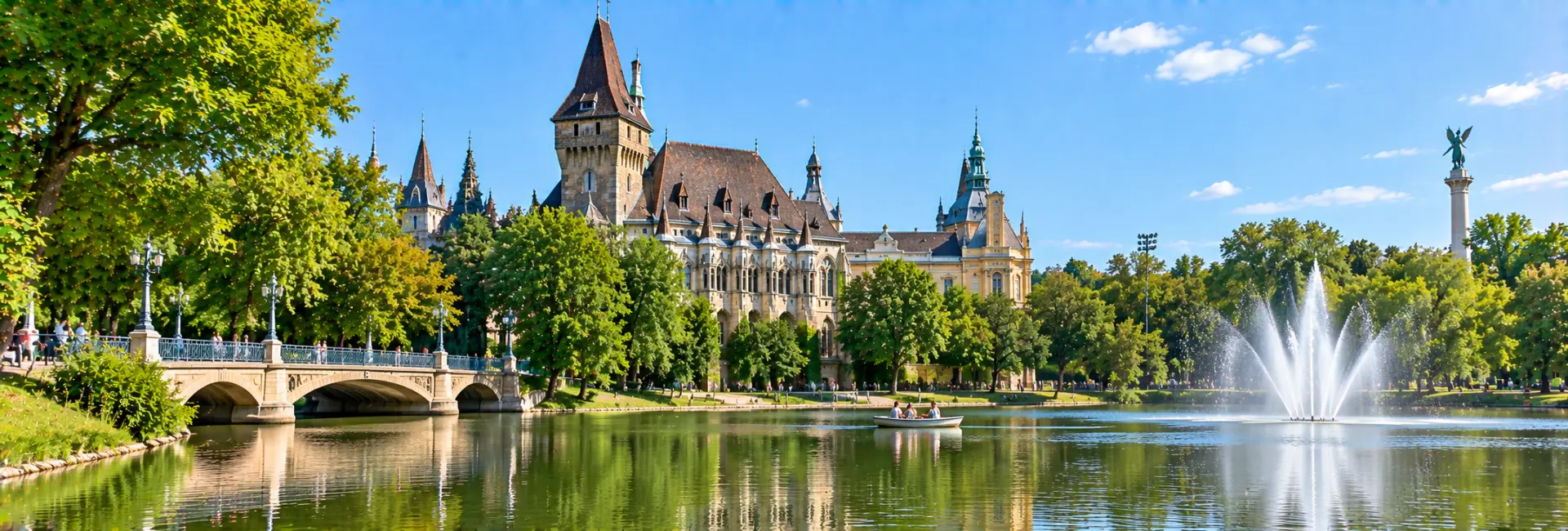
Built for the 1896 millennium exhibition and later reconstructed in permanent materials, Vajdahunyad Castle deliberately mixes architectural styles from across Hungarian history, from Romanesque to Gothic to Baroque. Its courtyard holds the statue of Anonymus, the unnamed medieval chronicler, and a small chapel modeled on the church of Ják. Today the castle also houses the Hungarian Museum of Agriculture, adding an educational layer to what began as a piece of exhibition architecture.
Heroes' Square and the Millennium Monument
Marking the park's main entrance, Heroes' Square centers on a tall column topped by the Archangel Gabriel, flanked by statues of the seven Magyar chieftains and, behind them, a colonnade of Hungarian kings and statesmen. The square has also served as the backdrop for pivotal modern events, including the 1989 reburial of Imre Nagy, a moment widely seen as a turning point in Hungary's transition away from communist rule.
Budapest Zoo and Botanical Garden
Opened in 1866, the zoo is one of the oldest in the world and combines historic Art Nouveau structures, such as its elephant house, with more recent naturalistic enclosures. It is home to thousands of animals across hundreds of species, spread across a compact site that rewards a slow, unhurried walk rather than a rushed circuit.
Széchenyi Thermal Bath
One of the largest medicinal bath complexes in Europe, Széchenyi draws on thermal springs discovered on the site in the late 19th century and remains a working bathhouse rather than a purely historic curiosity. Its yellow, neo-Baroque buildings and outdoor pools have become one of the most photographed sights in the park, especially in winter when steam rises off the water in the cold air.
Capital Circus and Gundel Restaurant
The Capital Circus of Budapest has staged performances on the site since 1891, while Gundel, opened in 1894, remains one of the city's most storied restaurants and a long-standing symbol of Hungarian fine dining.
House of Music Hungary and Museum of Ethnography
Completed in 2022 as part of the Liget Budapest redevelopment, the House of Music Hungary, designed by architect Sou Fujimoto, and the new Museum of Ethnography building represent the park's most recent additions, adding contemporary architecture to its historic mix. Both buildings were designed with an emphasis on blending into the park's greenery, from the Museum of Ethnography's grass-covered roof to the House of Music's perforated canopy.
Recognition / Status
Városliget is frequently cited as one of the first public parks in the world, having been formally opened to the public in the early 19th century, decades before many comparable green spaces elsewhere in Europe. Heroes' Square, at the park's entrance, forms part of the UNESCO World Heritage listing covering Andrássy Avenue, an extension added to Budapest's original 1987 inscription in 2002.
The park's ongoing redevelopment through the Liget Budapest project has also drawn international attention, both for its scale and for the architectural ambitions of its new museum buildings.
Lake, Trees & Natural Features
Despite its urban setting, Városliget retains a genuinely green, tree-filled character, with thousands of trees spread across its lawns and pathways. A central lake, roughly six hectares in size, sits at the heart of the park and changes character with the seasons.
- A lake used for boating in warmer months and transformed into an ice rink in winter
- Extensive lawns, flowerbeds, and mature tree cover throughout the park
- A small bird-friendly nature trail and demonstration garden near the park's King's Hill area
- Playgrounds, sports fields, and a dedicated dog park among the green space
The mix of open lawns, dense tree stands, and water features gives Városliget a noticeably softer, quieter feel than the busy streets just beyond its edges, even though its main entrance sits directly against one of Budapest's grandest public squares.
Ways to Experience It
Városliget rewards both a quick stroll and a full day of exploring, since its attractions can be mixed and matched depending on how much time is available.
- Rent a rowboat on the lake in summer, or lace up skates when it freezes over in winter
- Spend a few hours at Budapest Zoo or unwind at the Széchenyi Thermal Bath
- Catch a concert at the House of Music Hungary or an exhibition at the Museum of Ethnography
- Walk or cycle the park's paths, or simply picnic on the lawns near Vajdahunyad Castle
Visitors with more time can also fold in a meal at Gundel Restaurant or an evening performance at the Capital Circus, both long-running institutions that predate most of the park's newer attractions.
Best Time to Visit
The park itself is open around the clock and free to enter, so timing largely depends on which attractions inside it you want to visit. Spring and summer bring green lawns, boating on the lake, and outdoor events, while winter turns the lake into one of Central Europe's most atmospheric outdoor ice rinks, with Vajdahunyad Castle as a backdrop.
Because several major sights, including the zoo, Széchenyi Bath, and the museums, operate on their own schedules and require separate tickets, it's worth checking individual opening hours before planning a visit built around one of them.
Visitor Tips
- The park is free to enter, but the zoo, baths, circus, and museums each charge separate admission
- The closest metro stops are Hősök tere and Széchenyi fürdő on line M1, Budapest's oldest metro line
- Wear comfortable shoes, since covering the park's major sights involves a fair amount of walking
- Bring swimwear if you plan to visit Széchenyi Bath, as towel and swimsuit rental is limited
- Combine a visit with a walk down Andrássy Avenue, which leads directly to the park's Heroes' Square entrance
Nearby Attractions
Városliget sits at the far end of Andrássy Avenue, putting several of Budapest's landmark sights within easy reach.
- Andrássy Avenue, the UNESCO-listed boulevard leading back toward the city center
- Museum of Fine Arts, facing Heroes' Square at the park's entrance
- Palace of Art (Műcsarnok), an exhibition hall on the opposite side of Heroes' Square
- Oktogon, a major intersection roughly midway along Andrássy Avenue
FAQs about visiting Városliget (City Park)
What makes Városliget famous? +
It's often cited as one of the first public parks in the world and packs an unusual concentration of attractions into one green space, including Vajdahunyad Castle, the Széchenyi Thermal Bath, Budapest Zoo, and Heroes' Square.
Is Városliget free to visit? +
Yes, the park itself is free and open around the clock, though individual attractions inside it, such as the zoo, baths, circus, and museums, charge their own admission.
How much time should I plan for a visit? +
A quick walk past the main landmarks can take an hour or two, but a fuller visit that includes the zoo, a bath, or a museum can easily fill half a day or more.
When is the best time to visit? +
Spring and summer are best for the lake, lawns, and boating, while winter turns the lake into a popular outdoor ice rink; the park's indoor attractions make it a worthwhile stop in any season.
How do I get to Városliget? +
The Hősök tere and Széchenyi fürdő stations on metro line M1 both open directly onto the park, and it also sits at the end of Andrássy Avenue for those walking from the city center.
Is Városliget suitable for families and children? +
Yes, the park has playgrounds, a zoo, boating and skating on the lake, and wide lawns, making it one of Budapest's most popular destinations for families.
Do I need to book tickets in advance for the zoo or baths? +
Booking ahead is recommended in peak season for both the zoo and Széchenyi Bath, since both can reach capacity or involve long queues on busy days.
What's inside Vajdahunyad Castle? +
The castle houses the Hungarian Museum of Agriculture and a small chapel in its courtyard, alongside the statue of the medieval chronicler known as Anonymus.
What's nearby to combine with a visit? +
Andrássy Avenue, the Museum of Fine Arts, and the Palace of Art all sit right at the park's Heroes' Square entrance, making them easy to pair with a visit.