Table of Contents
Overview
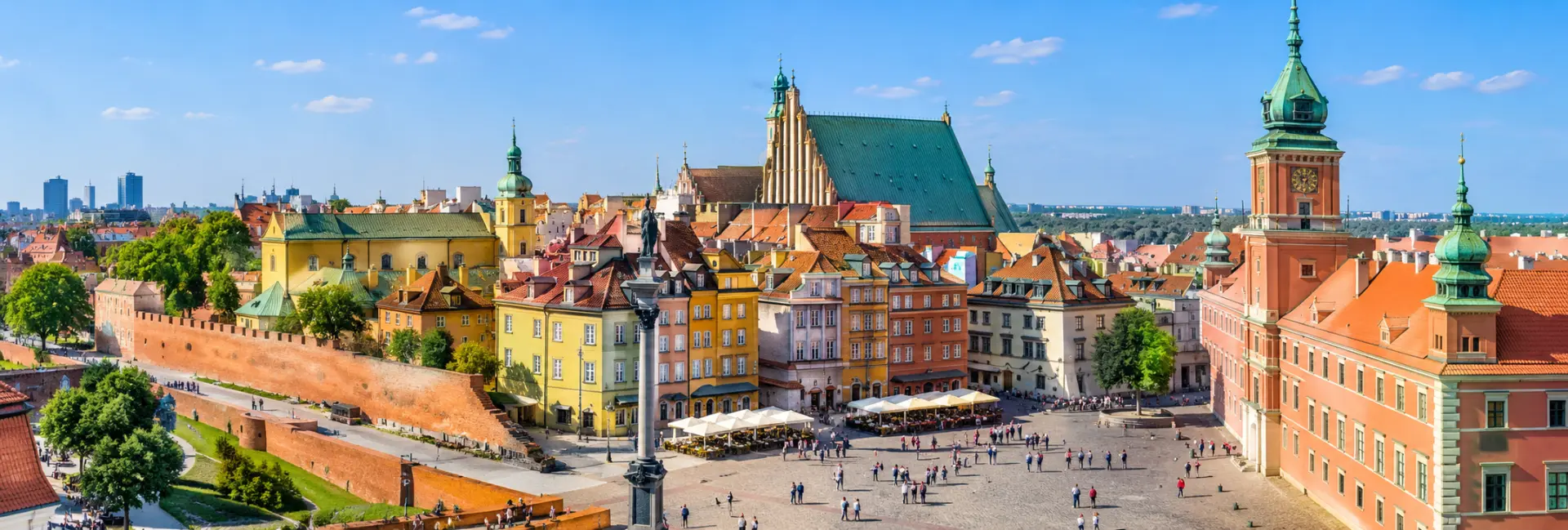
Warsaw's Old Town is the historic heart of the Polish capital, a compact district of pastel-coloured townhouses, cobbled squares and medieval walls perched above the Vistula river. Its picturesque appearance hides an extraordinary story, since almost everything visitors see today was rebuilt from rubble after the district was almost entirely destroyed during the Second World War.
That act of reconstruction has made the Old Town famous in its own right, recognised internationally as one of the most complete and carefully researched historic restorations ever undertaken. For visitors, it remains Warsaw's most atmospheric quarter, packed into a small, walkable area around the Royal Castle and the Old Town Market Place.
History
Medieval Origins
The district traces its origins to the 13th century, when a fortified settlement grew up around a stronghold belonging to the local ruling dukes, later developed into the Royal Castle. A defensive wall was added within a few decades, and a market square was laid out nearby along the main road connecting the castle to the newer settlement that grew up to the north.
Destruction in the Second World War
The district suffered heavy damage from aerial bombing during the German invasion of Poland in 1939, but far greater devastation followed after the 1944 Warsaw Uprising, when occupying forces carried out a deliberate, systematic demolition of the city in retaliation, reducing the vast majority of the Old Town's historic buildings to rubble.
Post-War Reconstruction
In the years that followed, Polish architects, historians and volunteers undertook an ambitious project to rebuild the district as closely as possible to its pre-war appearance, drawing on old photographs, architectural surveys and detailed 18th-century townscape paintings that had captured the area's streets and buildings in fine detail. Much of the rebuilding was substantially complete by the 1950s, though some individual landmarks, including the Royal Castle itself, were not fully reconstructed until decades later.
Recognition & Status
Warsaw's Old Town was added to the UNESCO World Heritage List in 1980, recognised as an outstanding example of a near-total historic reconstruction rather than as an original medieval survival. It has also been designated a Historic Monument of Poland, reflecting its significance within the country's own national heritage protections.
Its listing highlights a rebuilding effort so faithful that many visitors are unaware the buildings around them are largely mid-20th-century reconstructions rather than centuries-old originals, a distinction that continues to shape how the district is understood and studied internationally.
Architecture & Streetscape
The Old Town's architecture recreates a broad sweep of styles that developed here over several centuries, from Gothic-influenced church towers to the tall, narrow, brightly painted townhouses associated with the 17th and 18th centuries. Facades along the Market Place in particular are known for their varied colours and decorative detailing, based closely on pre-war appearances.
Surviving and reconstructed fragments of the medieval defensive walls still trace parts of the district's old boundary, linking to a fortified gatehouse that once controlled access between the Old Town and the neighbouring New Town to the north.
Key Areas
Castle Square
This open square marks the southern entrance to the Old Town and is dominated by the Royal Castle and a tall column honouring a 17th-century Polish king, making it a natural starting point for exploring the district.
Old Town Market Place
The rectangular market square at the heart of the district is lined on all four sides by reconstructed merchant townhouses, now home to restaurants, galleries and a museum tracing the city's history.
The City Walls and Barbican
Following the line of the old defensive walls northward leads to a fortified gatehouse structure linking the Old Town with the New Town, one of the district's most recognisable defensive landmarks.
Notable Landmarks
- The Royal Castle, the former residence of Polish monarchs, rebuilt over several decades after wartime destruction.
- The column honouring King Sigismund III on Castle Square, among the oldest secular monuments of its kind in Europe.
- St. John's Archcathedral, a Gothic-style church with roots stretching back to the district's earliest history.
- The Barbican, a fortified gatehouse forming part of the historic city walls.
- The Old Town Market Place, surrounded by reconstructed merchant houses now housing shops, cafes and a city history museum.
Ways to Experience It
The Old Town is compact and best explored on foot, with most major landmarks within a short walk of one another. Many visitors begin at Castle Square before wandering through narrow streets toward the Market Place and onward to the city walls and Barbican.
- Self-guided walking is easy thanks to the district's small size and pedestrian-friendly streets.
- Guided walking tours are widely available and often cover the district's wartime history and reconstruction in detail.
- The Royal Castle and Museum of Warsaw both offer indoor exhibits for those wanting a deeper look at the city's history.
Best Time to Visit
Spring and early autumn generally offer a comfortable balance of mild weather and smaller crowds compared with the height of summer, when the Market Place can become very busy with visitors. Early mornings are a good time to see the square's architecture without the crowds that build later in the day.
Evenings bring a livelier atmosphere to the Market Place, with outdoor seating at restaurants and cafes making it a popular spot to relax after a day of sightseeing.
Visitor Tips
- Comfortable shoes are recommended, since the district's streets and squares are cobbled throughout.
- The Royal Castle and Museum of Warsaw both charge separate admission fees, so budget accordingly if planning to visit both.
- Restaurants directly on the Market Place tend to charge a premium, with better value often found on quieter side streets nearby.
- Public transport connections are limited within the pedestrianised core, so most visitors arrive on foot from central Warsaw.
FAQs about visiting Warsaw Old Town
Is Warsaw's Old Town really old, given the wartime destruction? +
The district's layout and street pattern are genuinely medieval, but most of its buildings are careful 20th-century reconstructions built after near-total destruction in the Second World War.
Why is Warsaw Old Town a UNESCO World Heritage Site? +
It was recognised in 1980 specifically for the scale and accuracy of its post-war reconstruction, which UNESCO considers an outstanding example of restoring a historic urban area from near-total ruin.
How long does it take to see Warsaw Old Town? +
Most visitors spend two to three hours exploring the main squares and landmarks, longer if visiting the Royal Castle or Museum of Warsaw as well.
Is the Royal Castle worth visiting? +
Yes, it houses restored royal apartments and notable artworks, including paintings connected to the Polish court, and offers useful context on the district's pre-war history.
Is Warsaw Old Town free to visit? +
Walking through the squares and streets is free, though the Royal Castle, Museum of Warsaw and other individual attractions charge separate admission fees.
Is Warsaw Old Town within walking distance of central Warsaw? +
Yes, it sits close to the city centre and can generally be reached on foot from nearby transport hubs, or via a short tram or bus ride.
What is the Barbican in Warsaw Old Town? +
It is a fortified gatehouse forming part of the historic city walls, originally built for defence and today one of the district's most photographed landmarks.