Table of Contents
Overview
POLIN Museum of the History of Polish Jews stands in Warsaw's Muranów district, on ground that once formed part of the city's prewar Jewish quarter and, later, the Warsaw Ghetto. Its name, drawn from the Hebrew word for Poland, also carries the meaning "rest here," referencing a centuries-old legend about the earliest Jewish settlers arriving in the region.
Rather than focusing narrowly on the Holocaust, the museum sets out to tell a much longer story, tracing a thousand years of Jewish life, culture and community in Poland from the medieval period through to the present day. Its striking modern building and immersive core exhibition have made it one of Warsaw's most significant cultural institutions since opening in the 2010s.
History of the Museum
Origins of the Project
The idea for a dedicated museum of Polish Jewish history developed through the efforts of a historical association working with individual and institutional supporters from the mid-1990s onward, gradually building both public interest and funding for what would become a major national cultural project.
Construction and Opening
A cornerstone for the building was laid in 2007 following an international architectural competition, with construction continuing over the following years on a site directly facing a monument commemorating the start of the Warsaw Ghetto Uprising. The museum building opened to the public in 2013, with its extensive core historical exhibition following roughly a year later after further development work.
Recognition
Since opening, the museum has received significant international recognition for both its architecture and its approach to presenting difficult history, including a major European museum award recognising its impact and design within just a few years of opening.
Architecture & Building
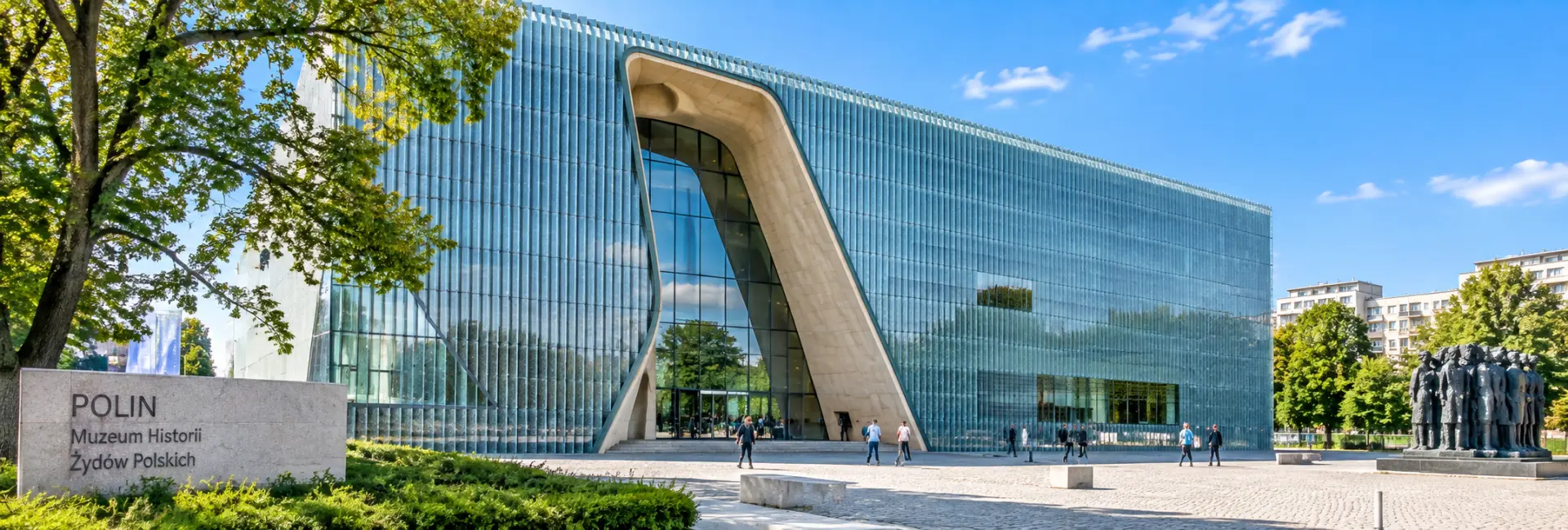
The museum building was designed by a Finnish architectural team following an international competition, and takes a deliberately restrained, modern form on the outside, faced in glass panels and a copper mesh screen that catches changing light throughout the day. Its exterior gives relatively little away about the depth of what lies inside, a contrast that many visitors find striking.
Stepping through the entrance reveals a dramatic, cavern-like hall with tall, undulating walls, designed to evoke a symbolic parting or rupture in the building's structure. This striking central space sets the tone before visitors descend into the museum's main historical galleries below.
Collections & Exhibits
The museum's core exhibition unfolds across several large galleries, guiding visitors chronologically from the earliest Jewish settlement in the region through the flourishing communities of later centuries, the upheavals of the 19th and early 20th centuries, and the devastation of the Holocaust, before closing with the postwar period and the present day.
Rather than relying solely on static displays, the exhibition combines multimedia storytelling, interactive elements and large-scale reconstructions to bring different historical periods to life, aiming to convey the everyday richness of Jewish life in Poland alongside its most difficult chapters.
Must-See Highlights
- A full-scale reconstruction of the painted roof and ceiling of a historic wooden synagogue, built using traditional techniques.
- The museum's dramatic main hall, with its tall, curved walls symbolising rupture and continuity.
- Multimedia galleries covering the flourishing Jewish communities of the Polish-Lithuanian Commonwealth period.
- Exhibits addressing the Warsaw Ghetto and the Holocaust, presented within the museum's wider thousand-year narrative.
Ways to Experience It
Most visitors follow the core exhibition's chronological route through its galleries, a visit that can comfortably take several hours given the depth of material covered. Audio guides and scheduled tours are generally available for those wanting more detailed context as they move through the different historical periods.
- The chronological layout works well as a self-guided visit, though guided tours can add valuable context.
- Temporary exhibitions, talks and cultural events are held regularly alongside the core historical exhibition.
- An education centre and resource area support school groups and those researching family history.
Best Time to Visit
Weekday visits, particularly in the morning, tend to be quieter than weekends, when the museum can draw larger numbers of both local and international visitors. Given the depth of the core exhibition, arriving earlier in the day allows more time to explore thoroughly without feeling rushed toward closing.
Visitor Tips
- The core exhibition is extensive, so allowing at least two to three hours is recommended for a thorough visit.
- Tickets can usually be booked online in advance, which is worth doing during busier periods.
- The museum stands directly opposite a monument marking the start of the Warsaw Ghetto Uprising, worth visiting alongside the museum itself.
- A cafe and museum shop are available on-site for visitors wanting to take a break during a longer visit.
Nearby Attractions
Located in Warsaw's Muranów district, the museum sits close to several other sites connected to the history of the former Jewish quarter.
- The Monument to the Ghetto Heroes, standing directly across from the museum's main entrance.
- Warsaw's Old Town, a short distance to the east.
- The Nożyk Synagogue, a short walk into central Warsaw.
- The Palace of Culture and Science, reachable within a short journey south of the museum.
FAQs about visiting POLIN Museum
What does POLIN mean? +
POLIN is a Hebrew word meaning either "Poland" or "rest here," referencing a legend about the arrival of the earliest Jewish settlers in the region.
How long does it take to visit POLIN Museum? +
Most visitors spend two to three hours exploring the core exhibition, longer if attending a guided tour or visiting a temporary exhibition as well.
Is POLIN Museum only about the Holocaust? +
No, while the Holocaust is covered as part of the story, the museum's core exhibition spans a full thousand years of Jewish history and culture in Poland, from medieval settlement to the present day.
Where is POLIN Museum located? +
It stands in Warsaw's Muranów district, on land that formed part of the city's prewar Jewish quarter and, later, the Warsaw Ghetto.
Is POLIN Museum suitable for children? +
The museum covers difficult historical material, so it generally suits older children and teenagers better than very young visitors, though family-friendly resources are available.
Do I need to book tickets in advance? +
Booking online in advance is recommended, particularly during busy periods, to guarantee entry at a preferred time.
What is the significance of the museum's location? +
The museum stands directly opposite a monument marking the start of the Warsaw Ghetto Uprising, situating it firmly within the historic heart of Warsaw's former Jewish quarter.