Table of Contents
Overview
The Copernicus Science Centre (Centrum Nauki Kopernik) is Warsaw's flagship hands-on science attraction, set on the west bank of the Vistula in the Powiśle district. Instead of glass cases and "do not touch" signs, it offers more than 400 exhibits that you push, spin, build and test yourself. It takes its name from the astronomer Nicolaus Copernicus, but in spirit it is closer to a playground for curiosity than a traditional museum.
It is the largest institution of its kind in Poland, and in 2023 attendance passed 1.3 million, its best year on record at the time. Families and school groups make up much of the audience, yet teenagers and adults find plenty to do, from research-style experiments in the LivingLAB to a family of robots that answer questions with the help of artificial intelligence.
History of the Centre
Origins
In early 2004 Warsaw's city government put together a small team to turn the idea of a large science centre into reality, an idea widely credited to the physicist Łukasz Turski. A founding agreement followed in June 2005, and that December an architectural competition was won by the firm RAr-2 from Ruda Śląska. Construction began in 2008.
Opening and Early Growth
The first module opened to the public on 5 November 2010 with five galleries. Through 2011 the complex filled out: a gallery for teenagers arrived in March, the Heavens of Copernicus planetarium in June, the Discovery Park in July, and chemistry, biology, robotics and physics laboratories by December. Alongside the building, the centre has co-organised the Science Picnic with Polish Radio since 2008.
Recent Chapters
In 2022 the Copernican Revolution Lab, an education research-and-development building of roughly 6,000 square metres, joined the complex next door and is linked to the main building by an underground passage. The main building has since been renovated and reopened to visitors, and today its permanent exhibition centres on the open-plan Experimental Zone.
Architecture & Building
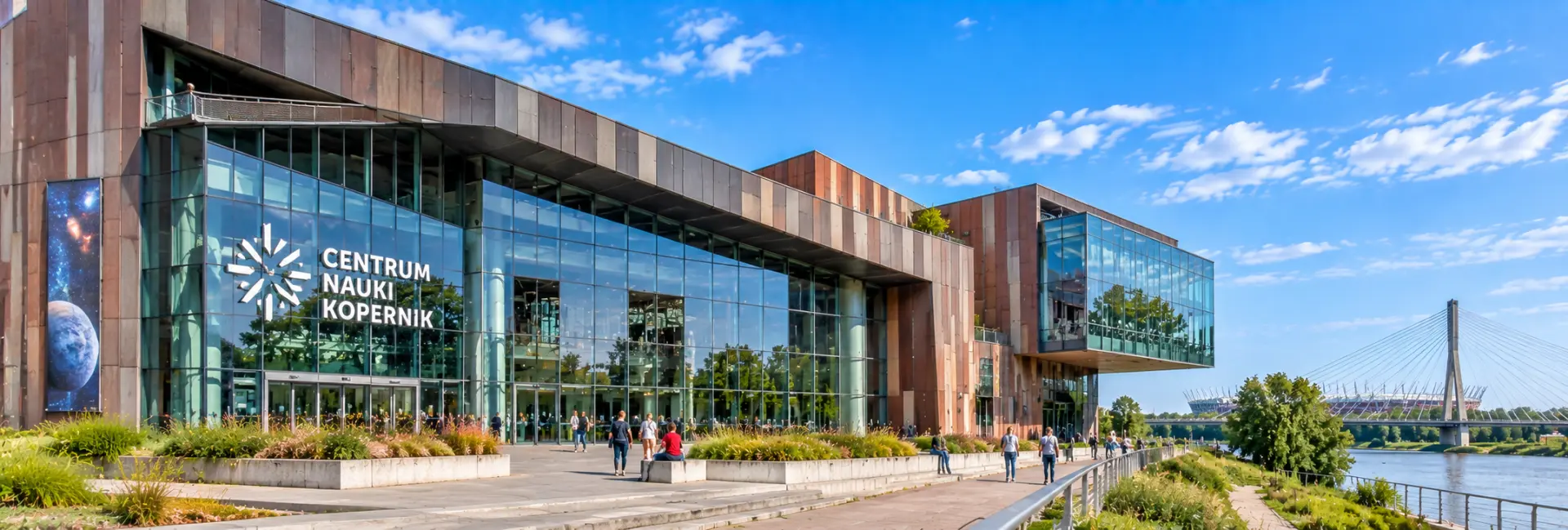
The main building was designed by RAr-2, with engineering by Buro Happold. It rises two storeys and covers about 15,000 square metres, sitting at the corner of Wybrzeże Kościuszkowskie and Zajęcza streets directly above the Wisłostrada road tunnel. A landscaped garden crowns the roof, so the structure works as both an exhibition hall and a piece of the riverside park.
The complex is more than one building. A quick map of what you will meet on site:
- The main exhibition building, with the ticketed galleries, theatres, laboratories, cafés and a conference centre.
- The Planetarium, housed in its own boulder-shaped building with an observation deck.
- The Discovery Park, an open-air zone with experiment stations, art installations and an amphitheatre.
- The Copernican Revolution Lab, the newer research building next door.
Exhibits & Galleries
The Experimental Zone
The Experimental Zone fills the entire open first floor and holds around 200 exhibits, most of them built in the centre's own workshop. Multimedia is kept to a minimum on purpose, so attention stays on doing rather than watching. One half explores physical phenomena such as waves, electricity, fluids and chaos, while the other turns you into the test subject through senses, reflexes, illusions and living organisms.
Exhibits are grouped so that one phenomenon, such as resonance, thermal expansion or stroboscopic effects, is shown from several angles. There is no fixed route and no guided tour, which suits people who like to wander and go deeper wherever something catches the eye.
Buzzz! for Young Explorers
Buzzz! is a sensory gallery for children up to seven, built around touching, smelling, stacking and knocking things down. Expect experiences such as seeing the world the way a snake does or peering into the inside of a giant kaleidoscope.
Theatres, Workshops and Labs
The High Voltage Theatre stages live shows with dramatic electrical discharges, while the Robotic Theatre puts robot performers on stage in fairy tales and stories by Stanisław Lem. In the Thinkatorium you build flying machines, catapults or anything else you can imagine, with no instructions and no time pressure. Chemistry, biology and physics laboratories and a robotics workshop add hands-on classes for older children and adults.
Must-See Highlights
With hundreds of exhibits and no set path, it helps to know which stops people remember longest. These are the ones worth steering towards first.
- The gyroscopic suitcase, the Magnetic Bridge and the Rotating Table in the physical phenomena area, where familiar forces behave in surprising ways.
- The bed of nails and the illusion stations in the human and nature area, which test your body and your senses.
- The large orange pavilion with a darkened interior, dedicated to light, colour and vision.
- The High Voltage Theatre, entered through a heavy metal door, for Poland's most electrifying science show.
- The robot family, including AMECA, SPOT, Babyclon and a robotic Copernicus that wears the astronomer's face and answers questions using AI.
- The LivingLAB, where five research stations let you take part in genuine studies on cooperation, curiosity and creativity.
- The Thinkatorium, if you want to build something and see whether it flies.
The Planetarium
The Heavens of Copernicus is a fulldome planetarium in the boulder-shaped building beside the main entrance. Films and shows are projected onto a spherical screen that wraps around the audience, backed by a sound system placed around the dome. Most screenings last about 45 to 50 minutes and are preceded by a short live presentation from the planetarium team, which is given in Polish.
The programme covers a wide range, from gentle films for children aged three and up to more demanding titles about black holes, dark matter and the Voyager mission for teenagers and adults. Some films are available in English or other languages through translation headphones, so check the film description before booking. The dome also hosts concerts and music-and-space shows, which makes it worth a look even on a return visit.
Rooftop Garden & Discovery Park
The Rooftop Garden
The garden on top of the main building is designed to echo an eroded riverbank landscape, with winding paths, crater-like openings and dozens of hardy plant species chosen to cope with harsh rooftop conditions. It opens to the public free of charge from May to October and is reached by a ramp from the southern side of the building. From the top you get wide views over the Vistula, its bridges and the city skyline.
The Discovery Park
Between the building and the river lies the Discovery Park, opened in 2011 and available to visitors all day without a ticket. It was co-designed by engineers, artists and landscape architects, and its exhibits include acoustic mirrors and a device called the Whisperer for playing with sound. In warmer months the park also hosts astronomical observations, outdoor cinema and art installations.
Ways to Experience It
There are no guided tours at the centre, and outside guides are not permitted to work inside. Instead, staff known as explainers, dressed in red T-shirts, roam the galleries to answer questions and show how exhibits work. Beyond the standard visit, several formats are worth considering:
- An exhibitions ticket, which covers the Experimental Zone and the extra attractions such as the theatres, Buzzz! and the Thinkatorium, although availability of some of them varies through the day.
- A combined exhibitions and planetarium ticket, which costs less than buying separately and lets you walk between the two through an internal passage.
- Short workshops run by explainers in different parts of the exhibition, where you solve puzzles and run small experiments.
- Laboratory classes for individual visitors on weekends, holidays and school breaks, recommended from age nine and mostly held in Polish.
- Seasonal and annual events, including the outdoor Science Picnic, the Przemiany Festival and evenings designed for adults.
- Free extras, namely the rooftop garden in season and the Discovery Park.
Best Time to Visit
Weekday mornings are usually the calmest, especially outside the spring school-trip season. Spring is the busiest stretch of the year, and the centre itself points to April and May as the months with especially crowded dates. If you can, avoid weekends and school holidays, when families fill the galleries and the popular theatres reach capacity sooner.
The seasons change what you can do. From May to October you can add the rooftop garden and enjoy the park by the river, and summer evenings suit a stroll along the Vistula afterwards. Between November and April the visit is fully indoors, which makes the centre a dependable choice for a cold or rainy day. Whatever the month, book a morning slot if you also want time for a planetarium show and lunch without rushing.
Visitor Tips
A little preparation makes the day much smoother, particularly with children in tow.
- Buy tickets online in advance. They are sold through the centre's own ticket site, and the ticket desks only hold whatever remains for the same day.
- Your ticket has a flexible entry window: you can enter from 30 minutes before to 60 minutes after the time printed on it. Planetarium screenings and laboratory classes start on time, so do not be late for those.
- Entry to the exhibition area is one-time only, so finish your bistro visit and any locker stops before you pass the gates. Combined-ticket holders can return from the planetarium through the internal passage.
- Self-service lockers stand to the left of the entrance and take a 2 zloty coin, which is returned. There is no left-luggage service for bulky bags.
- You can eat at the Wiem bistro outside the exhibition area, at the café on the first floor with its terrace over the river, or in designated spots with food you bring yourself.
- Prams may go into the exhibitions but not into the High Voltage Theatre, the Robotic Theatre or the planetarium projection room, and they must stay outside the Buzzz! gate.
- Children under 13 may not stay without an adult, and anyone using a discounted or free ticket should carry proof of eligibility.
- The metro station on line M2 is named Centrum Nauki Kopernik and is a short walk from the entrance. The small on-site car park is paid and fills up, so public transport is the easier option.
Nearby Attractions
The centre sits in a part of Warsaw that rewards a longer afternoon, with parks, viewpoints and historic sights all within reach.
- University of Warsaw Library Garden: a free rooftop garden, one of the largest in Europe, with gently sloping paths, bridges and views of the river, a short walk along the bank.
- Vistula Boulevards: the riverside promenade beside the centre, popular for walking, cycling and cafés in the warmer months.
- PGE Narodowy stadium: Poland's national stadium on the opposite bank, easy to spot from the rooftop garden.
- Nicolaus Copernicus Monument: the bronze statue by Bertel Thorvaldsen on Krakowskie Przedmieście, in front of the Polish Academy of Sciences, a fitting companion stop to the centre that shares his name.
FAQs about visiting the Copernicus Science Centre
What is the Copernicus Science Centre? +
It is Warsaw's interactive science centre on the bank of the Vistula, with more than 400 hands-on exhibits, theatres, laboratories, a planetarium and a rooftop garden. It is designed for touching and experimenting rather than reading labels behind glass.
How long should I plan for a visit? +
The centre says a relaxed visit to the exhibitions takes about five hours, though seeing the highlights in two to three hours is possible. Add roughly 45 to 50 minutes if you want to see a planetarium film.
Do I need to book tickets in advance? +
Yes, booking online is strongly recommended because all tickets are sold through the online system. The ticket desks only sell what is left for the same day, and popular dates can sell out.
Is it suitable for young children? +
Very much so. Buzzz! is built for children up to seven, and the planetarium screens films for ages three and up. Children under 13 must be accompanied by an adult, and those under two enter free.
Can I visit without speaking Polish? +
Yes, with some planning. There are no guided tours, but explainers in red T-shirts help in the galleries. Many planetarium films can be followed in English with translation headphones, although the live introduction and laboratory classes for individual visitors are in Polish.
How do I get there? +
Take the M2 metro line to the station named Centrum Nauki Kopernik, which is a short walk from the entrance. A small paid car park exists on site, but spaces are limited.
Is anything free to visit? +
Yes. The rooftop garden is free from May to October, and the Discovery Park beside the river is open to everyone during the day.
Can I leave the exhibitions and come back later? +
No, entry to the exhibition area is one-time only. The exception is combined-ticket holders, who can go to the planetarium and return to the exhibitions through the internal passage.