Table of Contents
Overview
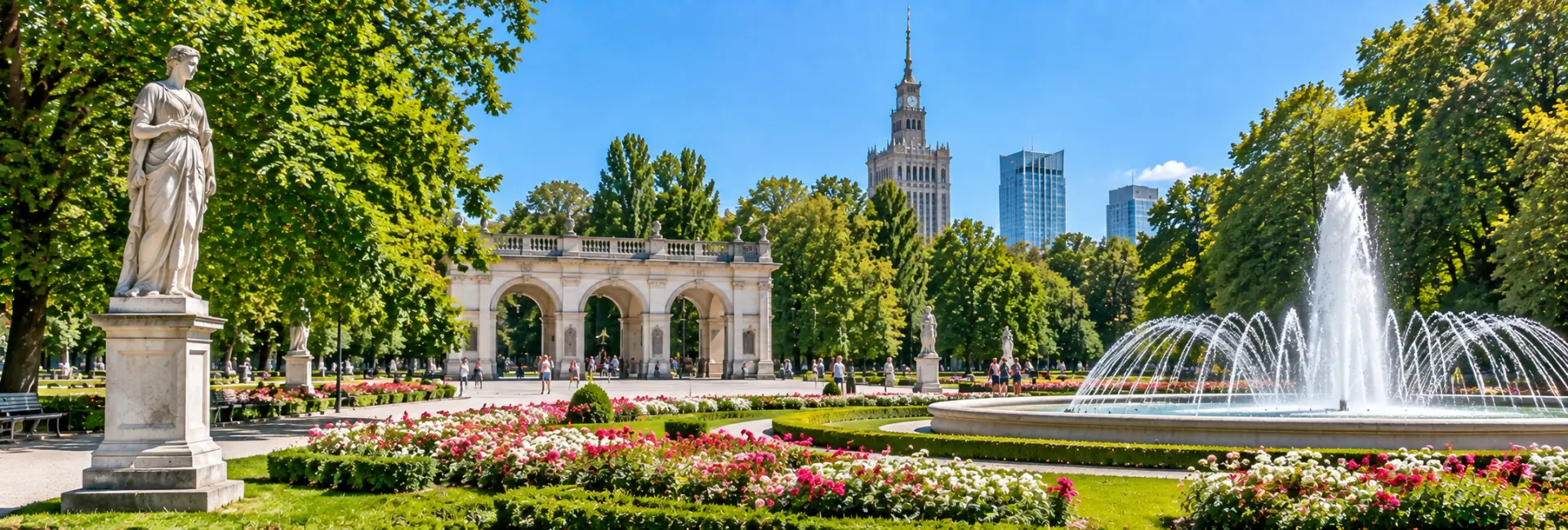
The Saxon Garden (Ogród Saski) is a leafy, formally laid-out park in the middle of Warsaw's Śródmieście district, stretching from Piłsudski Square on one side to busy Marszałkowska Street on the other. It began life as the private garden of a royal palace and became the city's first public garden in 1727, which is why Varsovians regard it as the capital's oldest park. Today it covers roughly 15 hectares of gravel paths, clipped flower beds, tall trees and rows of Baroque statues.
The garden is compact enough for a relaxed hour, yet layered enough to reward a longer visit. A walk takes you past a mid-nineteenth-century fountain, a marble sundial, a domed water tower dressed up as a Roman temple and a duck pond, and it ends beside the Tomb of the Unknown Soldier. Entry is free and there is no main gate, so you can drift in from several directions.
History
From Farmland to Royal Residence
Until the sixteenth century, this land was farmland belonging to the Warsaw starosty. In the second half of the 1600s, the poet and statesman Jan Andrzej Morsztyn built a palace with a garden here, and that estate became the seed of everything that followed. In 1713, King Augustus II the Strong bought it, aiming to create a royal residence that could stand beside the great courts of Europe, with Versailles as his inspiration.
The new palace, its ceremonial courtyard and its French-style garden were lined up along a single sightline known as the Saxon Axis. Dresden architects, notably Johann Christoph Naumann and Matthäus Daniel Pöppelmann, shaped the plans.
The First Public Garden in Poland
On 27 May 1727, the central part of the royal garden was opened to Warsaw's residents, something that had never happened before in Poland. A private court amenity became a shared city space, and it has remained open to the public ever since. Access was not entirely free of conditions at first, as gatekeepers screened visitors well into the following century, but the idea of a public promenade had taken root.
An English Landscape and a Summer Salon
Between 1816 and 1824, the garden was reshaped into an English-style landscape park, with credit going to the gardener James Savage and several collaborators. The old palace was later replaced by a neoclassical building finished in 1842, and the Italian-born architect Henryk Marconi added a fountain, a mineral water institute with a café and the water tower.
By then the Saxon Garden had become the capital's summer drawing room, a place to stroll, be seen and meet friends, and it features in Bolesław Prus's novel The Doll. The neighboring palace had stories of its own. Fryderyk Chopin's father taught in a school housed there, and in the early 1930s Polish cryptologists working in the building broke the German Enigma cipher.
Destruction and Rebuilding
After the Warsaw Uprising collapsed at the end of 1944, German troops blew up the Saxon Palace. Only a fragment of its central arcades survived, and the garden lost nearly all of its trees. The fountain, the water tower and the 21 statues came through the war.
Postwar reconstruction was led by garden designer Alina Scholtz and architect Romuald Gutt. They kept a naturalistic layout around the pond and water tower and restored a formal arrangement along the old axis. The view down the main alley gained its present ending only in 1970, when the Lubomirski Palace across Marszałkowska Street was literally rotated on its site to frame the vista.
Recognition / Status
The Saxon Garden is protected on several levels. It has been entered in the regional register of monuments since 1965, together with the wider Saxon Axis urban layout, and it also appears in the municipal heritage record. The park lies within the buffer zone of the UNESCO-listed Historic Centre of Warsaw, which was inscribed in 1980.
It is also part of the Historic Monument of Poland titled "Warsaw - historic city centre with the Royal Route and Wilanów", a national designation dating from 8 September 1994. Several neighboring sites carry protection as well, including the water tower, the Blue Palace with its front garden, the Tomb of the Unknown Soldier and Piłsudski Square.
Layout & Design
The Main Axis
The park is organized around a broad central alley that begins behind the Tomb of the Unknown Soldier and runs straight toward Marszałkowska Street. Statues stand at even intervals along both sides, rows of trees frame the walk, and rectangular flower beds edged with lawn fill the space between. A decorative parterre surrounds the fountain at the far end, and the view carries on across the street to the Lubomirski Palace on Iron Gate Square.
Two Moods in One Park
The avenue splits the garden into two halves with different characters. One side leans toward the French tradition, with compact, orderly rows of single-species trees forming green walls and paths that lead toward Królewska Street. The other side is looser and more picturesque, with open lawns around the pond and water tower and freely arranged plantings closer to Marszałkowska Street.
Entrances and Ground Level
There is no single main gate. Most visitors enter from Piłsudski Square, walking past the Tomb of the Unknown Soldier, or from the corner where Królewska meets Marszałkowska, while further paths connect to Niecała and Senatorska streets. Almost the whole park is flat, with one exception: the artificial mound crowned by the water tower.
Sculptures, Fountain & Water Tower
The Muses and Virtues
Twenty-one Baroque sculptures of muses and virtues line the main alley, and they are the only original survivors of the buildings and gardens of the Saxon Axis. They come from workshops associated with sculptors such as Jan Jerzy Plersch, Franciszek Ksawery Deybel, Jan Jerzy Donat and Józef Vinache. Because each figure stands on its own pedestal at regular spacing, the walk feels like an open-air gallery.
The Marconi Fountain and the Sundial
A late neoclassical fountain by Henryk Marconi stands at the end of the main axis and serves as the garden's centerpiece. It was one of four fountains built in Warsaw to crown the completion of the city's first public waterworks in the 1850s. Close by, a marble sundial from 1863 can tell the time to within about five minutes.
The Water Tower and the Pond
On the garden's only hill rises a domed building modeled on the Temple of Vesta at Tivoli. In reality it is a water tower, the main reservoir of that same waterworks, and it has served as a technical building for the Grand Theatre since 1957. At the foot of the hill, an oval pond of about 0.2 hectares is decorated with a small fountain that copies Theodor Erdmann Kalide's "Boy with a Swan".
Memorials & the Tomb of the Unknown Soldier
The Tomb of the Unknown Soldier
The tomb occupies a surviving fragment of the Saxon Palace colonnade at the garden's eastern edge, facing Piłsudski Square. The remains of an unidentified soldier were placed here on 2 November 1925 to honor everyone who fought for Poland's freedom. After the war the ruined arcade was preserved as a permanent monument, and an honor guard keeps watch over it during state ceremonies.
Other Places of Remembrance
- A boulder near the pond, set in place in 1927, marks 200 years since the garden opened to the public.
- A plaque on the main axis recalls the spot where Marshal Józef Piłsudski thanked soldiers returning from the victorious Battle of Warsaw in 1921.
- A symbolic slab at the end of the axis honors the six million Poles who died in World War II.
- A stone monument to the poet Maria Konopnicka, carved by Stanisław Kulon, has stood beside the Blue Palace since 1966.
The Alley of Remembrance
Pyramid-shaped oaks along the outer path beside the tomb form a living memorial, part of a project called the Tree of Memory. The first was planted in 2010 for the victims of the Katyn massacre, and later trees mark the 75th anniversary of the Warsaw Ghetto Uprising, a century of restored independence and the deportations to Siberia and Kazakhstan. A separate oak, planted in 1996 during a visit by Queen Elizabeth II, grows nearby.
Trees, Flowers & Wildlife
Old Trees and Natural Monuments
The garden holds around 1,200 trees, most of them broadleaved, with small-leaved lime, horse chestnut and Norway maple leading the count. Six trees are officially protected as natural monuments: four ginkgos near the pond, a horse chestnut beside Królewska Street and a grey poplar beside Marszałkowska Street.
Seasonal Flower Beds
Flower displays change with the seasons and are redesigned every year using different plants. Spring brings bulbs and biennials, summer adds dahlias, verbena and gaura, and autumn arrives with ornamental cabbages, heathers and chrysanthemums.
Birds, Amphibians and Insects
This is a formal city park rather than a wild refuge, but the old trees and the pond still attract wildlife. Tree sparrows, hooded crows and magpies are the most common birds, while mallards favor the pond, coots sometimes nest on its edge and mute swans appear now and then.
Ways to Experience It
A Slow Walk Along the Axis
The classic visit is a leisurely stroll from Piłsudski Square down the main alley to the fountain and back through the more picturesque half. Allow time to pause at the statues, the sundial and the pond, and to sit on a bench.
Concerts, Readings and Festivals
Outdoor concerts are held here regularly, ranging from contemporary music to programs that travel through different historical periods. The garden is also one of the venues for the National Reading, an annual event in which passages of Polish literature are read aloud in public. Since 2022, a Saxon Garden Festival has celebrated the park's history with retro fashion, vintage cars and interwar-style music.
With Children
The garden has a playground, and the pond and its ducks are an easy hit with younger visitors. Wide, level paths suit strollers, and the open lawns leave room to run.
Best Time to Visit
By Season
- Spring: bulbs and early blossoms brighten the flower beds, and the trees begin to fill with fresh green.
- Summer: shade from the mature trees, full flower displays and the busiest calendar of outdoor events.
- Autumn: the ginkgos turn golden, and maples and other broadleaved trees add orange and red to the paths.
- Winter: quieter and more architectural, with bare branches showing off the strict lines of the axis and the sculptures.
By Time of Day
Early morning is the calmest moment, when the light is soft and joggers and dog walkers outnumber tourists. Late afternoon suits photography, as low sun warms the statues and the fountain.
Visitor Tips
- Entry is free. The park manager lists the garden as open around the clock, though daytime is the more comfortable choice, as in any city park.
- There is no main gate, so choose the approach that suits your route: Piłsudski Square, the Królewska and Marszałkowska corner, or the side streets Niecała and Senatorska.
- By public transport, the nearest metro stations are Świętokrzyska (lines M1 and M2) and Ratusz Arsenał (line M1), and several bus and tram routes run along Marszałkowska Street.
- The paths were resurfaced with permeable material between 2012 and 2014, and the ground is nearly flat, which helps visitors with strollers or limited mobility.
- Reconstruction of the Saxon Palace and the neighboring Brühl Palace is planned on the western side of Piłsudski Square, and archaeological and preparatory work has taken place there. Fenced areas and timelines can change, so check current conditions before you go.
Nearby Attractions
Right Beside the Garden
Piłsudski Square adjoins the garden and is one of the largest squares in Warsaw, the site of major public ceremonies. The Zachęta National Gallery of Art faces Małachowski Square just to the south. The Grand Theatre, whose technical facilities occupy the garden's water tower, is a short walk away.
A Short Walk Further
The Royal Route along Krakowskie Przedmieście begins close to Piłsudski Square and leads toward the Old Town, which lies about a kilometer from the garden. The Krasiński Garden, another historic Warsaw park, is a pleasant follow-up stop on foot.
FAQs about visiting the Saxon Garden (Ogród Saski)
What is the Saxon Garden and why is it famous? +
It is Warsaw's oldest public park, created as the garden of a royal palace and opened to the public in 1727. It is known for its Baroque sculptures, the Marconi fountain, the Vesta-style water tower and its position beside the Tomb of the Unknown Soldier.
Is the Saxon Garden free to enter? +
Yes, entry is free, and no tickets are needed. The park manager lists the garden as open around the clock, although visiting during daylight hours is the more comfortable choice.
How much time do I need in the Saxon Garden? +
Plan on 45 minutes to an hour for an unhurried walk along the main alley, the fountain and the pond. Add extra time if you want to look at the memorials, sit on a bench or catch an event.
How do I get to the Saxon Garden? +
The nearest metro stations are Świętokrzyska (lines M1 and M2) and Ratusz Arsenał (line M1), and buses and trams run along Marszałkowska Street. On foot, you can enter from Piłsudski Square, from the Królewska and Marszałkowska corner, or from Niecała and Senatorska streets.
When is the best time to visit? +
Spring and autumn are especially rewarding, with fresh blossom and bulbs in spring and golden ginkgos in autumn. Summer brings full flower beds and outdoor events, while early mornings are the quietest in any season.
Is the Saxon Garden suitable for children and visitors with limited mobility? +
Yes. The garden has a playground, a pond with ducks and wide paths on almost entirely level ground. The one gentle rise is the hill under the water tower.
Can I see the Saxon Palace? +
No, the palace was blown up in 1944, and only a fragment of its arcades remains as the Tomb of the Unknown Soldier. A reconstruction is planned but its timetable has shifted over time, so check current news if you want to see progress.
What should I combine with a visit to the garden? +
Piłsudski Square, the Zachęta gallery and the Royal Route are all a few minutes away on foot. The Old Town is about a kilometer from the garden, so the whole area fits easily into a half-day itinerary.