Table of Contents
Overview
Wilanów Palace sits at the southern end of Warsaw's historic Royal Route, a grand Baroque residence built as a summer retreat for one of Poland's most celebrated monarchs. Unlike many of the country's other historic palaces, Wilanów survived both the partitions of Poland and two world wars largely intact, making it one of the few places where visitors can see centuries of original interior decoration still in place.
Often nicknamed Poland's "Little Versailles," the palace combines French, Italian and traditional Polish architectural influences into a single, richly decorated whole, set within extensive historic gardens that remain a popular destination for a relaxed day out from the city centre.
History
A Royal Summer Residence
Construction began in 1677 at the request of King Jan III Sobieski, who wanted a residence close enough to Warsaw to remain involved in state affairs, yet far enough away to enjoy a quieter country retreat with his wife. The project was entrusted to an Italian-trained architect, and the resulting building grew steadily in scale and grandeur over the following two decades to reflect the king's rising status.
Later Owners
Following the deaths of the king and his immediate family, the palace passed through a succession of noble owners over the 18th and 19th centuries, each adding their own alterations, artworks and furnishings. This long line of ownership left the palace with a rich and varied collection of interiors spanning several different periods of taste, rather than a single unified decorative scheme.
Surviving War and Occupation
The palace suffered looting and damage during the Second World War, particularly after the 1944 Warsaw Uprising, when occupying forces ransacked the building. Despite this, its structure survived largely intact, unlike much of the rest of the city, allowing careful postwar restoration to recover a significant proportion of its original decoration and furnishings.
Architecture & Notable Rooms
Exterior Design
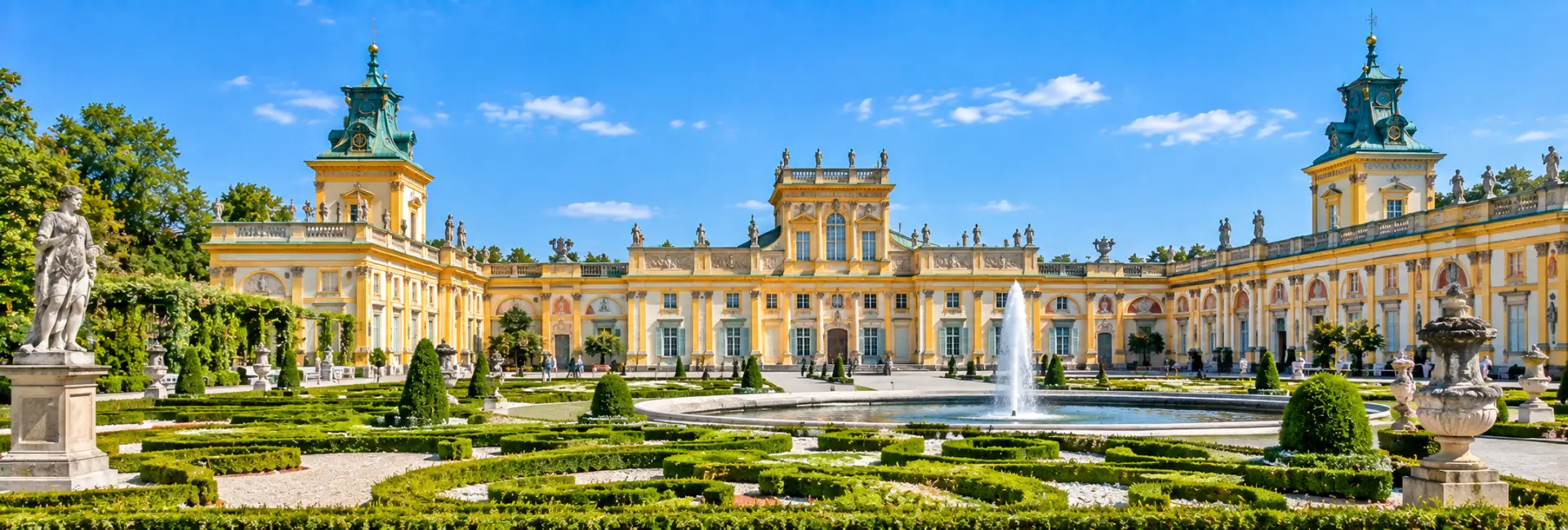
The palace's facade blends architectural influences from French palace design, Italian villa traditions and Polish manor house style into a single distinctive composition, decorated with inscriptions and sculptural details celebrating the achievements of its royal founder. Later wings and additions were designed to harmonise with this original Baroque character even as the building expanded.
The White Hall and Royal Apartments
Inside, one of the most impressive spaces is a large formal hall added in the early 18th century, now decorated in a later, more restrained style and hung with portraits of the palace's successive owners. The original royal apartments, including the king's bedroom and an antechamber where courtiers once waited to be received, preserve a more intimate sense of daily life within the 17th-century court.
The Chinese Room
Among the palace's more unusual interiors is a room decorated with genuine lacquer panelling, reflecting the fashion for chinoiserie decoration that spread through European courts during this period.
Grounds & Gardens
The palace is surrounded by an extensive historic park combining several distinct garden styles developed over different periods, including a formal Italian-style terraced garden close to the building itself. Later English-style landscaped sections and a lake add a more naturalistic contrast further from the palace, giving visitors a variety of settings to explore on a longer walk through the grounds.
Cultural Significance
Wilanów holds particular significance in Poland as one of the country's few major historic residences to survive the turbulent 19th and 20th centuries with much of its original fabric intact. Its founder, King Jan III Sobieski, remains one of Poland's most celebrated historical figures, closely associated with a decisive military victory over Ottoman forces in the late 17th century.
The palace has also functioned as a working museum since the early 19th century, among the oldest such institutions in the country, reflecting a long-standing recognition of its importance to Poland's cultural heritage.
Ways to Experience It
Most visitors follow a set route through the palace's ground floor and main upper-floor rooms, taking in both the surviving 17th-century royal apartments and later additions from subsequent owners. Audio guides are widely used to add historical context to individual rooms and artworks along the way.
- A full visit to the palace interior typically takes around one and a half to two hours.
- Garden tickets are sold separately from palace entry, allowing a shorter visit focused solely on the grounds if preferred.
- Multimedia displays and portrait galleries add further context on the palace's various historical owners.
Best Time to Visit
Spring and summer bring the palace gardens into full bloom, particularly in areas planted with roses, making these the most visually rewarding seasons for a visit. Weekday mornings tend to be quieter than weekends, when the palace and grounds can draw larger crowds, particularly during the warmer months.
Visitor Tips
- The palace and gardens require separate tickets, so plan accordingly if intending to visit both.
- The palace is typically closed one day a week, so it's worth checking current opening days before visiting.
- Free or reduced-price entry is sometimes offered on specific days of the week, which can be worth planning around.
- Comfortable shoes are recommended for exploring the extensive gardens surrounding the palace.
Nearby Attractions
Sitting at the southern end of Warsaw's historic Royal Route, Wilanów Palace is within reach of several other notable sites in the surrounding area.
- Łazienki Park, further north along the same historic royal route.
- Warsaw's Old Town and Royal Castle, at the northern end of the Royal Route.
- The Poster Museum, located within the palace's own grounds.
- Old Wilanów, a historic village-like neighbourhood surrounding the palace complex.
FAQs about visiting Wilanów Palace
Who built Wilanów Palace? +
It was built between 1677 and 1696 as a summer residence for King Jan III Sobieski, one of Poland's most celebrated monarchs.
Why is Wilanów Palace called Poland's "Little Versailles"? +
The nickname reflects its grand Baroque style and royal origins, though the palace blends French, Italian and Polish architectural influences into its own distinct character rather than directly copying Versailles.
How long does it take to visit Wilanów Palace? +
A visit to the palace interior typically takes around one and a half to two hours, with additional time needed to explore the surrounding gardens.
Are the palace and gardens covered by the same ticket? +
No, tickets for the palace interior and the gardens are sold separately, so visitors wanting to see both should plan for two admissions.
Did Wilanów Palace survive the Second World War? +
Yes, although it suffered looting and damage during the war, its structure survived largely intact, making it one of the few major historic residences in the Warsaw area to do so.
Is Wilanów Palace far from central Warsaw? +
It sits at the southern end of the historic Royal Route, several kilometres from the Old Town, and is generally reached by bus or car from the city centre.
What can I see inside Wilanów Palace? +
Highlights include the surviving 17th-century royal apartments, a large formal hall known as the White Hall, and a room decorated with original Chinese lacquer panelling.