Table of Contents
Overview
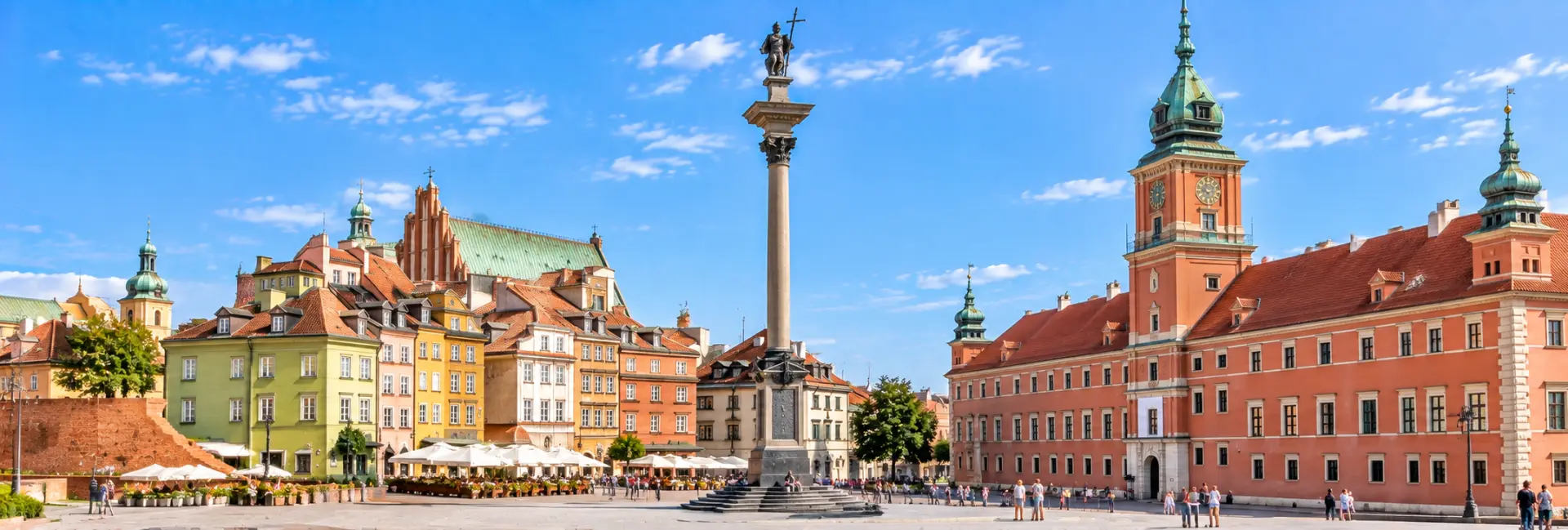
Sigismund's Column (Kolumna Zygmunta) is the tall bronze-topped monument that anchors Castle Square, the open plaza where Warsaw's Old Town meets the Royal Castle. Rising roughly 22 metres above the cobblestones, it is one of the most recognisable symbols of the city and the first thing many visitors photograph on arrival.
The monument honours King Sigismund III Vasa, the ruler who shifted Poland's capital from Kraków to Warsaw in 1596. It has also lived through deliberate demolition in 1944 and a painstaking postwar revival, which is a large part of why locals treat it with such affection.
History
A Son's Tribute
Sigismund III died in 1632, and his son and successor, Władysław IV Vasa, ordered a monument to him in 1643. It was completed the following year and formally unveiled on 24 November 1644. The location was chosen deliberately: it stood in front of the Kraków Gate, the principal route into the capital at that time, so anyone entering the city met the Vasa dynasty's message immediately.
Centuries of Repairs
The original shaft was made of red marble and needed attention repeatedly. It was renovated in 1743, 1810, 1821 and 1828, and a wooden fence added in 1681 was later swapped for a permanent iron one. In 1854 the base was surrounded by a fountain with marble tritons, and between 1885 and 1887 the weathered marble column was replaced with a new one in granite. A restoration in the late 1920s removed the fountain and fence to bring back the monument's earlier look.
Destruction and Rebuilding
On 1 September 1944, during the Warsaw Uprising, German forces brought down the column, badly damaging the bronze statue. The figure was carried away on a sleigh to St. Anne's Church and shown at the National Museum in the spring of 1945 in an exhibition about wartime destruction. A committee formed that year to restore the monument, the statue was repaired, and in 1949 it was raised again on a new granite column cut from stone quarried at Strzegom, placed a few metres from the original spot.
Architecture & Design
The Column
The monument was designed by the Italian-born architect Constantino Tencalla, with the Italian Agostino Locci also credited in several accounts. Its form follows Roman precedents that Władysław IV had seen on a visit in 1625, notably the column outside the basilica of Santa Maria Maggiore and the ancient Column of Phocas. Today's shaft is granite in the Corinthian style and is decorated with four eagles.
The Statue
The king, sculpted by Clemente Molli and cast in bronze by Daniel Tym, stands about 2.75 metres tall. He wears armour beneath a coronation robe, a crown and a medallion of the Order of the Golden Fleece. His right hand holds a sabre and his left a Latin cross, and his right foot rests on a plumed helmet, so that both military strength and religious faith are represented in one pose.
The Pedestal
The side of the base facing Krakowskie Przedmieście carries a Latin plaque. It lists the king's achievements, from victories over Moscow and the Ottomans to a reign that lasted more than four decades, in the grand language of Baroque commemoration. Reading it closely shows how much the monument was meant to celebrate the dynasty as well as the man.
Recognition / Status
The column is part of the Historic Centre of Warsaw, which UNESCO inscribed on the World Heritage List in 1980. The listing is notable because the district was rebuilt almost entirely after the Second World War, and it was recognised for the scale and care of that reconstruction.
- UNESCO World Heritage Site: the Historic Centre of Warsaw, inscribed in 1980 under criteria ii and vi.
- Historic Monument of Poland: the Warsaw historic city centre with the Royal Route and Wilanów, designated on 8 September 1994.
- Register of historical monuments: the column itself was entered on the national register in 1965.
Cultural Significance
When the column appeared, it broke with convention. Public monuments in this style had traditionally honoured Christ, the Virgin Mary or saints, so raising one for a secular ruler drew a formal protest from the papal nuncio, Mario Filonardi. That tension is part of why historians describe it as the first secular monument in column form in the country.
The square around it has long been a stage for public life, hosting patriotic demonstrations, speeches and, in earlier centuries, darker events, so the column has watched many chapters of the city's story. Its meaning has grown well beyond royal propaganda. After 1944 the rebuilt column became a sign that Warsaw would be restored rather than abandoned, and it still works as a shorthand for the city's resilience. It also has an everyday role, since arranging to meet "at Zygmunt" is a familiar habit among Varsovians, and it is the standard gathering point for walking tours of the Old Town.
What to See There
The column stands in the south-west part of Castle Square, a roughly triangular space framed by reconstructed townhouses. Five streets feed into it: Krakowskie Przedmieście, Senatorska, Podwale, Świętojańska and Piwna. Beneath the square runs the tunnel of the W-Z Route, one of the city's main east-west traffic arteries, so the calm plaza above sits on top of a busy transport link.
It is worth slowing down and taking in the details before you move on.
- The statue and eagles at the top, best seen from a little distance so the whole silhouette fits in view.
- The Latin plaque on the pedestal, on the side facing Krakowskie Przedmieście.
- The original marble and damaged granite column sections, which lie on the ground near the south-west corner of the Royal Castle as a reminder of the monument's history.
- The Royal Castle on the east side of the square, once the residence of Polish kings and rebuilt after the war.
- The entrance to the Old Town's lanes, which begin just beyond the square to the north.
Ways to Experience It
The column is an open-air monument with no ticket, so the choice is really about how much context you want. Many visitors simply stop for a few minutes on the way to somewhere else, while others use the square as the start of a longer walk.
- Independent visit: walk around the base, read the plaque and take photos at your own pace.
- Guided Old Town walk: several tours meet in front of the column and use it as the first story, covering the capital's move from Kraków and the district's reconstruction.
- Old Town loop: continue from the square to the Old Town Market Square and return by a different street.
- Royal Route walk: head south along Krakowskie Przedmieście for one of Warsaw's grandest promenades.
Best Time to Visit
Because the square is open at all hours, timing is mostly about crowds and light. Early in the morning, before tour groups arrive, you can see the column with the castle facade and empty cobblestones behind it, which makes for the best photographs and the calmest atmosphere.
Spring and summer suit the square best, when street performers, cafés and horse-drawn carriages give it a lively feel. In winter the visit is short and cold, but the crowds thin out and the pale castle walls look striking on a clear day. If you want a full picture of the surrounding area, plan the stop for the daytime, when the Royal Castle and other nearby sights are open.
Visitor Tips
A visit here is simple, but a few practical points help you get more from it.
- Entry is free, and the square can be reached at any hour, though nearby attractions such as the Royal Castle keep their own opening times.
- Tram and bus stops named Stare Miasto sit beside the square, so public transport is the easiest way to arrive. Parking in the Old Town is limited and can be expensive.
- The surface is cobbled, which can be awkward for wheelchairs, prams and heels, so allow extra time if mobility is a concern.
- Stand back from the base for photographs, since the statue is far easier to capture from across the square than from directly beneath.
- Choose a clear day if you want to see the details on the statue, as the top can disappear against a flat grey sky.
- Agree on a specific meeting spot if you are arranging to meet friends, because the square is very busy and it can be hard to find people among tour groups.
Nearby Attractions
The column sits at a crossroads of Warsaw's historic sights, so almost everything worth seeing in the area is a short walk away.
- Royal Castle: the former seat of Polish monarchs on the eastern side of the square, reconstructed after the war.
- St. John's Cathedral: one of the Old Town's oldest churches, visible from Castle Square and a short walk into the lanes beyond it.
- Old Town Market Square: the rebuilt medieval heart of the district, filled with colourful townhouses and cafés.
- St. Anne's Church: a short walk away on the Royal Route, connected to the story of the damaged statue in 1944.
- Warsaw Barbican: the reconstructed fortified gateway to the north, reached by walking through the Old Town.
- Krakowskie Przedmieście: the beginning of the Royal Route, lined with historic buildings, churches and the Nicolaus Copernicus Monument.
FAQs about visiting Sigismund's Column
What is Sigismund's Column? +
It is a 17th-century monument on Castle Square in Warsaw, made up of a granite column topped with a bronze statue of King Sigismund III Vasa. It stands roughly 22 metres tall in total.
Why was it built? +
King Władysław IV had it made to honour his father, Sigismund III, who moved Poland's capital from Kraków to Warsaw in 1596. It was unveiled in 1644.
Is the column I see today the original? +
Only partly. The bronze statue survived the 1944 demolition and was repaired, but the column beneath it is a granite replacement raised in 1949. Sections of the earlier columns lie near the Royal Castle.
Do I need a ticket or is there an opening time? +
No. It is an outdoor monument in a public square, free to visit at any hour of the day or night.
How long should I spend there? +
A quick look takes around fifteen minutes, longer if you join a walking tour or want to read the plaque. Combine it with the Royal Castle and the Old Town if you want a half-day outing.
How do I get to Castle Square? +
The easiest option is a tram or bus to one of the Stare Miasto stops beside the square. You can also walk south from the Old Town Market Square or north along Krakowskie Przedmieście.
Why do people say "meet at Zygmunt"? +
The column is the best-known landmark on the square, so it has become the default meeting point for locals and tour groups alike.