Table of Contents
Overview
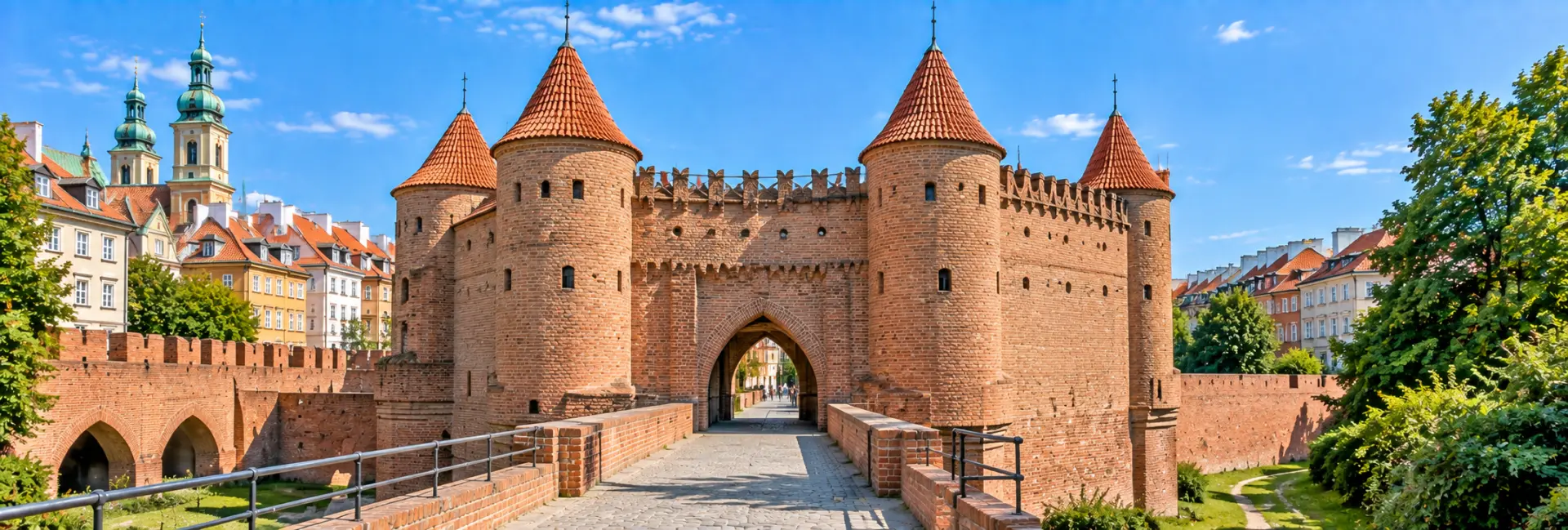
The Warsaw Barbican (Barbakan Warszawski) is a red-brick fortified gateway that stands at the northern edge of the Old Town, where the historic streets give way to the New Town. Its rounded bastion, pointed arches and stepped towers make it look like a piece of a medieval fortress dropped into the middle of the city, and it is one of the most photographed corners of Warsaw.
It is also a story about survival and reconstruction. The Barbican you walk through today is largely a postwar rebuild, yet it stands beside genuine stretches of the old defensive walls, so a short stroll here shows how the city defended itself, lost much of that heritage and then brought it back to life.
History
Guarding the Northern Gate
Warsaw's fortifications began in the early 14th century as earth and timber ramparts and grew into a double ring of brick walls. In the mid-16th century, during a project that ran through the 1540s, the Italian builder Giovanni Battista of Venice (known in Poland as Jan Baptysta Wenecjanin) created the Barbican to protect the northern entrance to the city along Nowomiejska Street. It was one of three elements that together made up the former New Town Gate, alongside a drawbridge and further gate structures.
By the 17th century the town could be entered through three main gates: the Nowomiejska Gate in the north, the Krakowska Gate in the south and the later Poboczna Gate in the west. The northern one, guarded by the Barbican, was the road to the New Town and the countryside beyond, which made it one of the two most important entrances to the city.
A Fortress Overtaken by Cannons
Advances in artillery made the structure outdated almost as soon as it was finished. It saw real defensive use only once, during the Swedish invasion known as the Deluge, when Polish forces led by King John II Casimir had to retake it from the Swedes on 30 June 1656. In the 18th century it was partly dismantled, and in the 19th century its remains were absorbed into new tenement buildings.
Destruction and Rebuilding
Conservation work began on the northern walls before the Second World War, but the 1939 invasion halted the plans. The Barbican was heavily damaged in 1939 and almost entirely destroyed in the 1944 Warsaw Uprising. Between 1952 and 1954 it was reconstructed from 17th-century etchings, using bricks salvaged from historic buildings demolished in Nysa and Wrocław. Two outer gates and the oldest tower on the Old Town side were not rebuilt.
Architecture & Design
The Barbican takes the form of an elongated, semicircular bastion with four towers and three levels, connected to the city walls by a Gothic-style bridge. Historians give its width as about 14 metres, its height as roughly 15 metres from the bottom of the former moat, and its reach beyond the walls as around 30 metres. Round openings for firearms are set into the interior corridors, so defenders could fire in several directions.
The moat that once surrounded the walls was fed by the small Dunaj stream, and the area is now a grassy hollow. One clever detail comes from the postwar restoration: conservators used black mortar to mark the authentic medieval fragments, so you can learn to spot the difference between surviving original brickwork and the new sections. The walls were also rebuilt to their full height only in some stretches, which is why the Old Town's rooftops remain visible from Podwale Street.
Recognition / Status
The Barbican is one of only a few surviving barbicans in Poland, with Kraków's being the largest and Warsaw's usually ranked second. Because the entire Old Town was reconstructed with unusual care, the district as a whole earned international recognition.
- UNESCO World Heritage Site: part of the Historic Centre of Warsaw, inscribed in 1980.
- Historic Monument of Poland: included in the Warsaw historic city centre with the Royal Route and Wilanów, designated on 8 September 1994.
- Museum branch: today the site is managed by the Museum of Warsaw, which runs a seasonal exhibition inside.
Cultural Significance
City walls were a mark of prestige in medieval Poland, and in Mazovia only Warsaw and Płock were fortified in this way. The walls enclosed an area of more than eight hectares and ran for over a kilometre, and they shaped daily life. Residents were obliged to stand guard on the ramparts and to pay for repairs, so the defences were as much a civic responsibility as a military asset.
Warsaw's citizens also organised themselves for defence through the Fowler Brotherhood, a shooting association founded before 1539 whose members trained with bows, crossbows and later firearms. Each year they held a contest in which the best marksman was crowned Fowler King. Today the Barbican carries a different kind of meaning: as a rebuilt monument, it stands for the postwar effort to recover the Old Town, and the artists who have shown their work along its wall since the 1960s have given it a lively, creative reputation as well.
What to See There
The Barbican is only one part of a longer stretch of preserved fortifications, and walking the wider area rewards a slow pace. These are the features to look for.
- The gateway passage and bridge, where a portcullis and drawbridge once protected the entrance to the city.
- The interior corridors, with narrow stairs, small round firing windows and models of vanished city gates.
- The Gunpowder Tower beside the Barbican, easy to recognise by its conical brick top and a reminder of the magazine once kept there.
- The Knights' Tower, an unusual rectangular tower rising more than 13 metres, dating from the earliest phase of the walls.
- The Little Insurgent monument, a 1983 sculpture of a small boy in an oversized helmet honouring the youngest fighters of 1944.
- The Mermaid statue on the wall, placed in 1972 on the site of the former Marshal Tower.
- The paintings and wooden carvings sold by artists in the passage, a tradition that reaches back to the 1960s.
Ways to Experience It
There are two layers to a visit: the free public spaces that are open all year, and the paid exhibition inside that runs only in summer. Many people do the first without ever going in, but the museum adds real context.
- Walk-through: stroll through the gate and along the walls at any time without a ticket.
- Summer exhibition: photographs, drawings, models and films in the Barbican's interior trace the history of the walls and the effort to rebuild them.
- Guided tours: the Museum of Warsaw offers guided visits in several languages, which can be booked in advance for groups.
- Self-guided wall trail: the museum publishes a route with audio recordings that follows the fortifications from the Vistula escarpment to Castle Square.
- Old Town walk: pair the Barbican with the Market Square and Castle Square for a compact historic-centre loop.
Best Time to Visit
The best months are late spring to late summer. The interior exhibition is a seasonal opening, so a summer trip is the only way to see inside the tower, and the wall-side artists tend to set up on warmer days, especially at weekends. The gateway and the walls remain open all year, so a winter visit is entirely possible, though a cold morning is better suited to a quick photo stop than a long wander.
Arriving earlier in the day usually means fewer people in the narrow gateway and cleaner photographs of the brickwork. Later hours are livelier, as visitors and locals pass between the Old and New Towns.
Visitor Tips
The Barbican is compact, so a few practical notes make the difference between a quick glance and a satisfying visit.
- Passing through the gate and walking along the walls is free and possible year-round. Check the Museum of Warsaw for the current exhibition dates and ticket prices before you go, as it opens only in the summer season.
- Interior access is by steps and uneven historic surfaces, so it is not suited to wheelchairs or pushchairs.
- Allow around 30 minutes for the exhibition and a little longer if you want to walk the full stretch of walls.
- Look closely at the brickwork and the black mortar lines to tell original medieval fragments from reconstructed sections.
- Leave a few minutes to browse the paintings and carvings the artists display in the passage, which are a local tradition.
- The nearest tram and bus stops are called Stare Miasto, and Castle Square is a short walk away through the Market Square.
Nearby Attractions
Because the Barbican links the Old Town and New Town, an afternoon here can easily take in several museums and squares.
- Old Town Market Square: the rebuilt medieval centre, with colourful townhouses, cafés and the Museum of Warsaw about 200 metres away.
- Castle Square and Sigismund's Column: a five to seven minute walk south through the Market Square, with the Royal Castle beside it.
- Museum of Pharmacy: a small museum on Piwna Street, roughly a five-minute walk away.
- Marie Curie Museum: on Freta Street in the New Town, reached by walking north through the Barbican itself.
- Heritage Interpretation Centre: an exhibition on the destruction and rebuilding of the Old Town, on Brzozowa Street near the Vistula escarpment.
FAQs about visiting the Warsaw Barbican
What is the Warsaw Barbican? +
It is a semicircular brick bastion from the 16th century that once guarded the northern gate of Warsaw's Old Town. Today it sits between the Old and New Towns and is one of the city's best-known landmarks.
Is the Barbican original or a reconstruction? +
The structure you see was rebuilt between 1952 and 1954 after wartime destruction, using historic etchings as a guide. Some original medieval fragments survive in the adjoining walls and are marked with black mortar.
Do I need a ticket to visit? +
Not to walk through the gateway or along the walls, which is free at any time of year. A ticket is only needed for the exhibition inside, which opens seasonally.
Can I go inside the tower? +
Yes, but only during the summer season when the Museum of Warsaw runs its exhibition there, so check the current dates before you plan a visit.
How much time should I set aside? +
About 30 minutes covers the exhibition and a look around the gateway. Add time if you want to follow the walls or browse the artists' paintings.
Is the Barbican accessible for wheelchairs and pushchairs? +
Not fully. The interior has steps and uneven historic surfaces, though the passage and nearby streets can be seen from outside.
How do I get there from Castle Square? +
Walk north through the Old Town Market Square and along Nowomiejska Street, which takes only a few minutes on foot.
Did the Barbican ever see battle? +
Only once. It was involved in fighting during the Swedish Deluge in 1656, when it changed hands and was recaptured by Polish forces.