Table of Contents
Overview
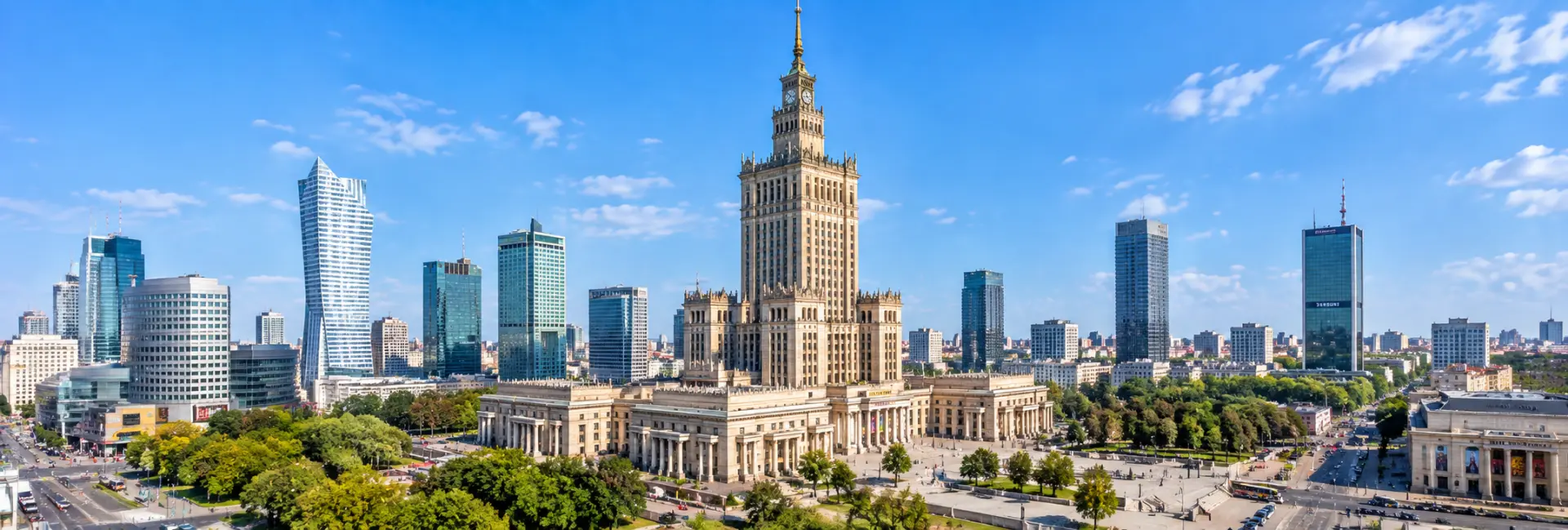
The Palace of Culture and Science dominates the Warsaw skyline as the city's tallest and most instantly recognisable building, its ornate spire rising high above the surrounding streets. Built in the 1950s, it remains one of the most debated structures in Poland, seen by some as an unwelcome symbol of a difficult political era and by others as an inseparable part of the city's modern identity.
Whatever view visitors take, the building's scale and detail make it worth a closer look, and its rooftop viewing terrace offers one of the best panoramic vantage points over central Warsaw, taking in both the reconstructed Old Town and the glass towers of the modern business district.
History
A Gift with Political Strings
The building was constructed between 1952 and 1955 as a large-scale gift from the Soviet Union to the people of Poland, at a time when Poland was firmly under Soviet political influence. Thousands of Polish and Soviet workers built the structure together, with many Soviet labourers housed in a purpose-built residential district on the edge of the city for the duration of the project.
From Stalin's Name to a Changed Symbol
On its completion the building was formally dedicated to the Soviet leader Joseph Stalin, whose name was dropped from the title only a few years later as political attitudes shifted following his death. Since then the building's meaning in Polish public life has continued to evolve, moving gradually from a resented symbol of foreign domination toward a more ambivalent, sometimes even affectionate, place in the city's everyday landscape.
Later Additions
Over the following decades the building has been updated and adapted for new uses, including the installation of large illuminated clock faces near the top in the late 1990s, temporarily making it home to one of the largest clock towers in the world. It has also taken on a role as a stage for major public events and concerts staged in its surrounding square.
Architecture & Design
The building was designed by the Soviet architect Lev Rudnev in a heavy, ornamental style closely associated with the Soviet Union's architecture of the period, drawing visible inspiration from a similar group of skyscrapers built in Moscow around the same time. Its stepped, tapering profile and decorative stonework have led to comparisons with that Moscow group, sometimes described informally as an additional member of the same family of buildings.
Despite its overall Soviet styling, the design also incorporates decorative details drawn from historic Polish architecture, added deliberately after the architect toured several Polish cities during the planning process. The result is a building that blends imported political symbolism with borrowed local ornament, standing 42 storeys tall and containing several thousand individual rooms.
Recognition & Status
Despite its politically loaded origins, the Palace of Culture and Science has been formally recognised as a protected historic monument, reflecting its significance as a major example of mid-20th-century architecture in Poland. It remains the second-tallest building in the country, and for decades after its completion it stood as the tallest structure in Poland by a wide margin.
What to See There
- A public viewing terrace located roughly two-thirds of the way up the tower, offering panoramic views over central Warsaw.
- Detailed exterior stonework and sculpture around the building's base and upper terraces, blending Soviet and Polish decorative motifs.
- Several theatres, cinemas and exhibition spaces housed within the building, many still in active use.
- The large public square surrounding the building, regularly used for concerts, markets and civic events.
Ways to Experience It
Most visitors ride an elevator directly to the viewing terrace, spending time taking in the panorama before exploring some of the building's public spaces at ground level. Guided tours covering the building's architecture and history are also available for those wanting more context than a self-guided visit provides.
- The viewing terrace is the main visitor draw and can be reached quickly by elevator.
- Several cultural venues inside the building host film screenings, theatre performances and exhibitions worth checking in advance.
- The surrounding square is worth a walk in its own right, particularly when hosting a public event.
Best Time to Visit
Clear days offer by far the best experience on the viewing terrace, since visibility across the city can be significantly reduced in overcast or hazy conditions. Late afternoon visits, timed to catch sunset over the city, are particularly popular among visitors looking for photography opportunities from the terrace.
Visitor Tips
- Tickets for the viewing terrace are usually purchased on-site or online, with separate pricing from any events held inside the building.
- The terrace can be windy and considerably cooler than street level, so an extra layer is worth bringing.
- The building's scale means wayfinding inside can be confusing, so following signage toward the terrace elevators is recommended.
- The surrounding square is well connected to public transport, making the building easy to combine with other central Warsaw sightseeing.
FAQs about visiting the Palace of Culture and Science
Why was the Palace of Culture and Science built? +
It was constructed in the 1950s as a large-scale gift from the Soviet Union to Poland, at a time when the country was under strong Soviet political influence.
Is the Palace of Culture and Science the tallest building in Poland? +
It was the tallest building in Poland for several decades and remains the second-tallest today, having since been surpassed by a newer high-rise in Warsaw.
Can visitors go up the Palace of Culture and Science? +
Yes, a public viewing terrace partway up the tower offers panoramic views over central Warsaw and is open to visitors with a ticket.
Why is the building controversial in Poland? +
It is closely associated with Poland's period under Soviet political influence, and opinions remain divided between those who see it as an unwanted symbol of that era and those who view it as part of the city's identity.
How tall is the Palace of Culture and Science? +
The building stands 237 metres tall including its spire, with the public viewing terrace located significantly lower, around two-thirds of the way up.
What is inside the Palace of Culture and Science? +
The building houses theatres, cinemas, exhibition spaces and various public institutions across its many floors, alongside the viewing terrace near the top.
Is the Palace of Culture and Science in central Warsaw? +
Yes, it stands in the heart of the city on a large public square, within easy walking distance of Warsaw's main shopping streets and transport hubs.