
Table of Contents
Overview
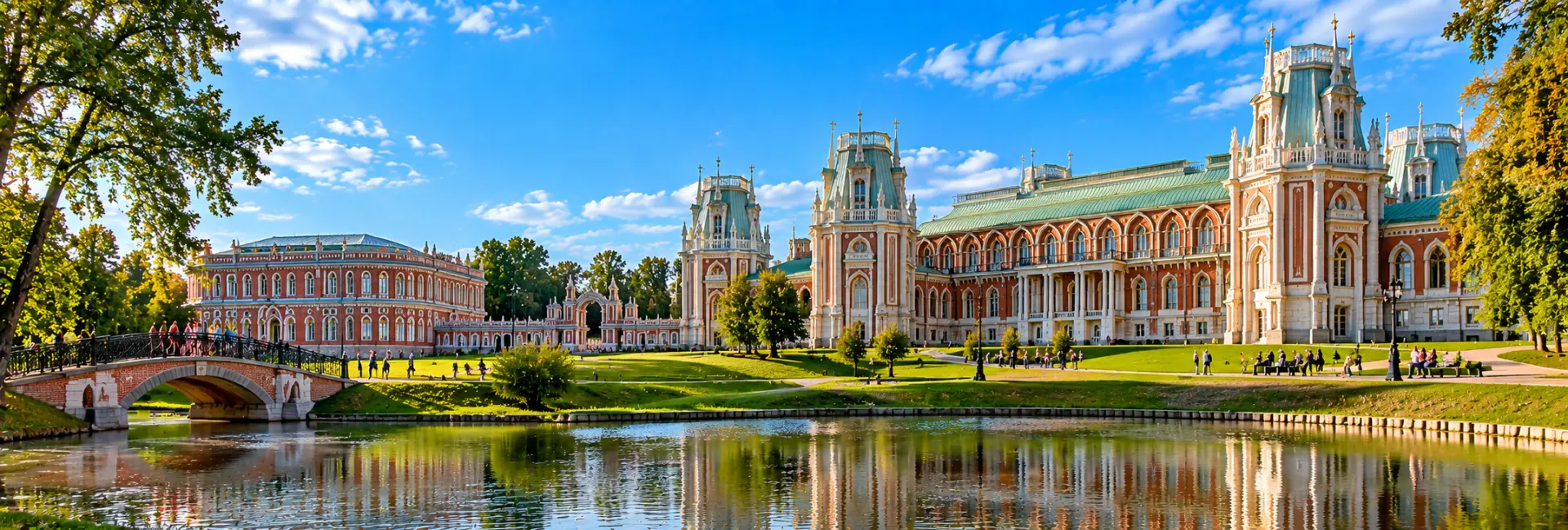
Tsaritsyno is a palace-and-park complex in the south of Moscow, begun in the 1770s as a country retreat for Empress Catherine the Great. Its red-brick walls trimmed with white stone, pointed arches and crenellated rooflines look more like a fairy-tale fortress than a typical Russian palace, and the style is often called pseudo-Gothic.
The empress never actually lived here. Construction stopped after her death, and for roughly two centuries the buildings stood roofless and overgrown. A long restoration eventually brought the ensemble back, and today it works as a museum-reserve covering about 405 hectares, with palaces, a historic landscaped park, a chain of ponds and a modern fountain that performs to music.
The result is one of Moscow's most atmospheric day-trip destinations. It combines architecture, history and open space, and it suits couples, families and anyone who enjoys a long, scenic walk with a few interesting buildings along the way.
History
From Black Mud to Imperial Estate
The land was known for centuries as Chernaya Gryaz, meaning Black Mud, and belonged to Russian tsars or their favourites. In 1775 Catherine the Great bought the property and renamed it Tsaritsyno, a name meaning the Empress's place. She commissioned the court architect Vasily Bazhenov to design a new residence in the so-called Gothic taste, which he interpreted as a blend of medieval Russian forms and Moscow Baroque, built in brick and white stone.
The Empress's Disappointment
Construction began in 1776 and continued for nearly a decade. When Catherine inspected the Grand Palace in June 1785, she left dissatisfied and ordered changes. Some scholars believe her unhappiness was as much about Bazhenov personally as about the design. He was dismissed, and his former assistant Matvey Kazakov took over, taking down the main building and starting a new palace with castle-like roofs and towers.
Ruin and Neglect
Work slowed and then stopped after Catherine died in 1796, when her successor halted construction. By then the Grand Palace was nearly finished but never occupied. Over the following decades the buildings decayed, and in the 1880s the roof and interior floors of the main palace were removed because of their condition. Plans to convert it into a holiday centre or even a champagne factory never materialised.
Rebirth as a Museum
A history museum opened in one of the surviving buildings in 1927, and the area survived the twentieth century as parkland and a local museum site. In 1984 it was designated a museum-reserve, and restoration of the palaces and grounds followed. The work was largely completed in the mid-2000s, with the territory refreshed in time for Moscow's anniversary celebrations in 2007.
Architecture & Notable Buildings
Tsaritsyno is a rare large-scale example of late eighteenth-century pseudo-Gothic architecture in Russia. Bazhenov mixed Moscow's old-fashioned brick-and-limestone traditions with pointed arches, turrets and ornate carving, creating a look that feels both medieval and playful.
The Grand Palace
The largest building is the Grand Palace, rebuilt according to Kazakov's later design with towers and decorative roofs. Inside, exhibition halls cover the estate's story, including an archaeological display of finds uncovered during the excavation of the palace and its surroundings.
The Bread House
Built in 1784 and 1785, the Bread House was originally the palace kitchen. It is the biggest surviving Bazhenov building on the site, and above its entrance you can find a monogram referring to bread and salt, the traditional Russian symbols of hospitality. It now hosts displays, including a permanent exhibition on Soviet-era culture.
The Opera House and Small Palace
The Middle Palace is commonly called the Opera House, a name that appeared in the 1800s even though music was rarely heard there for most of its history. Concerts and performances are staged here today. Nearby, the Small Palace carries Catherine's monogram on its pediment and offers another glimpse of the estate's decorative style.
Gates, Bridges and Outbuildings
The Figured Gates and the Figured Bridge lend the park a theatrical air, with carved details and sharp silhouettes. Cavalry buildings, orangery structures and smaller pavilions complete the ensemble.
Grounds, Ponds & Fountain
The Historic Park
The landscaped park surrounds the palaces with long paths, shaded avenues, old trees and open lawns. It is large enough to feel like a genuine escape from the city, and it is open to walkers, joggers and picnickers throughout the day.
The Ponds
A chain of ponds forms the park's visual heart, reflecting the red-and-white palaces in calm weather. In warm months visitors can rent boats or catamarans, and the shores are lined with benches that make good vantage points for photographs.
Greenhouses and Quiet Corners
Beyond the main palace area, the reserve includes historic greenhouses that are open to visitors and often host exhibitions and concerts. Further out, the paths become quieter and more rural, passing wooded stretches and open meadows where Muscovites come to cycle, jog or simply sit. The contrast between the polished palace core and these wilder edges is part of what makes the estate so enjoyable to explore at a slow pace.
The Light-and-Music Fountain
One of the park's modern showpieces is its large fountain, set on an island in the pond. More than 800 jets rise as high as 15 metres, moving in time with music, and thousands of underwater lights turn the show into a nightly spectacle during the season. The fountain runs through the warmer months, with the illuminated show starting in the late evening.
Cultural Significance
Tsaritsyno stands for an unfinished dream. The story of an empress who commissioned a lavish retreat and then rejected it has made the estate a symbol of ambition, taste and changing fortunes. For many Muscovites it is also a place of personal memories, from childhood picnics to wedding photographs.
The site matters architecturally as one of the few ensembles of its size from its era in Russia, and as a showcase for how a historic complex can be reconstructed after generations of decay. Debate over how closely the restoration followed the original designs adds another layer of interest for architecture buffs.
It is also an active cultural venue. Exhibitions, concerts, festivals and seasonal events are held in the palaces and across the park, and the grounds are a popular place for weddings. The museum-reserve therefore feels less like a frozen monument and more like a living part of Moscow's cultural life.
Ways to Experience It
A Palace Visit
Start with the Grand Palace and Bread House, where the exhibitions explain the estate's history and show how the buildings were rebuilt. Allow time to look at the architectural details from outside as well, since the facades are the main attraction.
A Park Walk
Walk the circuit around the ponds, passing the palaces, bridges and gates, and finish at the fountain. If you are short on time, a one-hour route from one gate to another covers the highlights.
Boats, Concerts and Events
In the warm season you can hire a boat on the water, and the Opera House and other venues host concerts and exhibitions throughout the year. Guided tours offer more background on the architects and the estate's turbulent history.
Best Time to Visit
By Season
Late spring to early autumn is the most popular period. Fountains are on, boats are available and the park is green. Early autumn also brings colourful foliage that suits the red-brick buildings particularly well.
Winter is quieter and has its own appeal when snow settles on the roofs and ponds, though the fountain is off and temperatures can be harsh. It is a good time to focus on the indoor exhibitions.
By Time of Day
Weekday mornings are calm and best for photographs. Late afternoon gives the palace walls a warm glow. If you visit in summer, stay for the evening, when the fountain's light show begins and the park fills with strollers.
Visitor Tips
- Getting there: the Tsaritsyno metro station is a short walk from the park gate, and a second entrance is reachable from the Orekhovo station side.
- Entry: the park itself is free to enter, while the palaces, Bread House, Opera House and greenhouses charge separate admission. Check official sources for current ticket prices and any free-entry days.
- Opening days: museum buildings usually close one day a week and keep shorter hours than the park, so confirm times before you go.
- Photography: taking photos inside is typically allowed without flash, but check signs in each building.
- Comfort: wear sturdy shoes, since the park is large and some paths are uneven, and bring water in summer.
- Time needed: plan roughly two to three hours for the main buildings and ponds, and add more if you want to stay for the fountain show.
- Before you travel: entry rules and government travel advice for Russia can change, so check the latest requirements for your nationality well in advance.
Nearby Attractions
Tsaritsyno is in the far south of the city, so it is easiest to pair it with other sights in the same district or along the metro line. Kolomenskoye, another historic estate on the Moskva River with its famous white-stone church, is a short ride away and makes a good second stop for an architecture-themed day.
Within the museum-reserve itself, the greenhouses, the Opera House and the quiet outer paths of the park give you plenty to explore before you head elsewhere. For a relaxed finish, linger by the ponds or settle at one of the park's cafés before taking the metro back toward the centre.
FAQs about visiting Tsaritsyno Museum-Reserve
What is Tsaritsyno? +
It is a former imperial estate in southern Moscow, begun for Catherine the Great in the 1770s, that now operates as a museum-reserve with palaces, a landscaped park, ponds and a modern fountain.
Did Catherine the Great ever live there? +
No. She visited in 1785, was unhappy with the main palace and ordered it rebuilt. Construction stopped after her death and the palace was never lived in.
Is the park free to enter? +
Yes, the park is free to enter. The palaces, Bread House, Opera House and greenhouses require tickets.
How long should I allow for a visit? +
Two to three hours is enough for the main buildings and a walk around the ponds. Add more time for the evening fountain show or extra exhibitions.
How do I get to Tsaritsyno? +
Take the metro to Tsaritsyno station, which is a short walk from the park entrance. Another gate is accessible from Orekhovo station.
When does the fountain run? +
It operates during the warm season, with the light-and-music show held in the evening. Check the official website for this year's schedule.
Is Tsaritsyno suitable for children? +
Yes, the open lawns, boats and fountain make it popular with families, and there is plenty of space to walk and play.
