
Table of Contents
Overview
The Palau de la Música Catalana is a concert hall in Barcelona's Sant Pere neighborhood, built at the height of the Catalan Modernisme movement as a home for the choral society Orfeó Català. Completed in 1908, it remains a working concert venue, hosting performances year-round rather than functioning purely as a historic site.
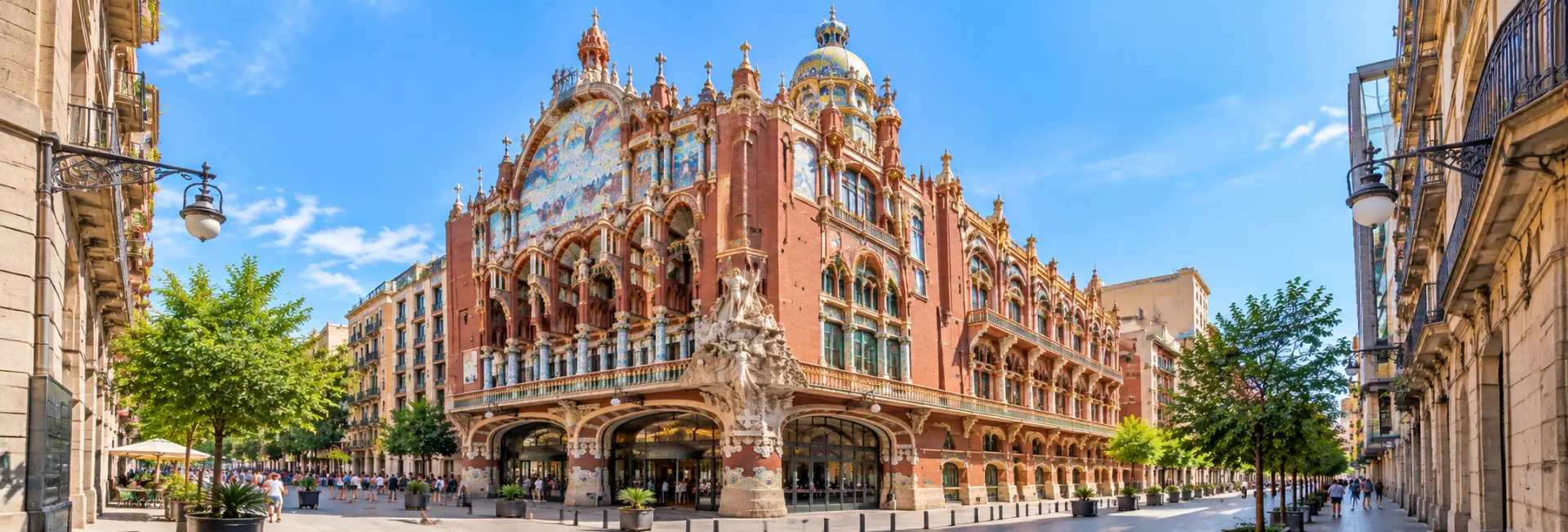
What sets it apart from most concert halls is how completely its architecture, sculpture, stained glass, and mosaic work all come together around a single theme: music itself. Every surface, from the tiled columns of the facade to the sculpted muses framing the stage, was designed to turn the building into an artwork about the act of making and listening to music, making it as much a destination for architecture lovers as for concertgoers.
History
A Concert Hall Born from a Choir
The Palau de la Música Catalana was commissioned by the Orfeó Català, a choral society founded in 1891 by musicians Lluís Millet and Amadeu Vives to promote Catalan choral singing and culture. As the society outgrew its existing rehearsal spaces, it commissioned architect Lluís Domènech i Montaner, one of the leading figures of Catalan Modernisme, to design a new headquarters and concert hall. Construction began in 1905 on the site of a former convent and was funded largely through public subscription from the Orfeó's members and Barcelona's wealthier patrons, with the building inaugurated on 9 February 1908.
Expansion and Restoration
The Palau's popularity eventually outgrew its original footprint, and starting in the early 1980s the Orfeó Català Foundation undertook a long program of restoration and expansion. An adjoining church was demolished to make way for a new wing designed by architect Òscar Tusquets, a project that, combined with extensive repairs to the original Modernista structure, spanned roughly two decades. The building continues to serve as the Orfeó Català's home today, alongside its role as one of Barcelona's principal concert venues.
Architecture & Design
A Structure Built Around Light
Domènech i Montaner designed the Palau around a central iron structure clad in glass, an ambitious engineering choice for its time, stabilized by a system of buttresses and vaults inspired by Gothic architecture. Natural light was treated as a design material in its own right, entering through large stained-glass walls, a central inverted skylight, and windows positioned to flood the interior with color throughout the day.
A Facade Covered in Symbolism
The exterior combines exposed brick with brightly colored ceramic mosaics and sculptural groups. A corner sculpture by Miquel Blay, shaped like the prow of a ship, depicts an allegory of Catalan folk song, while busts of composers including Bach, Beethoven, Palestrina, and Wagner look out from the columns of the main facade. Above them, a large mosaic pediment by Lluís Bru depicts members of the Orfeó Català choir gathered around a scene inspired by the poem "La Balanguera."
Recognition & Status
The Palau de la Música Catalana was declared a UNESCO World Heritage Site on 4 December 1997, listed jointly with Barcelona's Hospital de Sant Pau as an outstanding example of Modernisme's fusion of architecture and the applied arts. It holds the distinction of being the only concert hall in this architectural style with UNESCO World Heritage status, and it remains one of the most recognized symbols of Catalan cultural identity.
- UNESCO World Heritage Site since 1997, jointly inscribed with Hospital de Sant Pau
- Regarded as one of the defining buildings of Catalan Modernisme
- Still serves as the working headquarters and rehearsal home of the Orfeó Català
Inside the Concert Hall
The interior of the main auditorium is widely considered the building's centerpiece. Above the stage, a carved arch separates two sculptural groups: one showing composer Anselm Clavé conducting a scene from a traditional Catalan song, the other depicting Wagner's Valkyries riding above a bust of Beethoven. Eighteen sculpted muses, rendered as a mix of relief and mosaic, line the back of the stage as a classical backdrop for performers.
- A blue-and-gold inverted stained-glass skylight representing the sun, at the center of the ceiling
- Eighteen sculpted muses framing the rear of the stage
- Sculptural groups of Wagner's Valkyries and Anselm Clavé flanking the stage arch
- Tiled, mosaic-covered columns throughout the foyer and auditorium
- An organ positioned above the stage, its pipes designed to evoke male choral voices
Ways to Experience It
There are two main ways to see the Palau: attending a live performance, or joining a guided tour of the building during the day. Both give access to the auditorium, though a concert offers the added experience of hearing the space in use.
- Guided tours of the concert hall, foyer, and Lluís Millet Hall, offered in multiple languages
- Attending a scheduled concert, ranging from classical and choral music to jazz and contemporary performances
- Visiting the ground-floor cafe-restaurant, set among the building's tiled columns
- Photographing the exterior facade and mosaics from Carrer Sant Pere Més Alt
Best Time to Visit
Guided tours run throughout the day, and arriving for one of the earlier time slots tends to mean smaller groups and a quieter experience of the interior. Because the building operates as an active concert venue, availability for tours can vary around performance schedules, so booking in advance is worthwhile no matter the season.
For those hoping to see the hall in use rather than on a tour, checking the season's concert calendar ahead of a trip is the best way to plan around a specific performance, since the program changes throughout the year.
Visitor Tips
A few practical points can help in planning a visit.
- Book tour or concert tickets online in advance, as time slots and performances can sell out, especially in peak travel season
- Check the Palau's official website for current opening hours, tour times, and ticket prices, since these change periodically
- Guided tours generally last under an hour and cover the main public spaces of the building
- Photography without flash is typically permitted during tours but restricted during live performances
- The Urquinaona metro station is a short walk from the entrance
- Dress for a concert if attending an evening performance, as some events lean toward smart-casual attire
Nearby Attractions
The Palau sits at the edge of Sant Pere, within easy walking distance of several other Ciutat Vella landmarks.
- The Museu Picasso and the medieval palaces of Carrer Montcada, a short walk south
- Santa Maria del Mar basilica, in the neighboring El Born district
- The Mercat de Santa Caterina, known for its colorful undulating roof
- Barcelona's Gothic Quarter, within easy walking distance to the southwest
FAQs about visiting the Palau de la Música Catalana
What is the Palau de la Música Catalana known for? +
It's a UNESCO World Heritage-listed concert hall built in the early 1900s in the Catalan Modernisme style, celebrated for its stained-glass skylight, sculpted muses, and richly decorated facade.
Who designed the Palau de la Música Catalana? +
It was designed by architect Lluís Domènech i Montaner, one of the leading figures of Catalan Modernisme, and built between 1905 and 1908 for the Orfeó Català choral society.
Do you need to attend a concert to visit the Palau? +
No, the building offers guided tours during the day for visitors who want to see the interior without attending a performance, in addition to its regular concert schedule.
How long does a guided tour of the Palau take? +
Guided tours generally run under an hour and cover the main public areas, including the concert hall, foyer, and Lluís Millet Hall.
Is the Palau de la Música Catalana still used for concerts? +
Yes, it remains an active concert venue and the working home of the Orfeó Català choral society, hosting performances ranging from classical and choral music to jazz.
How do you get to the Palau de la Música Catalana? +
The Urquinaona metro station is a short walk from the building, and it's also an easy walk from the Gothic Quarter or the Museu Picasso.
Why is the Palau de la Música Catalana a UNESCO World Heritage Site? +
It was inscribed in 1997, jointly with Barcelona's Hospital de Sant Pau, as an outstanding example of how Catalan Modernisme fused architecture with sculpture, stained glass, and mosaic.
What's nearby the Palau de la Música Catalana worth visiting? +
The Museu Picasso, Santa Maria del Mar basilica, and the Mercat de Santa Caterina are all within a short walk, making it easy to pair with a visit to Barcelona's Born and Gothic Quarter neighborhoods.
