
Table of Contents
Overview
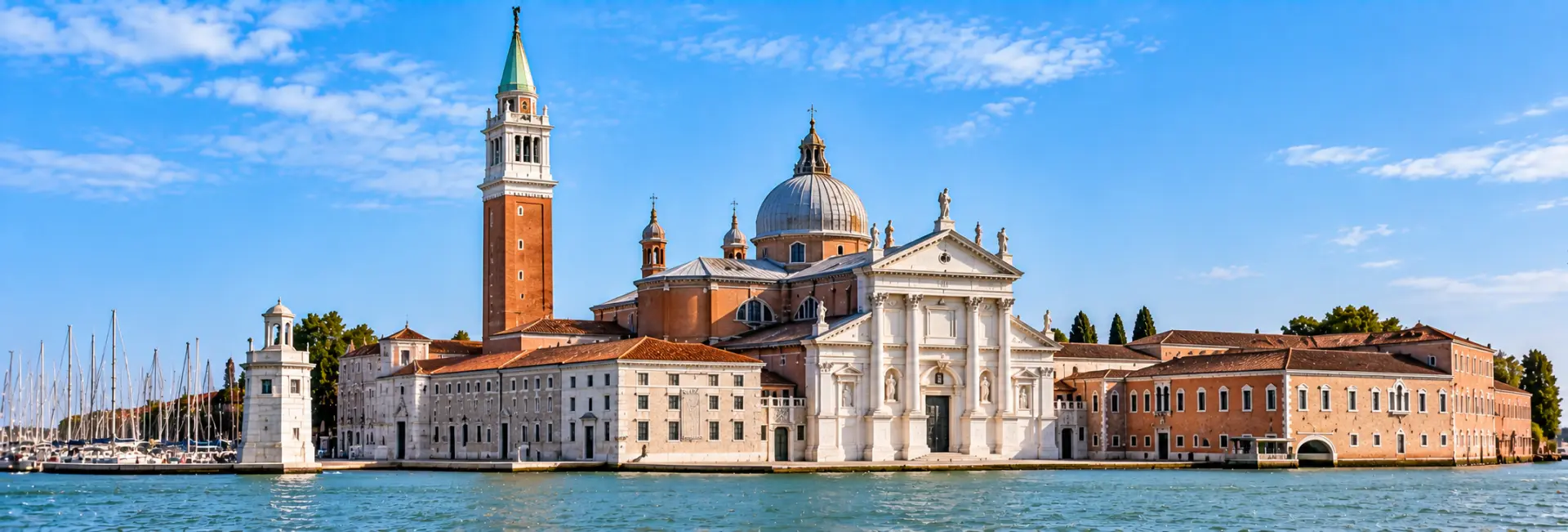
The Basilica of San Giorgio Maggiore stands on its own small island directly across the water from St. Mark's Square, its brilliant white facade forming one of the most recognizable pieces of Venice's skyline. Designed by the Renaissance architect Andrea Palladio, the church is widely considered one of his masterworks and a defining example of how classical architecture could be adapted to a Christian church without losing its temple-like monumentality.
Beyond its architectural significance, the basilica holds several major paintings by Jacopo Tintoretto, and its bell tower offers what many visitors consider the finest panoramic view of Venice available anywhere in the city. The island around it, once a working Benedictine monastery, is now home to the Cini Foundation, a cultural institution that has restored much of the surrounding complex and opened parts of it to visitors.
History
Origins and Early Monastery
A church has stood on this island since around 790, and in 982 the island itself was granted to the Benedictine order, which founded a monastery here. That early complex did not survive intact: an earthquake in 1223 destroyed most of the buildings on the island, and the monastery had to be rebuilt from the ground up in the centuries that followed.
Palladio's Commission
By the mid-16th century the monks considered their existing church too small and outdated, and in 1565 they commissioned Andrea Palladio to design a replacement. Palladio had first come to the monastery's attention a few years earlier, when he redesigned its refectory, and the church commission that followed gave him his first chance to design a complete building from foundation to facade rather than adapting an existing structure. Construction began the following year with the foundation stone laid in the presence of the Pope, and the main body of the church was largely complete by 1575. Palladio died in 1580 before the building was finished, and the facade, delayed for years afterward, was not completed until 1610 under the supervision of Vincenzo Scamozzi, who worked from Palladio's original model with only minor changes.
Suppression and Revival
The monastery's fortunes declined sharply after Napoleon's conquest of Venice, when the Benedictine community was suppressed in 1806 and the complex was converted into military barracks and an ammunition depot, a use that continued for over a century. The Italian state returned the monastery to religious and cultural use in 1951, when the industrialist and philanthropist Vittorio Cini established a foundation to restore the buildings and turn much of the complex into a center for cultural and scholarly work, a role it still holds today alongside the basilica's ongoing use as a working church.
Architecture and Design
San Giorgio Maggiore was Palladio's first opportunity to design a complete church from the ground up, and it became the proving ground for an idea he had already begun testing on a smaller scale elsewhere in Venice: layering two overlapping classical temple fronts to solve the problem of giving a Christian church, with its tall nave and lower side aisles, a coherent facade based on ancient temple architecture.
The solution reads clearly from across St. Mark's Basin, where the church's white Istrian stone facade catches the light against the water. Inside, the design is unusually restrained for a Venetian church of its era, with plain white and grey walls, engaged columns, and large thermal windows that flood the nave and transept with natural light. Decoration is deliberately limited, concentrated mainly in the geometric patterning of the floor tiles and the carved wooden choir stalls behind the high altar, made between 1594 and 1598. The main body of the building is constructed largely in red brick beneath its marble cladding, a material more commonly used for lesser buildings of the period, which Palladio disguised entirely behind the smooth white stone visible from the water.
Notable Artworks
The basilica holds one of the most significant concentrations of Jacopo Tintoretto's late work found anywhere in Venice, the result of his close ties to the Benedictine community that commissioned the church. Tintoretto was in his seventies when he completed the Last Supper and the Fall of Manna, and both paintings are considered among the most mature expressions of his signature use of dramatic light and unconventional perspective, departing sharply from the calmer, frontal compositions earlier Venetian painters had used for the same subjects.
- The Last Supper: painted between 1592 and 1594, this large canvas in the presbytery is among Tintoretto's most celebrated depictions of the subject, notable for its dramatic diagonal composition and use of light
- The Fall of Manna: hung opposite the Last Supper in the presbytery, this companion painting depicts the Israelites in the wilderness
- The Entombment of Christ: located in the Cappella dei Morti, painted by Tintoretto for the chapel
- The Risen Christ and Saint Andrew with the Morosini Family: a joint work by Jacopo and his son Domenico Tintoretto, hung above the Morosini altar
Beyond the Tintoretto paintings, the basilica houses an 18th-century altarpiece by Sebastiano Ricci, Madonna Enthroned with Saints, widely regarded as one of the finest works in the church. A carved wooden angel that once stood atop the campanile, removed after being struck by lightning in 1993, is displayed near the entrance to the bell tower.
The Campanile and Its View
The basilica's bell tower was first built in 1467 but collapsed in 1774, sharing the same fate that would later befall the campanile in St. Mark's Square. It was rebuilt in a Neoclassical style by 1791, deliberately echoing the profile of its counterpart across the water. Where climbing St. Mark's Campanile once required ascending ramps, visitors to San Giorgio Maggiore's tower now reach the top by elevator.
The observation deck offers a sweeping view across St. Mark's Basin, taking in the Doge's Palace, St. Mark's Campanile, the Basilica di Santa Maria della Salute, and much of central Venice laid out in one continuous sweep. Because the tower draws far fewer visitors than its counterpart in St. Mark's Square, many consider it the better vantage point for photographing the city, particularly in the softer light of late afternoon.
Ways to Experience It
The island of San Giorgio Maggiore sits just a few minutes by vaporetto from St. Mark's Square, making it an easy addition to a day otherwise spent in the city's busiest district.
- Visit the basilica interior: free to enter, with the Tintoretto paintings and choir stalls forming the core of a self-guided visit
- Ride the campanile elevator: a short, paid ride to the observation deck for panoramic views over the lagoon and central Venice
- Tour the Cini Foundation complex: guided tours cover Palladio's refectory, Baldassare Longhena's library and staircase, and the monastery's cloisters
- Walk the Borges Labyrinth: a boxwood maze on the grounds, laid out in tribute to the writer Jorge Luis Borges and open as part of certain foundation tours
- Explore the island's gardens and woods: quieter, less-visited grounds behind the monastery buildings, worth a slower walk after the main sights
Best Time to Visit
The basilica and its island see noticeably fewer visitors than St. Mark's Square, and that gap holds true across most of the year, making San Giorgio Maggiore a comparatively calm stop even during Venice's busiest summer months. Early morning and late afternoon tend to be quietest, and the light in the late afternoon is especially well suited to the view from the campanile.
Sunday mornings see the basilica close to visitors during Mass, so travelers planning a Sunday visit should check service times before arriving. Spring and autumn bring milder weather for time spent outdoors on the island's grounds, while the church interior remains a comfortable, sheltered visit regardless of season. Because the island sits fully exposed to the lagoon, the campanile can feel considerably windier and colder than street level in Venice, so a layer is worth carrying even on an otherwise mild day.
Visitor Tips
- Check Sunday Mass times before visiting, since the church suspends tourist access during the late-morning service
- Bring cash for the campanile elevator, since ticket booths on site may not always accept cards
- Visit the campanile in late afternoon for the best light over the Venice skyline
- Book Cini Foundation tours in advance if you want to see the Borges Labyrinth or the monastery's restored interiors, since these areas often require a guided visit rather than free entry
- Dress appropriately for a working church, with shoulders and knees covered, as is expected at most religious sites in Venice
- Take the short vaporetto ride rather than attempting to walk, since the island has no bridge connection to the rest of Venice
Nearby Attractions
The island's position just across St. Mark's Basin puts several of Venice's major sights within a short boat ride.
- St. Mark's Square and Basilica: the historic heart of Venice, a few minutes away by vaporetto
- Doge's Palace: the former seat of Venetian government, visible directly across the water from San Giorgio Maggiore's campanile
- Giudecca: a quieter residential island just across a narrow channel, reachable by a short additional boat ride
- Basilica di Santa Maria della Salute: a landmark Baroque church at the entrance to the Grand Canal, visible from the campanile and reachable by vaporetto
FAQs about visiting the Basilica of San Giorgio Maggiore
What is the Basilica of San Giorgio Maggiore known for? +
It is known for its Palladio-designed Renaissance facade, a collection of Tintoretto paintings including the Last Supper, and a bell tower widely considered to offer the best panoramic view of Venice.
How do you get to San Giorgio Maggiore? +
The island has no bridge to the rest of Venice, so it's reached by vaporetto, with the crossing from St. Mark's Square taking only a few minutes.
Is the basilica free to visit? +
Yes, entry to the church itself is free, though there is a separate paid ticket to ride the elevator up the campanile.
How long do you need to visit? +
Most visitors spend around an hour seeing the church interior and riding up the bell tower, though a Cini Foundation tour of the monastery grounds can extend a visit to two hours or more.
Is the view from the campanile better than St. Mark's bell tower? +
Many visitors and guides consider it comparable or better, since it offers a similar panoramic sweep of the city with noticeably smaller crowds than the campanile in St. Mark's Square.
What paintings by Tintoretto are inside? +
The basilica holds several late works by Jacopo Tintoretto, including the Last Supper and the Fall of Manna in the presbytery, and the Entombment of Christ in a side chapel.
Can you visit on a Sunday? +
Tourist visits are generally suspended during the late-morning Sunday Mass, so it's best to check service times or plan a visit for another part of the day.
What is the Cini Foundation, and can you tour it? +
The Cini Foundation is the cultural institution that restored and now manages most of the former monastery complex, and it offers guided tours of areas including Palladio's refectory and the Borges Labyrinth.
