
Table of Contents
Overview
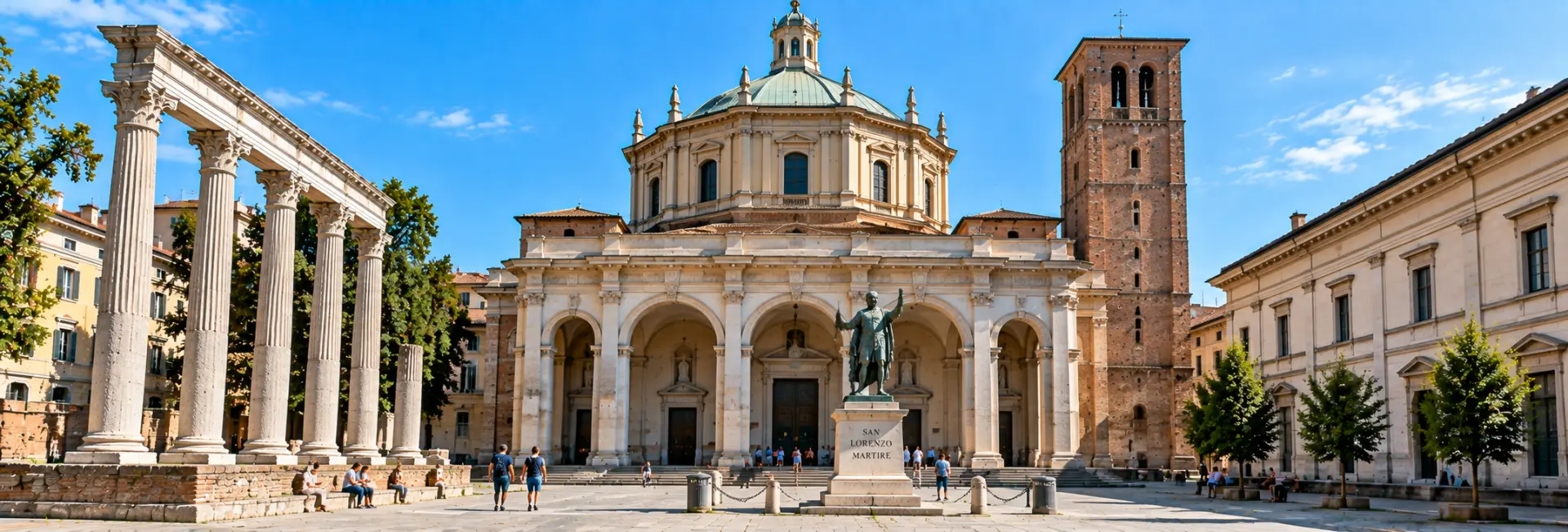
The Basilica di San Lorenzo Maggiore is one of the oldest surviving churches in Milan, dating back to a period when the city served as the capital of the Western Roman Empire. Set within the historic Navigli district near the medieval Porta Ticinese gate, it stands as a rare, still-functioning link to Milan's late antique past, long before the Duomo or the city's Renaissance and Baroque landmarks were built.
Scholars regard the building as an exceptionally bold piece of early Christian engineering, with a centrally planned layout that some historians consider the earliest of its kind in Western Christendom. A row of ancient Roman columns still stands guard in front of the facade, while inside, the small Cappella di Sant'Aquilino preserves mosaics and a mausoleum-like interior that predate the main basilica's later rebuildings.
Together, the basilica, its flanking chapels and the ancient columns outside form part of what is often called Milan's "Basilicas Park," a cluster of early Christian monuments concentrated in this corner of the city that offers one of the clearest windows anywhere in northern Italy into life in Milan during the last century of Roman rule.
History
Late Roman Origins
The exact founder and founding date of the basilica remain uncertain, but archaeometric analysis carried out in the early 2000s dated its construction to the final decade of the fourth century or the very start of the fifth, placing it in the twilight years of Emperor Theodosius's reign and the subsequent period dominated by Honorius and the general Stilicho. Some records point to consecration around 402. The basilica's dedication to the martyr Saint Lawrence is documented only from 590, well after the fall of the Western Empire, once Milan had come under Lombard rule.
A Building of Daring Design
Architectural historians have long singled out San Lorenzo Maggiore for the ambition of its original design, seeing it as an echo of the grand, centrally planned churches once built under Constantine and his successors in the Byzantine world, almost none of which have survived elsewhere. Its square main body, ringed by four large rounded exedrae, gave the building a symmetry that was highly unusual for its time and helped establish a design language later echoed elsewhere in Christian architecture.
Centuries of Rebuilding
Like many buildings of its age, the basilica has been damaged, altered and reconstructed many times over the centuries. Its dome in particular has had a turbulent history: an earlier version was destroyed by fire, and a later replacement collapsed after being struck by lightning. The dome visitors see today, still the tallest in Milan, was built between 1574 and 1591 as part of a broader Counter-Reformation-era renovation of the complex.
The Square Behind the Basilica
The open space behind the church, now a small park known as Piazza della Vetra, has its own layered history. It is believed to have once held a canal or small body of water, and later became one of Milan's most notorious sites for public executions. The area is referenced in Alessandro Manzoni's historical account "Storia della Colonna Infame," which recounts the brutal trial and execution of men falsely accused of spreading plague in seventeenth-century Milan.
Today the same square offers one of the best vantage points for appreciating the basilica's unusual silhouette, since it is from here, rather than the main facade, that visitors can take in the full arrangement of the towers and the flanking octagonal chapels at once.
Architecture & Design
Despite its many restorations, the basilica has kept much of its original late antique floor plan: a square central hall extended on each side by a large semicircular exedra, creating an unusually symmetrical, almost centralized layout rather than the elongated naves typical of most historic churches.
The Towers
Four brick towers rise at the corners of the building, and beyond their visual presence they originally served a structural purpose, helping contain and redistribute the outward thrust of the central dome. The towers are not identical: one, viewed from the square in front, has been truncated over time, while another is topped with a triple-arched loggia set on small columns with leaf-carved capitals, giving the exterior an asymmetrical, weathered character that reflects its long and complicated building history.
Flanking Chapels
Smaller chapels branch off the rear of the main body, most notably the octagonal Cappella di Sant'Aquilino on one side and the smaller Cappella di Sant'Ippolito on the other, both visible from the piazza behind the basilica and each adding to the complex's unusual, multi-lobed silhouette.
The Colonne di San Lorenzo
Standing in a row in front of the basilica's facade are sixteen tall Corinthian columns known as the Colonne di San Lorenzo, among the most significant surviving pieces of Roman-era architecture in Milan. Dating to the second or third century, the columns were originally part of a different Roman structure and were later moved to this spot and reused as material for the basilica's grand quadriporticus, the colonnaded forecourt that once stood in front of the church.
Although the rest of that ancient forecourt has long since disappeared, the surviving colonnade remains one of Milan's most recognizable Roman-era sights and a popular gathering spot, particularly in the evenings when the area around it becomes a lively meeting point for locals.
Cappella di Sant'Aquilino
Attached to the eastern side of the basilica, the Cappella di Sant'Aquilino is widely regarded as the most important surviving witness to Roman and early Christian Milan. According to tradition, it began life as an imperial mausoleum, possibly commissioned by Galla Placidia, daughter of Emperor Theodosius, sister of Honorius and mother of the later emperor Valentinian III, before later being rededicated first to Saint Genesius and eventually to Saint Aquilinus, an eleventh-century priest and martyr whose remains now rest in a rock-crystal and silver urn near the chapel's altar.
Architecture and Mosaics
The octagonal chapel is entered through a small vestibule and covered by a dome roughly 1,600 years old, built using a lightweight technique of interlocking hollow terracotta tubes that gives it an umbrella-like structure. Two large mosaics survive in the apses at the back of the chapel: one depicting Christ enthroned among the apostles, sometimes known as the Traditio Legis, and another portraying the biblical Rapture of Elijah, both set against luminous gold backgrounds typical of the period.
The Sarcophagus and the Roman Amphitheater
Inside the chapel stands a marble sarcophagus traditionally known as the tomb of Galla Placidia, though most historians now doubt she was actually buried here, since her famous surviving mausoleum stands in Ravenna and she is thought to have died and been buried in Rome. A staircase behind the basilica's main altar leads down to a crypt-like space containing remnants of a Roman amphitheater, offering visitors a glimpse of the site's history that predates even the basilica itself.
Restoration work carried out in recent years has cleaned and stabilized the chapel's mosaics and frescoes and updated its lighting, making the colors and detail of the ancient artwork considerably easier to appreciate than in earlier decades, when the chapel's decoration had grown dim and difficult to read.
Visiting Etiquette & Tips
- Dress modestly, covering shoulders and knees, as required in any active place of Catholic worship
- The main basilica is generally free to enter, while a small admission fee typically applies for the Cappella di Sant'Aquilino and the archaeological area beneath the altar
- Keep voices low and be mindful of ongoing services or private prayer, particularly around the main altar
- Photography is often restricted or limited inside the Cappella di Sant'Aquilino to help protect the fragile ancient mosaics, so check current signage before taking pictures
- Allow extra time to sit outside among the Colonne di San Lorenzo, since the columns and the piazza in front of them are as much a part of the experience as the basilica's interior
- Combine a visit with the archaeological area beneath the altar if time allows, since it's easy to overlook but offers a rare direct look at Roman-era remains
Best Time to Visit
The basilica generally keeps different hours on weekdays and weekends, opening earlier and running longer on Saturdays and Sundays, so it's worth checking current opening times before planning a visit, especially if the Cappella di Sant'Aquilino is a priority. Weekday mornings tend to be the quietest, while the square in front of the columns gets noticeably livelier in the evenings, when the area functions as an informal social gathering spot for locals.
Because the chapel's fragile mosaics benefit from natural light streaming through its small windows, a visit around midday can offer some of the best conditions for appreciating their color and detail, though this can vary depending on the season and weather.
Nearby Attractions
- The Colonne di San Lorenzo, the ancient Roman columns standing directly in front of the basilica
- Basilica di Sant'Eustorgio, another of Milan's important early churches, a short walk away in the same historic district
- The medieval Porta Ticinese gate, marking one of the old entrances to the city
- The Navigli canal district, known for its restaurants, bars and lively evening atmosphere
FAQs about visiting the Basilica of San Lorenzo Maggiore
What is the Basilica of San Lorenzo Maggiore known for? +
It's considered one of the oldest and architecturally boldest churches in Milan, notable for its centrally planned late antique design, the ancient Roman columns standing in front, and the early Christian mosaics preserved in its Cappella di Sant'Aquilino.
Is the basilica free to visit? +
The main church is generally free to enter, though a small fee usually applies for the Cappella di Sant'Aquilino and the archaeological area beneath the altar.
How much time should I plan for a visit? +
Most visitors spend around 30 to 45 minutes inside, plus additional time outside admiring the Roman columns and the surrounding piazza.
What are the Colonne di San Lorenzo? +
They're sixteen ancient Roman columns standing in front of the basilica, originally part of a different Roman-era structure and later reused to build the church's now-vanished colonnaded forecourt.
Who is buried in the Cappella di Sant'Aquilino? +
A sarcophagus in the chapel is traditionally linked to Galla Placidia, daughter of Emperor Theodosius, although most historians believe she was actually buried in Rome rather than in this tomb.
How do I get to the Basilica of San Lorenzo Maggiore? +
It sits within Milan's Navigli district, within easy walking distance of the medieval Porta Ticinese gate, and is reachable by several tram lines that serve the surrounding area.
Is the basilica still an active church? +
Yes, it functions as a working parish church following the Ambrosian Rite used throughout the Milan archdiocese, so visitors should be considerate of Mass times and services.
What else is worth seeing nearby? +
The Basilica di Sant'Eustorgio and the lively Navigli canal district are both within easy walking distance and pair naturally with a visit to San Lorenzo Maggiore.
