Table of Contents
Overview
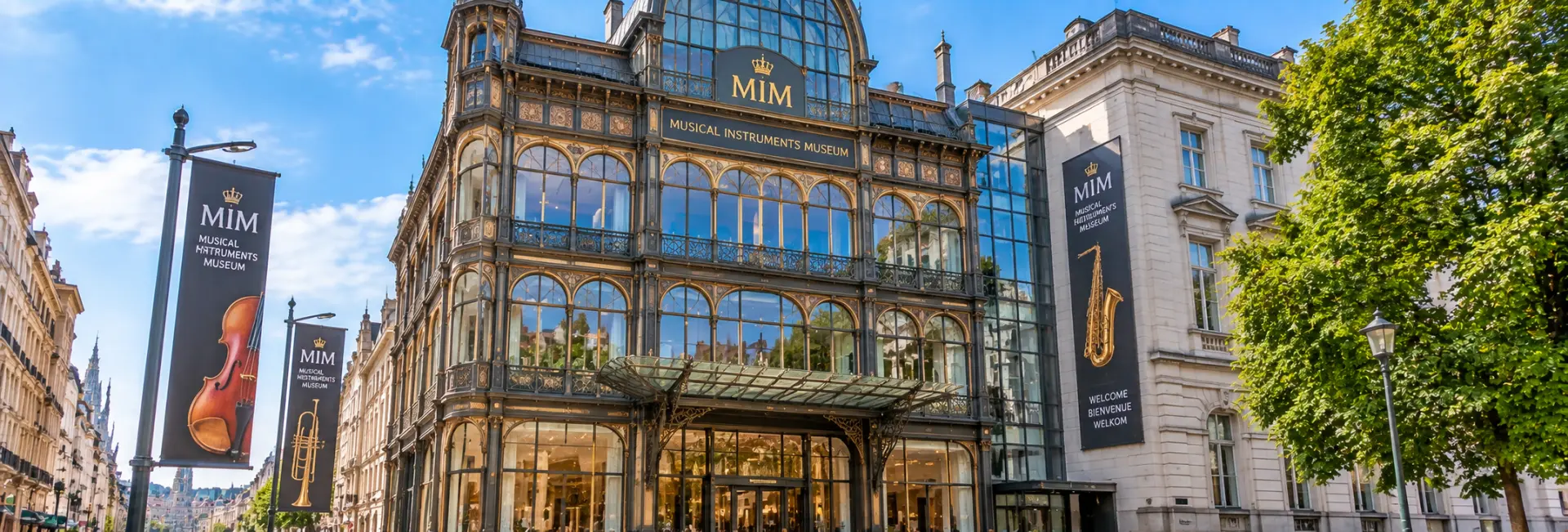
The Musical Instruments Museum, known locally as the MIM, turns a visit to a collection of thousands of instruments into something closer to a guided listening experience. Housed in a striking Art Nouveau building on Mont des Arts, the museum pairs its instruments with an audio guide that plays each one's actual sound as visitors approach, so silent glass cases become a journey through centuries of music instead.
The building itself, a former department store wrapped in iron and glass, is as much a reason to visit as the collection inside, offering some of the best interior views over central Brussels from its upper floors.
History of the Museum
Origins at the Royal Conservatory
The museum traces its roots to 1877, when it was founded as part of the Royal Conservatory of Brussels to give music students direct access to historical instruments as teaching aids rather than as a public attraction in its own right.
Growth of the Collection
Over the following century, the collection expanded well beyond its original teaching role, eventually becoming part of the Royal Museums of Art and History and building a reputation as one of the more significant instrument collections anywhere in the world.
Moving to Old England
For most of the 20th century, the museum operated from more modest premises before an ambitious move into the former Old England department store, a building that had stood vacant for years after closing as a shop in the early 1970s. Extensive restoration work through the 1990s adapted the structure for museum use, and the collection reopened to the public in its current home in June 2000.
Architecture & Building
A Department Store Ahead of Its Time
The Old England building was completed in 1899 to a design by architect Paul Saintenoy, built on a narrow, sloping site using an iron and steel frame combined with expansive glass walls. At the time, this combination of materials was more commonly associated with train stations and industrial structures than with a fashionable city-center shop.
Distinctive Details
An octagonal corner tower rises above the building's upper floors, topped by a delicate steel pergola, while the facade's vivid green ironwork and enameled signage still hint at the building's original life as a department store aimed at drawing in shoppers.
A Second, Older Building
Part of the museum's collection also spills into an adjoining 18th-century neoclassical building designed by Barnabe Guimard, which forms part of the same architectural ensemble facing Place Royale, giving the museum two very different structures joined into a single visitor route.
Collections & Exhibits
The permanent collection numbers in the thousands of instruments, drawn from Belgium, the wider European tradition, and musical cultures from Africa, Asia, and the Americas. Displays are organized across several floors by instrument family, historical period, and geographic origin, giving visitors a structured way to move from early European instruments toward global traditions and, eventually, mechanical and electronic instruments.
A basement-level gallery focuses on automatic and mechanical instruments from the late 19th and early 20th centuries, including self-playing devices and early music boxes, a section that tends to surprise visitors expecting only traditional acoustic instruments.
Must-See Highlights
- One of the oldest known surviving saxophones, tying the collection to Brussels-born inventor Adolphe Sax
- Elaborately decorated harpsichords from the historic Ruckers workshop
- A dedicated gallery of automatic and mechanical instruments, including orchestrions and early self-playing devices
- The Old England building's octagonal tower and belvedere, offering sweeping views over central Brussels
- An infrared audio guide that plays each instrument's sound automatically as visitors approach its display case
Ways to Experience It
An included audio guide is central to the museum experience, using infrared headsets that trigger recordings of each instrument's actual sound as visitors move past its case. This turns a normally quiet museum walk into an active listening tour, particularly effective in the sections covering instruments most visitors have never heard played.
Beyond the permanent galleries, the museum hosts concerts in its own hall, along with workshops for groups by reservation, giving repeat visitors reasons to return beyond the standard exhibition route.
Best Time to Visit
Weekday mornings tend to be the quietest time to explore the galleries at a relaxed pace, especially before larger tour groups arrive later in the day. The museum's rooftop-level cafe is a popular stop regardless of time of day, offering some of the best indoor views over the city center available anywhere in Brussels.
Visitors interested in live music should check the museum's concert schedule in advance, since performances in its hall add an extra dimension to a visit beyond the self-guided galleries.
Visitor Tips
- The included audio guide is an essential part of the experience, so allow extra time to actually listen at each stop rather than rushing through the galleries
- Workshops and group activities require advance reservation, so plan ahead if that's part of the visit
- The top-floor restaurant is accessible even without a museum ticket, reached by a direct elevator from the entrance, making it a good option for a break or a view without committing to the full exhibition
- The museum sits close to Brussels-Central train station, making it an easy stop right after arriving in the city
Nearby Attractions
The museum sits directly on Mont des Arts, within easy walking distance of the Royal Library of Belgium, the National Archives, and the garden terrace overlooking the historic center.
The Grand Place and Cathedral of St. Michael and St. Gudula are also a short walk downhill, making it simple to combine a museum visit with several of Brussels' other major landmarks in the same outing.
FAQs about visiting the Musical Instruments Museum
When was the Musical Instruments Museum founded? +
It was founded in 1877 as part of the Royal Conservatory of Brussels, originally intended to give music students access to historical instruments.
How many instruments are in the collection? +
The museum's holdings run into the thousands, with a large portion on permanent display across multiple floors at any given time.
What building does the museum occupy? +
It's housed in the former Old England department store, a striking Art Nouveau building completed in 1899, along with an adjoining 18th-century neoclassical structure.
Is an audio guide included with admission? +
Yes, an infrared audio guide is included, automatically playing each instrument's sound as visitors approach its display.
Can you visit the restaurant without a museum ticket? +
Yes, the top-floor restaurant is accessible via a direct elevator from the entrance without needing to buy a museum ticket.
What's the museum's most famous piece? +
One of the oldest known surviving saxophones is among its best-known holdings, reflecting Brussels' connection to the instrument's inventor, Adolphe Sax.
Is the museum good for a rainy day? +
Yes, since the entire visit takes place indoors across several floors, it's a reliable option regardless of weather.
How close is the museum to the Grand Place? +
It's a short walk downhill from Mont des Arts to the Grand Place, making the two easy to combine on the same visit.