
Table of Contents
Overview
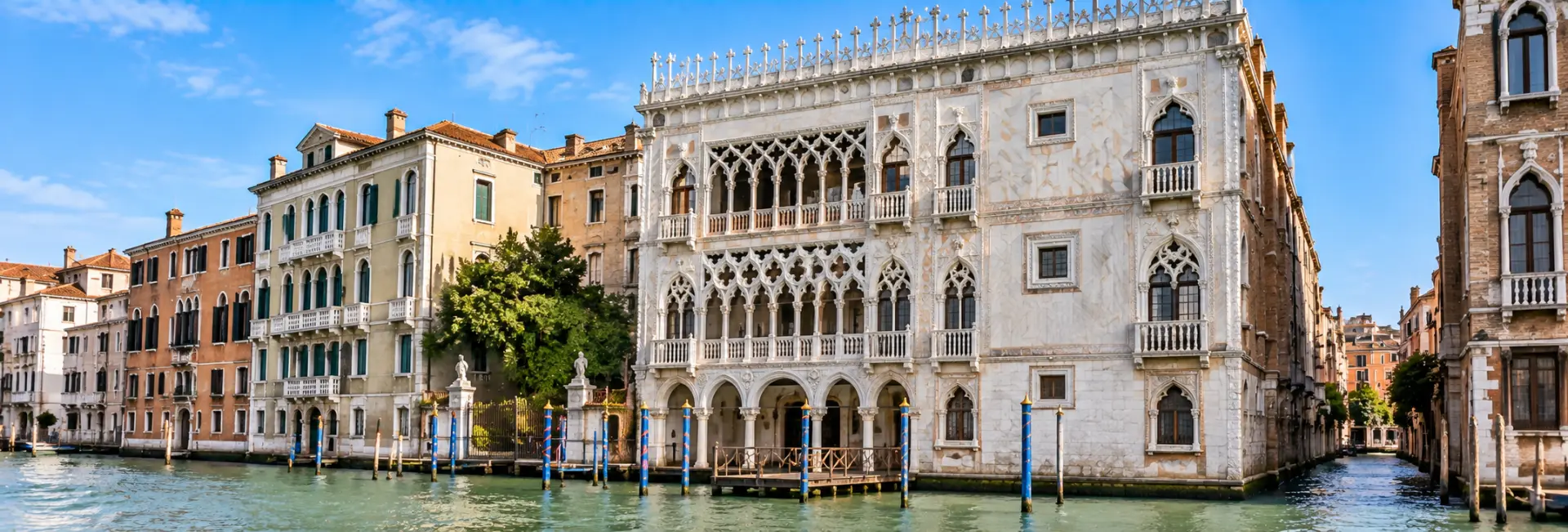
Ca' d'Oro, meaning "House of Gold," is a 15th-century palace on the Grand Canal in Venice's Cannaregio district, widely regarded as the finest surviving example of Venetian Gothic architecture. Its name comes from the gilding and polychrome decoration that once covered its facade, a level of ornamentation that made it one of the most extravagant private residences in the city when it was completed. Sitting roughly midway along the Grand Canal, the palace is easily spotted from passing vaporetti by its pale, lace-like stone tracery, distinct from the heavier Renaissance and Baroque facades that line much of the rest of the canal.
The palace now serves as a public museum, housing the Galleria Giorgio Franchetti, a collection of Renaissance paintings, sculpture, and bronzes assembled by the baron who restored the building in the early 20th century. Visitors come both for the artwork inside and for the building itself, whose delicate stone tracery and open loggias remain a benchmark for Gothic design on the canal.
History
Construction Under Marino Contarini
Ca' d'Oro was commissioned by Marino Contarini, a wealthy Venetian patrician and procurator of St. Mark's, who began construction around 1421 on the site of an earlier family property. The Contarini family was one of Venice's most prominent noble houses, having provided the republic with several doges over the centuries, and Marino intended the new palace to reflect that standing on the city's most prestigious waterway. The building took roughly two decades to complete, with the master builders Giovanni and Bartolomeo Bon and the stonemason Matteo Raverti among the craftsmen responsible for its elaborate tracery and carved details. Its original facade combined gold leaf with ultramarine blue and vermilion, a striking color scheme that gave the palace its name, though the pigments have long since weathered away, leaving the pale stone visible today.
Changing Hands and Decline
After Contarini's death, the palace passed to his heirs and, over the following centuries, changed ownership repeatedly, including periods under the Contarini, Marcello, and Loredan families. Its condition deteriorated significantly by the 19th century, worsened by a poorly conceived renovation in the 1840s commissioned by a Russian prince as a gift for the ballerina Marie Taglioni, which stripped away several original Gothic features, including the courtyard's staircase.
Restoration by Baron Franchetti
The palace's fortunes turned in 1894, when Baron Giorgio Franchetti purchased the building with the intention of restoring it as closely as possible to its 15th-century appearance. Franchetti removed the mismatched additions from the earlier renovation, reassembled original architectural elements where he could, and began installing his own collection of paintings, sculpture, and bronzes within the restored rooms. He donated the palace and its collection to the Italian state, and the building opened to the public as a museum in 1927, several years after his death. The gallery has continued to expand since then, incorporating additional works transferred from suppressed churches and other state collections, though the core of its holdings still traces back to Franchetti's own acquisitions.
Architecture and Design
Ca' d'Oro is considered the most complete surviving example of Venetian Gothic architecture on the Grand Canal, retaining features that were lost or altered in many comparable palaces over the centuries. Its facade blends Gothic tracery with Byzantine-influenced decoration along the roofline, a combination that reflects Venice's long trading relationship with the Byzantine world, along with patterning in colored stone across the flat wall surfaces that recalls Islamic decorative traditions absorbed through the same trade routes.
The building's most celebrated feature is its loggia system, a series of open, arcaded galleries stacked across the facade, with the most ornate positioned on the piano nobile, or main reception floor, where Contarini and his family would have received guests. The palace's layout is notably asymmetrical, since it was never completed with a matching left wing, leaving the facade slightly off balance in a way that is often cited as part of its distinctive character. Inside, a ground-floor courtyard features a decorative well-head, patterned stone flooring, and an open staircase, elements that give a sense of how the building's private and ceremonial spaces were once organized. The upper floors, once given over to the family's private quarters, reflect a hierarchy typical of Venetian palaces of the period, with the most richly decorated rooms reserved for the spaces where guests were received rather than for everyday domestic life.
The Franchetti Gallery Collection
The Galleria Giorgio Franchetti brings together paintings, sculpture, bronzes, and decorative arts spanning several centuries of Italian and European art, much of it assembled personally by the baron whose name the gallery carries.
- Saint Sebastian by Andrea Mantegna: one of the artist's several treatments of the subject, and among the collection's best-known paintings
- Venus with a Mirror by Titian: a Renaissance depiction of the goddess, part of the gallery's holdings of major Venetian School painters
- Views of Venice by Francesco Guardi: cityscape paintings offering an 18th-century view of the same canals visible from the palace's windows
- Sculpture and bronzes: Renaissance-era works gathered from churches and collections suppressed after the fall of the Venetian Republic
- Flemish paintings: including works brought together as part of Franchetti's broader collecting interests beyond Italian art
The collection also includes frescoes, medals, and decorative objects displayed throughout the palace's rooms, arranged in a way that lets visitors experience the art alongside the architecture that originally housed a private Venetian household rather than in a purpose-built museum setting. Because the rooms retain much of their original proportions and window arrangements, the light throughout the galleries shifts noticeably across the day, changing how individual paintings read depending on when they're viewed.
Key Spaces to See
The Grand Canal Loggias
The palace's arcaded loggias facing the Grand Canal are its architectural centerpiece, offering some of the finest close-up views of Gothic tracery found anywhere in Venice, along with sweeping views back across the canal itself.
The Ground-Floor Courtyard
An open courtyard just inside the entrance preserves the palace's decorative well-head and mosaic-patterned flooring, and it often hosts temporary exhibitions alongside the permanent architectural display.
The Piano Nobile
The main reception floor houses much of the Franchetti collection's painting galleries, including the rooms where Mantegna's Saint Sebastian and Titian's Venus with a Mirror are displayed.
Ways to Experience It
Ca' d'Oro sits directly on the Grand Canal, with its own vaporetto stop making it one of the easier Venetian palaces to reach without extensive walking through narrow streets.
- Self-guided gallery visit: explore the permanent collection at your own pace across the palace's several floors
- Architecture-focused visit: spend time in the loggias and courtyard even if the paintings aren't the main draw, since the building itself is the primary attraction for many visitors
- Temporary exhibitions: the museum periodically hosts rotating shows in the ground-floor courtyard and select gallery rooms
- Canal views from the loggia: step out onto the upper loggia for one of the more distinctive photo vantage points along the Grand Canal
Best Time to Visit
Ca' d'Oro draws a steadier, generally smaller crowd than Venice's largest museums, making it a comfortable visit across most of the year. Weekday mornings tend to be quietest, particularly outside the summer peak season when overall visitor numbers in Venice are highest, and the palace rarely produces the long entry queues associated with sights like St. Mark's Basilica or the Doge's Palace.
Because much of the collection and the building's most striking features are indoors, the museum makes a reliable option on days when Venice's weather is too wet or too hot for extended time outside. Its Grand Canal-facing loggia is especially rewarding in the softer light of late afternoon.
Visitor Tips
- Use the Ca' d'Oro vaporetto stop, which sits right in front of the palace and avoids a longer walk through Cannaregio's narrow streets
- Set aside about an hour for a thorough visit, more if a temporary exhibition is on display
- Don't skip the courtyard and loggias even if you're mainly interested in the paintings, since the architecture is a major part of what makes the site significant
- Check the museum's opening hours in advance, since they vary between Mondays and the rest of the week
- Combine a visit with a walk along Strada Nuova, Cannaregio's main pedestrian street, which runs close to the palace
Nearby Attractions
Ca' d'Oro's Cannaregio location puts it within easy reach of several other Grand Canal sights and the district's own attractions.
- Rialto Bridge: roughly a ten-minute walk or one vaporetto stop away along the Grand Canal
- Venetian Ghetto: the historic Jewish quarter of Cannaregio, with its synagogues and museum, a short walk inland
- Strada Nuova: Cannaregio's main shopping street, connecting the area around Ca' d'Oro to the train station
- Santa Lucia train station: Venice's main rail hub, reachable on foot or by vaporetto along the canal
FAQs about visiting Ca' d'Oro
What is Ca' d'Oro known for? +
It is known as the finest surviving example of Venetian Gothic palace architecture on the Grand Canal, and today for housing the Franchetti Gallery's collection of Renaissance art.
How do you get to Ca' d'Oro? +
The palace has its own vaporetto stop, Ca' d'Oro, directly on the Grand Canal, making it easy to reach without a long walk through Cannaregio's streets.
How long do you need to visit? +
Most visitors spend around an hour seeing the permanent collection and the palace's loggias and courtyard, longer if a temporary exhibition is running.
Is Ca' d'Oro free to visit, or do you need tickets? +
Admission is ticketed, with reduced rates for younger visitors and free entry for children and seniors from EU countries.
Why is it called the House of Gold? +
The name refers to the gold leaf and colored pigment that once covered its facade when it was built in the 15th century, though the original decoration has long since weathered away.
What are the must-see artworks inside? +
Andrea Mantegna's Saint Sebastian and Titian's Venus with a Mirror are among the collection's most celebrated paintings, alongside Renaissance sculpture and bronzes.
Is Ca' d'Oro suitable for a short visit to Venice? +
Yes, its compact size and canal-side vaporetto stop make it one of the more time-efficient palace visits in Venice compared with larger museums.
What should I combine a visit with? +
The Rialto Bridge and the Venetian Ghetto are both within easy walking distance and pair naturally with a Ca' d'Oro visit.
