
Table of Contents
Overview
The Venice Arsenal, or Arsenale di Venezia, is a vast walled complex of former shipyards and armories in the city's Castello district. For roughly seven centuries it was the industrial engine behind the Republic of Venice's naval and commercial power, building and outfitting the galleys that carried Venetian trade and warfare across the Mediterranean. At its height it ranked among the largest industrial sites in the world, long before anything resembling an industrial revolution existed elsewhere.
Today the Arsenal serves a very different purpose. Large sections of the complex, including its historic rope-making halls and dry docks, now host exhibitions for the Venice Biennale, while the Italian Navy retains a working presence in other parts of the site. Visitors can see the monumental gated entrance year-round and, during the Biennale, step inside spaces that were closed to the public for most of their history.
History
Founding and Early Growth
Construction of the Arsenal is traditionally dated to around 1104, during Venice's early republican era, though some historians believe shipbuilding activity on the site may reach back even earlier. The original yard handled maintenance and repair for the republic's ships, a comparatively modest operation next to what the site would later become.
The Arsenale Nuovo and Peak Production
The complex expanded dramatically in 1320 with the construction of the Arsenale Nuovo, or New Arsenal, which allowed the state to build and repair its entire fleet, including larger merchant vessels, within a single controlled site. By the 16th century the Arsenal had grown into a sprawling enclosure of roughly 45 hectares, protected by tall brick ramparts and staffed by as many as 16,000 workers at its peak, known locally as the arsenalotti. Production reached a level of speed that startled foreign visitors: the Arsenal was reportedly able to assemble a fully equipped galley within a single day when demonstrating its capacity to visiting dignitaries. The workforce lived close to the complex in the surrounding Castello district, summoned each morning by a bell, and the most skilled craftsmen were sometimes granted housing specifically for their proximity to the gates.
Decline and Modern Use
The Arsenal's importance faded alongside the Republic of Venice itself, and shipbuilding activity wound down sharply after Napoleon's conquest of the city in 1797, when parts of the complex were damaged or repurposed. Further destruction followed during the 20th century, including damage sustained in the Second World War. By the early 1900s, most large-scale shipbuilding had shifted to private yards elsewhere, and the site gradually transitioned toward the military and cultural uses it holds today. The Arsenal now falls within the Venice and its Lagoon UNESCO World Heritage Site, recognized alongside the wider historic city for its architectural and historical significance.
How the Arsenal Worked
What set the Arsenal apart from other shipyards of its era was its organization as a centralized, state-controlled production system rather than a loose collection of independent workshops. Different sections of the complex specialized in particular components, from rope and sailcloth to metal fittings and rigging, so that a galley's parts could be prefabricated in parallel and assembled quickly once needed, an approach that anticipated assembly-line methods centuries before they became standard practice elsewhere. Standardization extended down to the level of individual parts, with fittings and rigging built to consistent specifications so that damaged ships could be repaired quickly using interchangeable components rather than custom-made replacements.
- Carpenters and shipwrights built and assembled hulls in the covered dry docks
- Blacksmiths and forgers produced metal fittings, weapons, and ship hardware
- Rope makers worked in the Corderie, long covered halls purpose-built for producing ship rigging
- Women workers spun thread and wove sailcloth and banners, and some apprenticed into traditionally male trades
The Arsenal's methods drew attention from visitors across Europe, including Dante Alighieri, whose Inferno describes the sight of workers boiling pitch to waterproof hulls, a scene he used as the model for one of the poem's more vivid infernal images.
Architecture and the Porta Magna
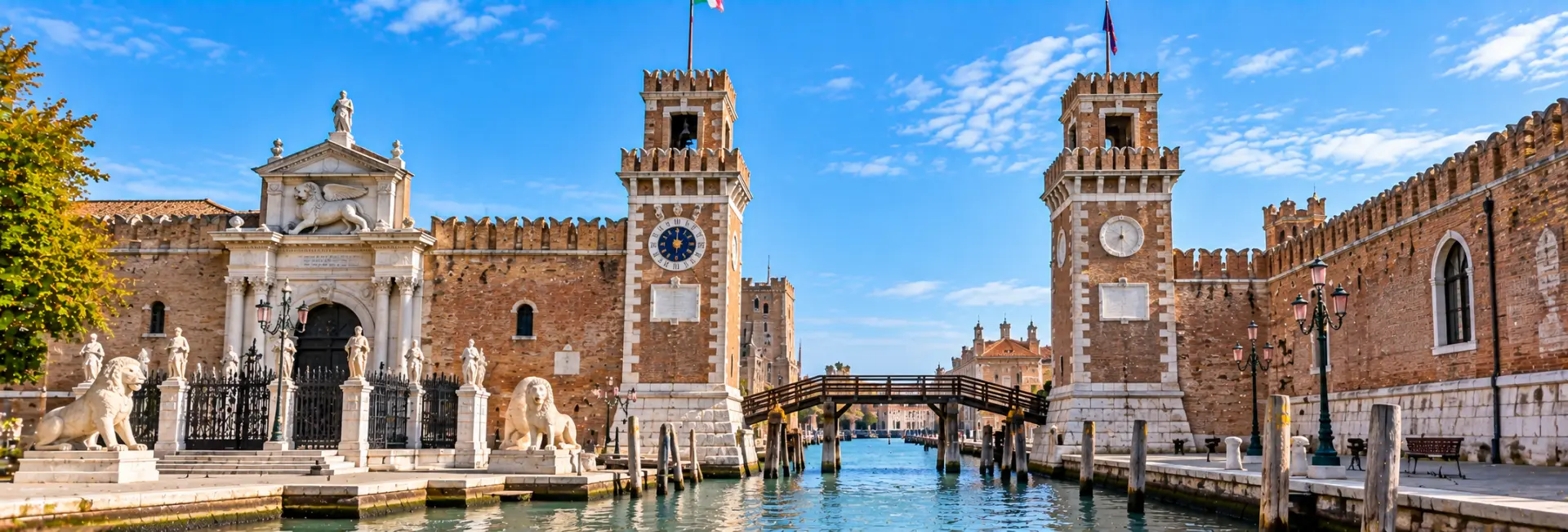
The Arsenal's most recognizable feature is the Porta Magna, its monumental main gate, added around 1460 and generally credited to the architect Antonio Gambello working from a design connected to the painter Jacopo Bellini. The gate is considered the first work of Classical Revival architecture built in Venice, and it set a visual tone that influenced later Renaissance buildings across the city. A terrace above the gate is decorated with Baroque statuary depicting allegorical figures and gods, added well after the gate's original construction as the complex continued to accumulate decoration over the centuries.
Flanking the gate stand several ancient marble lions, the most famous of which is the so-called Piraeus Lion, seized from the harbor of Piraeus in Greece by the Venetian commander Francesco Morosini in 1687. The lion is marked with runic inscriptions believed to have been carved by Scandinavian mercenaries centuries earlier, a detail only deciphered by scholars in the 19th century. A carved lion of St. Mark crowns the gate's pediment, shown here holding a closed book, a symbolic variation used to signal a city at war rather than at peace.
From Shipyard to Cultural Venue
The Arsenal's role as a cultural venue began in 1980, when its spaces were used for the first International Architecture Exhibition of the Venice Biennale. Since then, the complex has become one of the Biennale's two primary venues, alongside the Giardini, hosting national pavilions and large-scale installations within its historic rope-making halls and dockside buildings during both the art and architecture editions of the exhibition.
Outside of Biennale periods, access to most of the Arsenal remains limited, since the Italian Navy still maintains offices and facilities within parts of the complex. The Porta Magna and its lions remain visible from outside the gate year-round, and a northern entrance near Campo de la Celestia opens to the public on weekdays for a more limited view into the grounds.
Ways to Experience It
How much of the Arsenal a visitor can see depends heavily on timing, since large sections of the complex only open during specific events. The gap between what's visible year-round and what opens during the Biennale is significant, so setting expectations before arriving helps avoid disappointment for anyone hoping to walk the full grounds outside exhibition season.
- View the Porta Magna and its lions: accessible year-round from outside the gate along the Rio dell'Arsenale, no ticket required
- Visit during the Venice Biennale: the main way to enter the historic halls, when Arsenale exhibition spaces open to ticketed visitors for the art and architecture editions
- Walk the northern entrance grounds: open on weekday mornings and early afternoons for a partial view of the site outside Biennale season
- Visit the nearby Naval History Museum: covers Venice's maritime and shipbuilding history in more depth, including models and artifacts related to the Arsenal itself
- Take a guided Castello walking tour: several tours combine the Arsenal's exterior with other sights in the surrounding district
Best Time to Visit
The Biennale, held in alternating art and architecture editions roughly from May through November, is by far the best opportunity to see inside the Arsenal's historic halls, since most of the complex is otherwise closed to the public. Outside Biennale season, a visit is largely limited to viewing the Porta Magna and lions from outside the gate, along with the smaller public hours at the northern entrance.
Within Biennale season, mornings tend to be quieter than afternoons, particularly on weekdays, since the venue draws large numbers of visitors alongside its Giardini counterpart. Spring and autumn bring the most comfortable weather for the walk along Riva degli Schiavoni to reach the site.
Visitor Tips
- Check Biennale exhibition dates before planning a visit if you want to see inside the historic halls, since access outside those periods is limited
- Book Biennale tickets in advance during peak weeks, since queues at the Arsenale entrance can be long on weekends
- Visit the Porta Magna at any time of year, since it remains visible from outside the gate even when the complex itself is closed
- Combine a visit with the nearby Naval History Museum for context on the ships the Arsenal once built
- Walk along Riva degli Schiavoni to reach the site, since it offers a scenic approach from St. Mark's Square
- Wear comfortable shoes if visiting during the Biennale, since the exhibition halls span a large footprint and involve considerable walking
Nearby Attractions
The Arsenal sits within Venice's Castello district, close to several other historic and cultural sights.
- Naval History Museum: covers centuries of Venetian shipbuilding and maritime history, a short walk from the Arsenal's gate
- Riva degli Schiavoni: the wide waterfront promenade connecting the Arsenal to St. Mark's Square
- Giardini della Biennale: the Biennale's other main venue, home to many national pavilions, a walk or short vaporetto ride away
- Via Garibaldi: a lively local shopping street in Castello, known for a more residential, less touristic atmosphere
FAQs about visiting the Venice Arsenal
What is the Venice Arsenal known for? +
It is known as the medieval shipyard that built and supplied the Republic of Venice's navy and merchant fleet, and today for hosting major exhibitions during the Venice Biennale.
Can you go inside the Arsenal? +
Access to the historic halls is mostly limited to the Venice Biennale exhibition periods, though the Porta Magna gate and lions are visible from outside year-round, and a northern entrance offers limited public access on weekdays.
How do you get to the Arsenal? +
The main entrance is a walk along Riva degli Schiavoni from St. Mark's Square, or a short ride on vaporetto lines 1 or 4.1 to the Arsenale stop.
Is the Arsenal free to visit? +
Viewing the Porta Magna and lions from outside is free, but entry to the Biennale exhibition halls requires a paid ticket during exhibition periods.
When is the best time to see inside the Arsenal? +
The Venice Biennale, held roughly from May to November in alternating art and architecture editions, is the main opportunity to enter the historic shipbuilding halls.
What are the lions outside the Arsenal? +
They are ancient marble lions brought to Venice as war trophies, most notably the Piraeus Lion, seized from Greece in 1687 and marked with runic inscriptions carved centuries earlier.
How long do you need to visit? +
Viewing the exterior and gate takes about fifteen to twenty minutes, while a Biennale visit to the exhibition halls can easily take two hours or more depending on the installations on display.
Is the Arsenal still used by the military today? +
Yes, parts of the complex remain in use by the Italian Navy, which is one of the main reasons public access to most of the site stays limited outside Biennale periods.
