
Table of Contents
Overview
The Complesso Monumentale di Santa Chiara is one of the largest and most layered religious sites in Naples. Founded in the early 14th century by the Angevin royal couple, it brings together a Gothic basilica, a former convent and monastery, a museum, an archaeological area, and one of the most photographed cloisters in Italy.
Its setting is part of the appeal. The complex sits right on the busy Spaccanapoli axis, facing the dramatic diamond-pointed facade of the Gesù Nuovo, yet once you step inside the walls the noise of the city drops away. The cloister garden, with its citrus trees and shaded benches, is among the calmest places in the old centre.
The complex lies within the Historic Centre of Naples, a UNESCO World Heritage Site since 1995. Visitors come for very different reasons: some for the medieval royal tombs, some for the sparkling tilework, and others simply for a quiet hour away from the street.
History
A Royal Franciscan Foundation
Construction began in 1310 under King Robert of Anjou and his wife, Queen Sancia of Majorca, and the main buildings were completed by 1328. Both rulers were deeply devoted to Saint Francis and Saint Clare, and they conceived the project as a Franciscan citadel. One half was a convent for the Poor Clares, the nuns of the Franciscan order, and the other half a monastery for the Friars Minor.
The church at the centre was first dedicated to the Holy Body of Christ, a title inspired by the Eucharistic miracle reported at Bolsena in 1264. The name soon shifted to Santa Chiara, most likely because of the large community of nuns who lived there. The complex was also planned as a burial place for the Angevin dynasty, which is why it holds so many royal monuments.
Baroque Makeover
For its first four centuries the basilica kept its austere Gothic character. In 1742 the architect Domenico Antonio Vaccaro remodelled the interior in the fashionable Baroque taste of the day, covering the old walls with elaborate decoration. The cloister also took on much of its present look in this period.
The Bombing of 1943
On 4 August 1943, an Allied air raid struck the basilica, and fire destroyed most of the Baroque interior. Rather than rebuild the 18th-century scheme, restorers chose to return the church to its original medieval form, guided by the surviving evidence of the 14th-century design. The work took about a decade, and the basilica reopened for worship in 1953. The cloister came through the war largely intact.
Rediscovery Beneath the Ruins
The destruction had an unexpected benefit. Clearing the damaged area revealed the remains of a Roman bath complex from the first century AD, which now forms part of the visitor route and shows how much older the neighbourhood is than the Angevin monastery above it.
The Gothic Basilica
Exterior
The basilica is imposing but strikingly plain. Its broad facade is relieved mainly by a large rose window, and the bell tower beside it keeps only its lower part from the original. The design is credited to the architect Gagliardo Primario. After the wartime rebuilding, the church once again reads as a pure example of Angevin Gothic, far plainer than the exuberant churches around it.
Interior
Inside, a single wide nave is lined with chapels along both sides, ten in all, holding works from the 14th and 15th centuries. The space is high, bright, and simple, which gives it a calm, almost austere atmosphere that is rare among Naples' ornate churches.
Royal Tombs
The basilica serves as a pantheon of the Angevin dynasty. Behind the main altar stands the monumental tomb of King Robert, who died in 1343. Nearby are the tombs of his son Charles of Calabria, of Charles's second wife Mary of Valois, and of their young daughter, along with that of Mary of Durazzo. Together they form one of the most important collections of medieval royal sculpture in southern Italy.
The Nuns' Choir
Behind the altar wall, the nuns once worshipped in a separate three-aisled choir designed by Leonardo di Vito, a rare and important piece of Neapolitan Gothic. It was reached through the sacristy and was visible to the congregation only through a grille. Fragments of a fresco attributed to Giotto, who worked for King Robert in Naples in the late 1320s, survive here.
The Majolica Cloister
A Garden in Colour
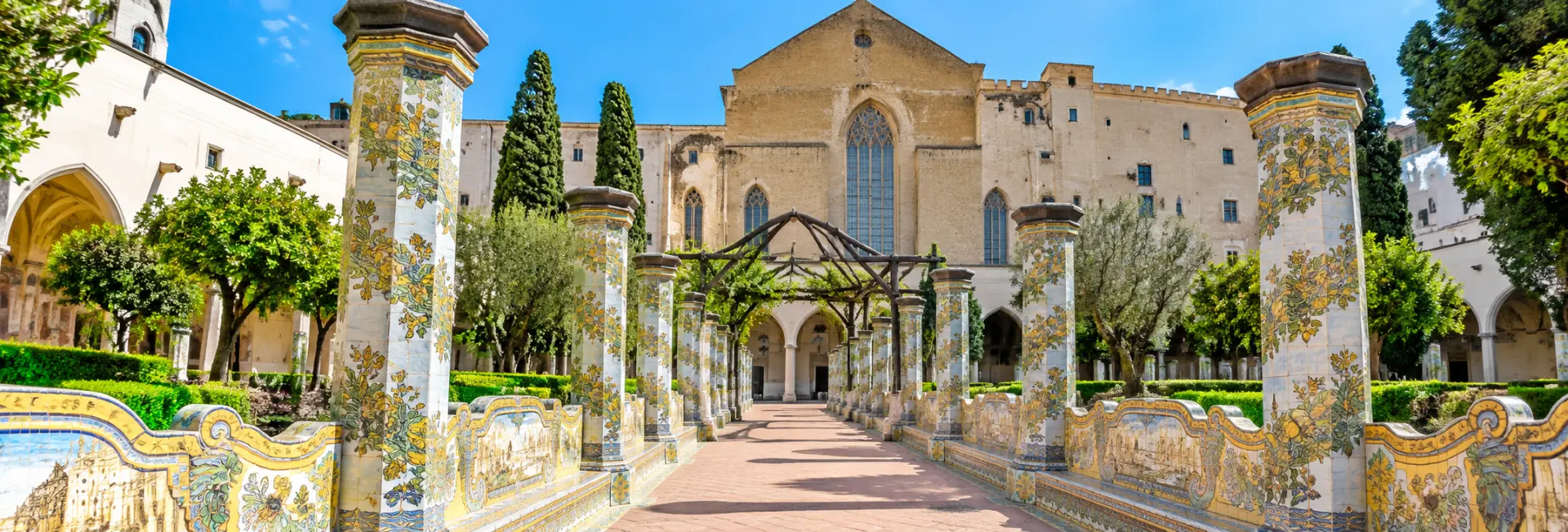
The cloister is the part of Santa Chiara that most visitors remember. Its 14th-century Angevin porticoes enclose a garden planted with citrus trees and lavender, crossed by two main paths. Along these paths run rows of octagonal pillars covered in glazed tiles, joined by long tiled benches, so that the whole garden feels like a covered, painted pergola.
The Tilework
The tiles were painted in the 18th century by the brothers Donato and Giuseppe Massa, working under Vaccaro's overall scheme. The designs mix plant garlands with lively scenes of everyday life, from hunting parties and country work to sea views and playful mythological figures. The colours stay bright, and the more closely you look, the more small details you find.
Painted Walls
The porticoes behind the pillars are covered with frescoes from the early 1600s. They show saints, allegories, scenes from the Old Testament, and episodes from Franciscan stories, and they give the cloister a gentler, more storybook feel than the sober basilica next door.
Why It Stands Out
Cloisters are normally places of silence and restraint, so the playful mix of sacred wall paintings and secular tile scenes here is unusual. The effect is a kind of village garden inside a convent, which is why it is so often photographed and so often described as one of the loveliest corners of Naples.
Museum, Roman Baths, and Nativity Scene
Museo dell'Opera
On another level of the complex, the museum shows the long history of the site through religious objects, architectural fragments, and items related to the church. It gives helpful context to the royal foundation and traces how the buildings changed between the medieval and Baroque periods.
The Roman Baths
The archaeological area exposes the remains of a first-century thermal complex found during post-war clearing. Visitors can see rooms from a Roman bath, including a well-preserved heated chamber of the kind used for dry sweating. Walking among these remains makes it easy to picture how thoroughly Naples is built on top of its own past.
A Neapolitan Presepe
Near the end of the route you will find a historic Neapolitan nativity scene. Like the celebrated crib figures made a short walk away on Via San Gregorio Armeno, it places the nativity story inside a lively street scene, with local costumes, market stalls, and ordinary people alongside the holy figures. It is a good way to link a visit here to the city's wider craft tradition.
Visiting Etiquette & Tips
Santa Chiara is both a heritage site and a place of worship, so a few simple habits will make the visit smoother.
- Know the two parts. The basilica is an active church and is normally free to enter, while the cloister, museum, and archaeological area form a separate ticketed visit with its own entrance.
- Dress respectfully. Cover shoulders and knees when entering the basilica, and keep your voice low inside.
- Avoid visiting during services. Sightseeing is generally discouraged while Mass is in progress, so plan around the schedule.
- Allow time. Plan roughly one and a half to two hours to see the basilica and the full complex without rushing.
- Look up as well as around. The details of the cloister tiles, the carved royal tombs, and the vaulted choir are easy to miss if you hurry.
- Check the current rules. Opening hours, ticket prices, and access to individual areas change, and parts of the complex may close for works, so confirm the latest information locally before you go.
The complex lies on a mostly pedestrian stretch of the historic centre. The nearest metro stop is Dante on Line 1, roughly a 450 metre walk away through the old streets.
Best Time to Visit
Time of Year
Spring and autumn offer the most comfortable conditions for combining the cloister garden with a walk through the old centre. In midsummer the garden can be hot in the middle of the day, though the shaded porticoes help, while the indoor parts of the complex stay sheltered from both heat and rain.
Around Christmas
In the weeks before Christmas the historic centre fills with visitors drawn to the nativity workshops, and Santa Chiara's own presepe makes a good counterpoint to the busy streets outside.
Time of Day
The first hours after the complex opens are usually the quietest, and the soft morning light on the tiles is especially flattering for photography. Late afternoon is also pleasant once the main tour groups have left, but check closing times, as the last entry comes before the doors shut.
Nearby Attractions
Santa Chiara sits in one of the richest walking areas in Naples, so it pairs easily with several other stops.
- Chiesa del Gesù Nuovo - Directly opposite, with a faceted stone front and an opulent Baroque interior that contrasts sharply with Santa Chiara's plain Gothic nave.
- Piazza San Domenico Maggiore - A short walk away, home to a large 18th-century obelisk and the church of San Domenico Maggiore.
- Cappella Sansevero - A nearby chapel famous for its sculpture, including the Veiled Christ, usually requiring advance booking.
- Via San Gregorio Armeno - The famous nativity-workshop street, within comfortable walking distance.
- Spaccanapoli - The long, straight street that cuts through the old town, lined with shops, cafes, and churches.
FAQs about visiting Santa Chiara
What is Santa Chiara in Naples? +
It is a large religious complex founded in 1310 by King Robert of Anjou and Queen Sancia of Majorca. It includes a Gothic basilica, a former convent and monastery, a majolica-tiled cloister, a museum, and a Roman bath area.
What is Santa Chiara most famous for? +
Most visitors know it for its cloister, where tile-covered pillars and benches painted with scenes of everyday life surround a quiet garden. The basilica is also notable as the burial place of the Angevin kings of Naples.
Do I need a ticket for Santa Chiara? +
Entry to the basilica is usually free, but the cloister, museum, and archaeological area require a ticket from a separate entrance. Prices and conditions can change, so check locally before you go.
How long should I allow for a visit? +
Plan around one and a half to two hours to see the basilica and the full complex. If you only want a quick look at the church and the cloister, an hour is usually enough.
How do I get to Santa Chiara? +
It stands in the historic centre, on Via Santa Chiara, close to Piazza del Gesù Nuovo, with another entrance on the Via Benedetto Croce side. The Dante stop on metro Line 1 is the most direct approach, followed by a walk of roughly 450 metres.
Was the church damaged in the Second World War? +
Yes. On 4 August 1943, an air raid destroyed most of the Baroque interior. The basilica was rebuilt in its original Gothic form and reopened for worship in 1953, while the cloister largely survived.
What should I wear? +
Dress modestly, with shoulders and knees covered, since the basilica is a working church. Comfortable shoes are also useful for the cobbled streets leading to it.
What else is worth seeing nearby? +
The Gesù Nuovo church is directly opposite, and Piazza San Domenico Maggiore, Cappella Sansevero, and Via San Gregorio Armeno are all a short walk away.
