
Table of Contents
Overview
The Catacombs of San Gennaro are the largest early Christian burial complex in southern Italy, carved into a hillside of soft volcanic rock beneath the Capodimonte area of Naples. They are named after Saint Januarius (San Gennaro), the patron saint of the city, whose remains rested here for centuries. The site is a maze of galleries, chambers and even underground basilicas, all cut directly from the rock.
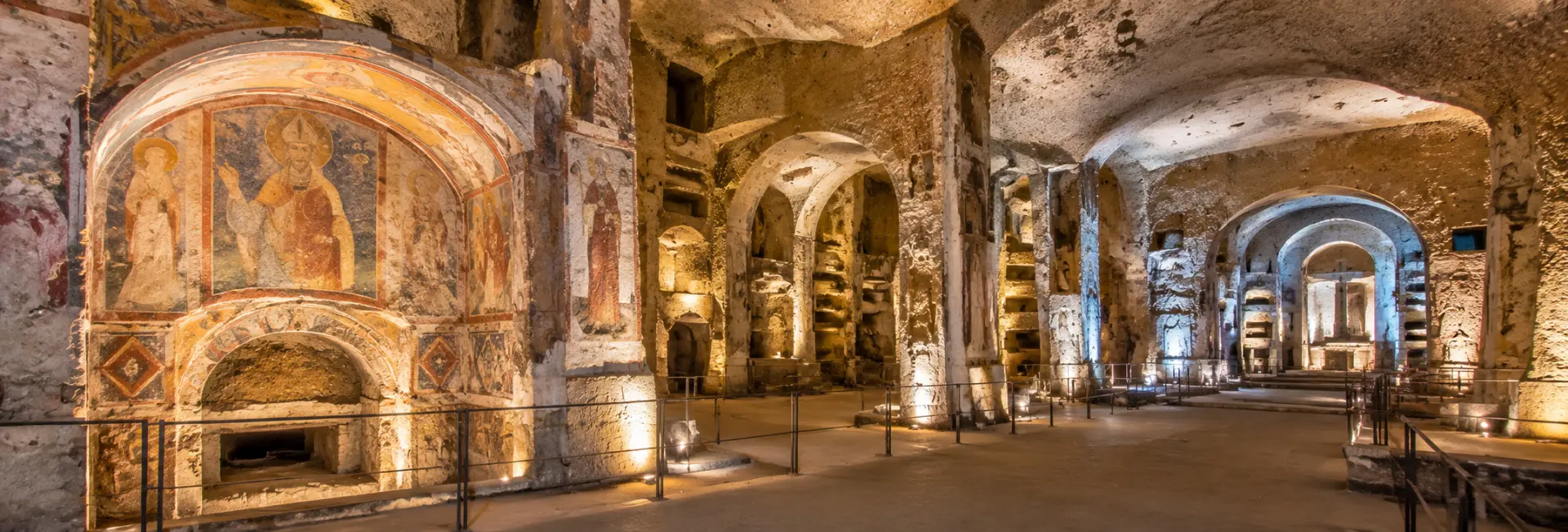
Unlike many catacombs that are known mostly for their tunnels and tombs, this one is remarkable for its scale, its architecture and its art. Walls and vaults carry paintings and mosaics that span several centuries, giving the visit a real sense of moving through time.
The entrance sits beside the large church of the Madre del Buon Consiglio, in the Rione Sanità district. The experience is quiet, cool and thoughtful, and it offers a very different side of Naples from the busy streets above.
History
A Noble Tomb Becomes a Christian Cemetery
The oldest part of the complex dates to around the 2nd century AD. It probably began as the burial chamber of a wealthy family, which later opened the space to the Christian community. Early painted decoration in a style reminiscent of Roman houses survives in this original nucleus.
Bishops, Saints and Expansion
The site grew in importance in the following centuries. Saint Agrippinus, an early bishop of Naples, was buried here, drawing more burials and encouraging the digging of new galleries. In the early 5th century the remains of Saint Januarius were placed in the catacombs, and the complex became a place of pilgrimage. Over time, separate underground burial areas were linked together, creating the sprawling two-level network visitors see today.
Burials continued for many centuries, and the catacombs stayed in use until around the 10th century. Bishops of Naples were laid to rest here, and the site remained an important spiritual centre.
Relics, Decline and Rediscovery
In the 9th century the relics of San Gennaro were removed from the catacombs, and they were later brought to the cathedral of Naples, where they are now venerated. From the later Middle Ages through the 18th century, the catacombs suffered from looting and neglect. Restoration began only after human remains were relocated to another cemetery, and full public opening came much later, as part of a community-led revival of the district.
Architecture & Layout
Two Levels Cut From Tuff
The catacombs are arranged on two superimposed levels, both excavated into the yellow volcanic tuff of Capodimonte hill. This rock was easy to carve but stable enough to support wide vaults, which is why the builders could create large chambers without any need for masonry supports.
The Lower Vestibule
A grand, tall entrance hall known as the lower vestibule is one of the highlights. Passages lead off it through decorated arches, and it contains a baptismal font that is traditionally linked to Bishop Paul II in the 8th century. The scale of the space comes as a surprise for those expecting only narrow tunnels.
Underground Basilicas
The most impressive architectural feature is the presence of full basilica-style spaces carved out of the rock. One of these is a large, three-aisled hall with columns and arches shaped from the tuff itself. It is unusual to find church-like architecture of this kind inside a catacomb, and it shows how important this place was to the early Christian community of Naples.
Burial Niches and Tombs
Along the corridors and chambers you will see rows of burial recesses cut into the walls, along with arched tombs and stone sarcophagi. Reports mention around two thousand recesses in total, giving a sense of how many people were laid to rest here across the centuries.
Art & Frescoes
Early Wall Paintings
The earliest decoration in the upper level shows lively painted ceilings with plants, birds and other motifs in rich reds, blues and ochres. These belong to the older aristocratic tomb and show how Roman decorative taste flowed into early Christian art.
Saints and Bishops
Later frescoes depict saints and important church figures, including portraits of San Gennaro himself in the company of other saints. Among the most valued images are those in the burial place of the bishops of Naples, which has decorative mosaics and painted details created for the leaders of the local church.
A Long Artistic Timeline
What makes the collection special is its range. Paintings and decoration span from the Roman period through late antiquity to the Byzantine-influenced art of the 9th and 10th centuries. In a single visit you can trace how images of faith changed across roughly eight centuries, all within the same underground space.
Cultural & Religious Significance
For Neapolitans, San Gennaro is much more than a historical figure. He is the protector of the city, and devotion to him is woven into daily life, from street shrines to public festivals. The catacombs are among the oldest places linked to that devotion, which gives them deep emotional meaning for many locals.
The saint is most famous for the ritual of the liquefaction of his blood, a ceremony held at the cathedral on set dates each year and followed closely by the city's faithful. While the relics no longer rest in the catacombs, the site remains a key part of his story, and the underground basilicas are a reminder of how early and how strongly the cult took root in Naples.
The complex also represents the wider Christian history of the region. It shows how burial practices moved from private family tombs to shared community cemeteries and then to places of worship, pilgrimage and civic identity.
The Rione Sanità Revival
From Neglect to Community Project
The catacombs lie beneath the Rione Sanità, a historic district that has long faced social and economic challenges. After years of neglect, local people and organisations began working together to recover the site. A church-supported initiative and local cooperatives, including young people from the neighbourhood, took part in restoring the spaces and opening them to visitors.
Visiting With Purpose
Tickets help support the ongoing management of the site and the wider regeneration of the district, which has included training and jobs for local young people. Many visitors find that this adds meaning to the experience, since it connects an ancient site with a living community.
A Guided Public Face
Guides are often from the neighbourhood, and their personal knowledge of the area gives the tour a warmer, more human character. That community involvement is one reason the catacombs are often described as a success story for cultural heritage in Naples.
Ways to Experience It
The Guided Tour
The standard way to visit is on a guided tour, usually lasting around an hour. Tours run at set times through the day, and English and Italian are the usual languages. The guide leads you through the main galleries, basilicas and painted chambers, explaining the history and symbolism as you go.
Combined Visits
The nearby Catacombs of San Gaudioso, beneath the Basilica of Santa Maria della Sanità, are managed by the same community project. Combined tickets have been offered in the past, and the two sites make a good pair because they show different periods and styles.
Special Events
The site sometimes hosts concerts, evening openings, exhibitions and other cultural events. If you are interested in something beyond the standard route, check the official programme before you go.
Photography
Photography has often been allowed in the catacombs, but rules can change, particularly around flash or tripods. Ask at the ticket office if you are unsure.
Best Time to Visit
Since the catacombs stay cool and steady at around 15°C all year, they are a good choice in any season. That makes them especially welcome on a hot summer day, when the temperature difference with the street above is striking.
Morning tours tend to be quieter and more relaxed, while afternoons can be busier, particularly at weekends and during school holidays. If you want a calm atmosphere, aim for a weekday and book an early time slot.
Spring and autumn offer pleasant weather for walking around the Sanità and Capodimonte areas before or after your visit. Winter is usually less crowded, though you may want an extra layer for the chill underground.
Opening days and tour times can change, so check the official website before you plan your trip.
Visitor Tips & Etiquette
- Book ahead where possible. Tours run at set times and can fill up, especially in high season.
- Arrive early. You may need to validate your ticket at the office before the tour starts, so allow extra time.
- Bring a light layer. The underground temperature is cool year-round, even when it is hot outside.
- Wear comfortable shoes. The floors can be uneven or damp, and there are stairs and slopes.
- Dress respectfully. This is a place of worship and burial, so avoid very revealing clothing.
- Follow your guide. Stay with the group, avoid touching walls and paintings, and respect any signs about restricted areas.
- Check accessibility. Some parts of the route are steep or uneven. Step-free access may be possible with advance arrangements, so contact the site beforehand.
- Confirm current details. Ticket prices, tour times and photography rules change, so rely on the official source for the latest information.
Nearby Attractions
The catacombs sit at the boundary between the Sanità district and the Capodimonte hill, so several interesting stops are close by.
- Basilica dell'Incoronata Madre del Buon Consiglio: the large domed church beside the entrance, with a striking hillside setting.
- Basilica of San Gennaro extra Moenia: an ancient church closely tied to the catacombs, in the same complex as a historic hospital.
- Catacombs of San Gaudioso: a nearby underground site beneath Santa Maria della Sanità, known for its unusual skull-decorated frescoes.
- Museo e Real Bosco di Capodimonte: a major art museum and royal park uphill from the catacombs.
- Fontanelle Cemetery: a vast ossuary in a former tuff quarry in the Sanità, associated with unusual Neapolitan folk traditions.
- Rione Sanità streets and Via dei Vergini: a lively, authentic neighbourhood with historic palaces, markets and local eateries.
Combining these stops can turn the catacombs into a rich half-day away from the more tourist-heavy centre.
FAQs about visiting the Catacombs of San Gennaro
What are the Catacombs of San Gennaro? +
They are the largest early Christian catacombs in southern Italy, cut into the tuff of Capodimonte hill in Naples. The complex includes galleries, burial niches, frescoes and underground basilicas, and it is named after the city's patron saint.
Where are they located? +
The address is Via Capodimonte 13 in the Rione Sanità district, beside the Basilica dell'Incoronata Madre del Buon Consiglio. The ticket office and entrance are next to that church.
How long does a visit take? +
Guided tours usually last around one hour. It is worth allowing extra time for check-in and for a look around the surrounding area.
Do I need a guide? +
Visits are normally made on a guided tour, which is included with the ticket. Tours run at set times, so check the current schedule and choose the right language.
Are the catacombs suitable for children? +
Older children who are comfortable in dim, cool spaces often enjoy them. The site has stairs and uneven ground, so parents of very young children may want to think about pushchair access.
Is it accessible for people with limited mobility? +
Parts of the route involve slopes and steps. Some adaptations may be possible with advance arrangements, so it is best to contact the site before you visit.
Can I take photos? +
Photography has often been allowed, but rules can change and flash may be restricted. Ask staff at the ticket office before you begin the tour.
What should I wear? +
Wear comfortable shoes and bring a light layer, since it stays cool underground all year. Choose modest clothing out of respect for the religious setting.
Is San Gennaro still buried here? +
No, his remains were moved from the catacombs in the past and are now associated with the cathedral of Naples. The catacombs remain one of the earliest places linked to his cult.
What else can I combine with the visit? +
The Catacombs of San Gaudioso, the Capodimonte Museum, the Fontanelle Cemetery and the Rione Sanità streets are all close by.
