
Table of Contents
Overview
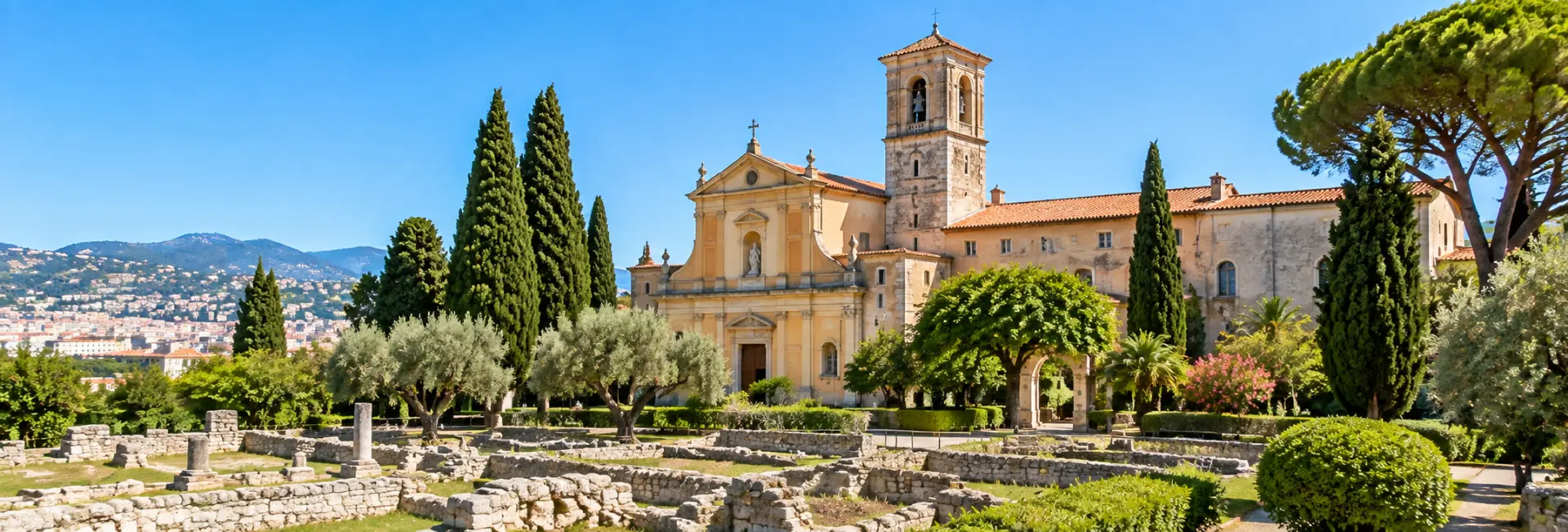
High on the hill of Cimiez, above the beaches and busy streets of Nice, the Cimiez Monastery is one of the most peaceful places in the city. It is a working Franciscan monastery with a 15th-century church, a small museum in the former friars' cells and a terraced Italian-style garden that looks out over rooftops, the Paillon valley and the sea.
The complex combines art, history and quiet in a way that few Riviera sights manage. Inside the church you can see altarpieces by Louis Bréa, the best-known painter of the Nice school. Upstairs, the Franciscan Museum tells the story of the friars in Nice, and next door a cemetery holds the graves of Henri Matisse and Raoul Dufy.
Entry to the garden, the church and the museum has traditionally been free, which makes this an easy and rewarding stop for anyone climbing the hill to Cimiez's other attractions.
History of the Monastery
Benedictine Origins
The monastery traces its roots to the early Middle Ages, when Benedictine monks from the Abbey of Saint-Pons founded a religious house on the Cimiez hill. The site is often dated to the 9th century, and it stands close to the remains of the Roman town of Cemenelum, which had once been the main settlement here.
The Franciscans Arrive
Franciscan friars had been present in Nice since the 13th century, but their convent in the city was destroyed during the siege of Nice in 1543. Three years later, in 1546, the Benedictines handed the Cimiez monastery over to the Franciscans, who moved up the hill with the treasures they had saved, including three altarpieces by Louis Bréa. The garden dates from the same period.
Revolution and Restoration
The French Revolution disrupted monastic life. The community was expelled and the buildings were used as barracks and later as a hospital. The friars eventually returned, and in the 19th century the monastery was restored, with a neo-Gothic facade and a porch added at the entrance. Today the whole complex is protected as a historic monument, and a small community of Franciscans still lives here.
Architecture & Layout
The monastery is built around a cloister dating from the 15th and 16th centuries, with the church on one side and the conventual buildings on the others. The church began in the 15th century and was altered over the following centuries, while the monastic buildings, with their frescoed interiors, date largely from the 17th century. The 19th-century neo-Gothic front gives the church a more formal look than the simpler, warmer buildings around it.
Inside the church, the vaults carry frescoes by Hercule Trachel showing the Assumption of the Virgin and scenes from the lives of Saint Francis and Saint Clare. A series of side chapels hold the older altarpieces, and the main altar features a large Baroque retable in gilded wood. The overall effect is intimate rather than monumental, which suits a monastery that has always been small and focused on prayer.
The cloister, the church and the garden are all within a few steps of each other, so the whole site is easy to explore on foot in a single visit.
Inside the Monastery
The Church of Notre-Dame de l'Assomption
The church is the heart of the complex and the main reason art lovers come. It houses three major altarpieces by Louis Bréa, the leading painter of the Nice primitive school, whose work covers about forty years of his career. The Pietà, dated 1475, is his earliest known work and has a Gothic feel. The Crucifixion, signed and dated 1512, shows a clear evolution toward Renaissance ideas, with more expressive figures and a more natural sense of space. The third, a Deposition, is dated around 1520 and is attributed to the Bréa family workshop.
The church also holds a recumbent Christ, a gilded Baroque altarpiece and the Trachel frescoes overhead. Because the building is a place of worship, visitors are expected to be quiet and respectful, especially during services.
The Franciscan Museum
The Franciscan Museum occupies the former friars' cells on the second floor of the 17th-century monastery buildings. It follows the life of the Franciscans in Nice from the 13th century onward and explains the message of Saint Francis of Assisi. The collection of roughly 350 pieces includes paintings, sculptures, engravings, liturgical objects, manuscripts and a beautifully illuminated book of chants. One highlight is a reconstructed 19th-century friar's cell, which gives a clear sense of the plain, disciplined daily life of the community.
The rooms are small and the atmosphere is calm, so the museum works well as a gentle half-hour visit rather than a long tour.
The Monastery Garden
The Jardin du Monastère de Cimiez covers around 9,550 square meters and is often described as the oldest garden in Nice. It was laid out in the Italian manner in the 16th century as a working garden, where the friars grew vegetables, vines, fruit trees and medicinal plants.
Today it has become a place for slow walks. Citrus trees, olive trees and cypresses line the paths, and pergolas covered in climbing roses give the space color and fragrance. A central well still marks the original layout. At the far end, a small terrace with a fountain and ponds opens onto a wide view over the Paillon valley all the way to the sea.
The garden is looked after with an ecological approach and is open to everyone free of charge. It is also a favorite picnic spot, and its calm setting is a good place to rest after climbing the hill.
The Cemetery
Next to the church lies the Cimiez cemetery, a historic burial ground with a Belle Époque atmosphere that adds to the contemplative mood of the hilltop. It is best known as the resting place of Henri Matisse, who spent his last years in Cimiez, and of Raoul Dufy. The writer Roger Martin du Gard is buried here too.
Many visitors stop at Matisse's grave after seeing the nearby Matisse Museum. As with any cemetery, it is a space for quiet and respect, so keep voices low and avoid blocking the paths.
Ways to Experience It
The monastery rewards a slow, unhurried visit. Here are some ways to make the most of it:
- Start in the church to see the Bréa altarpieces and the frescoed vaults
- Climb to the Franciscan Museum to understand the story behind the building
- Finish in the garden, where the terrace gives some of the best free views of Nice
- Pause at the cemetery to pay respects at the graves of Matisse and Dufy
- Check the calendar for concerts and art exhibitions, which are sometimes held in the cloister
- Bring a picnic and enjoy it among the roses and olive trees
Plan about an hour for the church, museum and garden together, and more if you want to linger or combine it with other Cimiez sights.
Best Time to Visit
By Season
Spring is the prettiest time, when the roses begin to bloom and the hillside is green. Early autumn is also lovely, with warm light and fewer crowds. In summer the elevation and the shade of the garden make it a cooler place than the seafront, but the climb up can be hot, so take water.
By Time of Day
The garden is open every day and is quietest in the early morning. The church and museum keep limited hours with a break around midday, so plan your visit for the morning or mid-afternoon and check the current schedule beforehand.
Visitor Tips
- Check opening times before you go: the church and museum have limited hours, a midday break and different schedules on Sundays and public holidays, while the garden is generally open daily.
- Dress modestly and keep your voice down inside the church, which is an active place of worship.
- Entry to the museum and garden has traditionally been free, though donations are appreciated and temporary events may have their own rules.
- One of the Bréa altarpieces was sent away for study and restoration in late 2025, so ask at the site or check online whether it is back on display.
- The monastery sits about 3 kilometers north of the main square in Nice, a steady uphill walk of roughly 30 to 40 minutes, so many visitors prefer to take a city bus.
- The garden is accessible to wheelchair users who propel themselves, but the museum is on the second floor of a historic building, so check access in advance.
- Wear comfortable shoes, as the paths in the garden and cemetery are uneven in places.
Nearby Attractions
The monastery is part of a cluster of sights on Cimiez hill, so it is easy to build a half-day around it:
- The Matisse Museum, set in a red-ochre villa in the Arènes de Cimiez park, with a large collection of the artist's work
- The Archaeological Museum and the ruins of Cemenelum, the Roman town that once stood on the hill
- The Parc des Arènes de Cimiez, a park filled with old olive trees and a good place for a walk
- The Marc Chagall National Museum, a short trip away and home to the artist's biblical paintings
- The Regina Palace hotel, built as a winter home for Queen Victoria
FAQs about visiting Cimiez Monastery
Is Cimiez Monastery still active? +
Yes. A small community of Franciscan friars still lives there, and the church remains a place of worship, so visitors are asked to behave respectfully.
What is the monastery best known for? +
It is best known for its church with altarpieces by Louis Bréa, its Franciscan Museum, its historic garden with sea views and the nearby cemetery where Matisse is buried.
Is it free to visit? +
The church, the museum and the garden have traditionally been free to enter. Check the latest details before your visit, as rules can change.
How long should I allow? +
About an hour is enough for the church, museum and garden. Add time if you want to visit the cemetery or have a picnic in the garden.
How do I get to Cimiez Monastery? +
It is on Cimiez hill about 3 kilometers north of Nice's main square. You can walk uphill, which takes around 30 to 40 minutes, or take a city bus to the Cimiez area. Check local transport information for the best route.
Where is Matisse buried? +
Henri Matisse is buried in the Cimiez cemetery, which is right next to the monastery church.
Can I combine it with other sights? +
Yes. The Matisse Museum, the Archaeological Museum and the Roman ruins, and the olive-tree park of the Arènes de Cimiez are all close by, so many visitors see them together.
Is it suitable for children? +
Children who enjoy gardens and stories will like the open space and the views, but the church and museum are quiet places, so it works best for families who are comfortable with a calm visit.
